Software
10 key features in HR software in Spain (2026–2027)
What each feature does, why it matters legally and operationally, and what to ask a vendor to find out whether they really deliver it. The reasonable minimum for managing people in Spain.
Choosing HR software in Spain is not the same as choosing it in Germany, Mexico or the United States. There is a very specific regulatory layer here (working-time records, statutory leave, document retention, data protection, pay transparency) that turns an apparently technical decision into a compliance decision. And if the tool does not cover it, the problem is not the vendor’s: it is yours, standing in front of a labour inspector.
The market does not help. Every platform presents its module catalogue using different names for the same things, and it is easy to end up comparing feature lists without knowing which items are essential and which are commercial filler. So instead of a generic list, this article sets out the 10 functions that genuinely make a difference in a Spanish company: what each one does, why it matters legally and operationally, and what to ask a vendor to find out whether they really deliver it.
It is written for HR leads, directors and administrators in small and mid-sized companies who are in the middle of digitalising HR, or who already have something in place and suspect it is falling short.
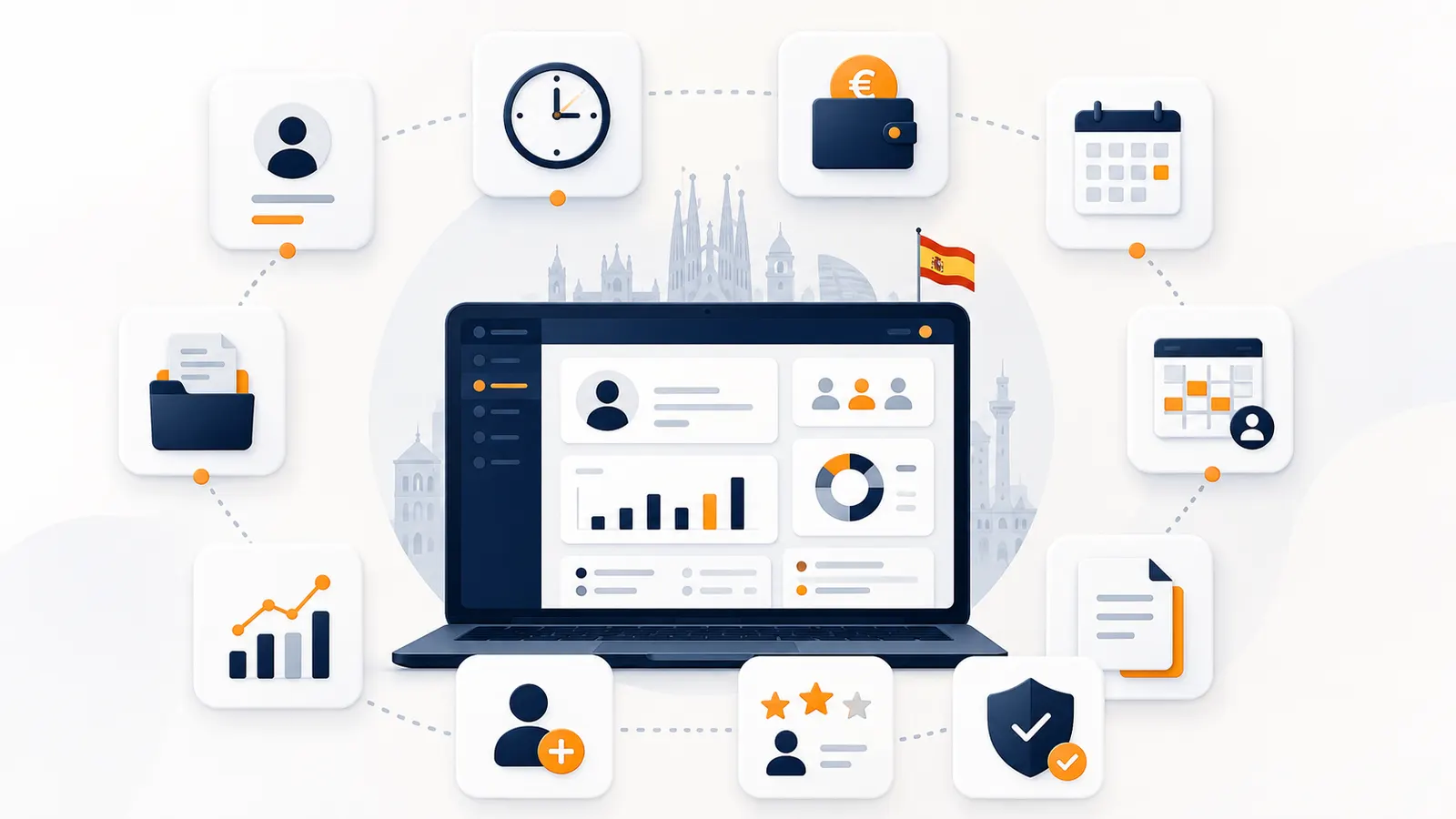
In short: a good HR management system in Spain has to cover traceable working-time records, leave, shifts, an employee portal, document management, performance, structure and permissions, reporting, automation and AI, and regulatory compliance. If any of those blocks is missing, sooner or later you end up covering it with a spreadsheet.
What HR software has to solve in Spain (before you look at features)
Before the list, it is worth framing it. HR software in Spain works on three planes at once:
- The legal plane. Recording the working day daily and keeping it for four years, managing leave under the Workers’ Statute, holding employment documentation and processing personal data in line with the GDPR.
- The operational plane. Cutting the time HR spends on admin: approving holidays, building rotas, chasing signatures, assembling reports by hand.
- The strategic plane. Turning all that data into useful information: absence, real cost per department, attrition, overtime, climate.
Most tools handle the second plane well. A fair few fail on the first. And very few reach the third without exporting to a spreadsheet. If you want to dig into how the different options on the market behave, we have a detailed comparison in 7 HR platforms for SMEs in Spain 2026.
1. A digital, reliable and traceable working-time record
This is function number one, and not by accident. Since 12 May 2019, article 34.9 of the Workers’ Statute, as amended by Royal Decree-Law 8/2019, has required every company, with no headcount threshold, to record the daily start and end time of each employee’s working day, to keep those records for four years and to make them available to the labour inspectorate.
As things stand the rule in force accepts paper, spreadsheets or a digital system. But there is an important nuance: since September 2025 the Ministry of Labour has been processing a royal decree that would make the digital-only format mandatory, with immutable records, traceability and interoperability with the inspectorate. The text received an unfavourable opinion from the Council of State in March 2026 and its approval has been postponed; it still has not been published in the BOE. We analyse it in detail in Mandatory digital working-time records 2026: what changes and how to prepare.
In practical terms: although spreadsheets are not yet banned, they are the worst place to be. They cannot prove when each entry was created, they can be edited without a trace, and they rarely survive scrutiny from an inspector.
What your software should offer:
- Clocking in from web, mobile app and, where relevant, a shared terminal or kiosk.
- An immutable, timestamped record: if something is corrected, the change history and its author remain.
- Breaks, overtime and time balance calculated automatically.
- Export of records per employee and period, in a format you can hand over as-is.
- Guaranteed four-year retention.
- Optional geolocation for mobile teams, with one caveat: Spain’s data protection authority requires proportionality, prior disclosure and a limited purpose, so you may validate where a clock-in happened but not follow someone through their whole day.
Failure to keep the working-time record is classified as a serious infringement in article 7.5 of the LISOS. The exact amounts depend on the degree the inspectorate applies and the current schedule in article 40, which has been updated over time; always check the consolidated text in the BOE.
👉 If you are starting here, read What time-tracking software is in Spain (and why you need it).
2. Leave, holiday and sick-day management under the Workers’ Statute
The second biggest consumer of HR time, and the one that generates most friction with staff. An email asking for days, a spreadsheet of balances, a signature sheet and, at the end of the year, the surprise that somebody has eleven days nobody counted.
A good leave module in Spain has to understand the Spanish legal framework, not a generic international one:
- Holidays: a minimum of 30 calendar days a year (art. 38 of the Workers’ Statute), pro-rata accrual, carry-over per collective agreement and year-end closing.
- Statutory paid leave: marriage or civil partnership, death and hospitalisation of relatives, moving house, public duties, antenatal appointments and family force-majeure leave. Note the bereavement rules: the extension to 10 days agreed in December 2025 has still not been published, so the entitlement today is 2 working days, or 4 with travel.
- Temporary incapacity: sick leave for common illness and for accidents at work, and their different treatment for cost and absence purposes.
- Birth and childcare, nursing leave, reduced hours for legal guardianship.
- Collective agreement: its own days, improvements and sector-specific rules, all configurable.
What it should offer: requests from mobile, an approval flow through the manager, automatic balance calculation, a team calendar that prevents overlaps, national, regional and local public holidays preloaded, and an auditable history of who approved what and when.
This block is also the way in to an expensive problem: absenteeism. We cover it with data in The hidden cost of absenteeism in Spain.
3. Shift and rota planning
If your workforce works shifts (hospitality, retail, logistics, healthcare, customer service, industry), this stops being an extra and becomes the heart of the system. And it is exactly where many office-oriented platforms fall short.
What it should offer:
- Rota creation by week or month, with reusable templates.
- Publishing the shift to the employee with an automatic notification (no more photographs of the rota on WhatsApp).
- Handling swaps, cover and substitutions with a record of who authorised what.
- Automatic contrast between the planned shift and the day actually clocked: this is where real overtime and cost deviations appear.
- Control of minimum rest between working days (12 hours, art. 34.3 of the Workers’ Statute) and weekly rest.
- Alerts when a plan breaches a legal or contractual limit before you publish it.
That last point is what separates a planning tool from a good-looking spreadsheet. If the system lets you publish an unlawful rota without warning, it is not protecting you.
📌 Specific comparison: HR software for shifts and time tracking: 7 platforms compared.
4. Employee portal and mobile app
HR automation is not about HR doing the same things faster; it is about HR no longer being the bottleneck for everything. And that only happens when people can resolve for themselves what they used to request by email.
A well-designed employee portal lets each person clock in, check their holiday balance, request leave, see their shift, download their payslips and documents, update their contact details and receive internal communications.
The criteria that genuinely matter:
- A real native app or PWA, not a rescaled website. If your team is not sitting at a desk, mobile is not a secondary channel: it is the only channel.
- Clocking in within three taps. Every second of friction becomes a forgotten entry, and a forgotten entry is a hole in your legal record.
- Multilingual support if you have an international workforce.
- Accessibility and usability for non-technical profiles. The real success metric for an HR system is the adoption rate at three months, not the number of modules you bought.
5. Document management and the digital employee file
Contracts, addenda, payslips, certificates, medical notes, training, PPE handovers, remote-work agreements, device-use policies, reviews. All of that exists in any company; the difference is whether it lives in an organised repository or is scattered between a network folder, the director’s inbox and a physical filing cabinet.
What a serious document repository should offer:
- A single file per employee with all their documentation attached.
- Granular permissions: who can see what. A department head has no business accessing their team’s medical documentation.
- Expiry dates and automatic alerts (certificates, mandatory training, medical checks).
- Traceability of access and downloads.
- Encrypted storage and a retention policy aligned with the GDPR and Spain’s LOPDGDD: keep what is necessary, for as long as necessary, and be able to prove it.
- Document delivery with acknowledgement of receipt, evidencing that the person received it.
This module also has an obvious defensive value: in a labour dispute, a company that can document what was communicated and when starts from a very different position.
6. Performance reviews and climate measurement
Here we move from compliance to retention. And it is worth being honest: performance reviews only work when they are light, regular and tied to something. Twenty-page annual processes nobody reads change no behaviour.
What it should offer:
- Configurable cycles (quarterly, half-yearly, annual) with automatic reminders.
- Self-assessment, manager assessment and, if it suits your culture, 360º feedback.
- Objectives per person and team, with visible tracking.
- Climate or satisfaction measurement through short, regular surveys, ideally anonymous so the data is worth something.
- A history you can compare over time: a single review is an opinion; a series is a trend.
The real value appears when you cross this module with the others. A team with falling climate, rising absence and accumulated overtime does not have three problems: it has one, and you are seeing it from three angles.
7. Organisational structure, departments and privilege control
An unglamorous function in demos and a decisive one day to day. When a company goes from 15 to 60 people, the "everyone sees everything" model stops being viable, and stops being lawful, because the GDPR requires access to personal data to be minimised to what is strictly necessary.
What it should offer:
- An org chart and departments, with assigned managers.
- Configurable roles and privileges: administrator, HR, department head, employee, and intermediate levels if you need them.
- Visibility scoped by department, work site or legal entity.
- Delegation of approvals for holidays and leave.
- An activity log that lets you reconstruct who made which change and when.
That activity log, besides being good security practice, is what lets you answer with data rather than memory when somebody questions a change to a clock-in or a holiday balance.
8. Reports, dashboards and people analytics
If you end up exporting to a spreadsheet to answer any question from your board, your HR tool is only doing half the job.
Reports you should be able to produce in under a minute:
- Working-time records per employee and period, ready for an inspection.
- Overtime per person, team and month.
- Absence rate by department and year-on-year trend.
- Holidays taken, outstanding and at risk of expiring.
- Staff cost by department, project or site.
- Attrition, average tenure and forecast departures.
- Workforce distribution by sex, category and pay band.
That last point is going to gain weight. Directive (EU) 2023/970 on pay transparency set 7 June 2026 as the transposition deadline, and Spain reached that date without domestic legislation approved. That does not remove the obligations that already exist (the pay register and, where applicable, a pay audit under Royal Decree 902/2020), but it does signal a more demanding standard ahead. Companies whose pay data is already structured will reach that transposition without drama; those keeping it in spreadsheets will not.
9. Automation, notifications and applied AI
HR automation is measured in tasks you stop doing, not in features you could use.
Automations that save real hours every month:
- Automatic reminders for a missed clock-in.
- An alert to the manager when a leave request is awaiting approval.
- A warning when an employee exceeds the overtime limit in their collective agreement.
- Notifications for the end of a probation period, a fixed-term contract or a document expiry.
- Automatic onboarding and offboarding checklists, with tasks assigned to each area.
- Climate surveys launched on a schedule.
On AI, a filter of healthy scepticism is in order. It is useful when it removes concrete work: summarising the state of a team, drafting an internal communication, spotting anomalous clock-in patterns, answering staff questions about their holiday balance or the leave policy. It is hot air when it promises "automatic decisions" about people. Besides, any use of AI in decisions affecting employment rights enters the territory of informing worker representatives and of the GDPR; demand clarity from your vendor about what data is processed and where.
Many of the failures automation prevents are, in reality, process failures. We collected them in 8 mistakes in the digital employee lifecycle.
10. Compliance, data protection and security
The tenth function is not a module: it is a condition that runs through the other nine. And it is the one most often skipped in commercial comparisons.
A compliance checklist to demand from any vendor:
| Requirement | What to ask |
|---|---|
| GDPR and LOPDGDD | Where is the data hosted? Is there a data processing agreement? Are there sub-processors outside the EU? |
| Working-time record retention | Are the 4 years guaranteed? What happens if I stop being a customer? |
| Immutability and audit | Can I prove a record has not been altered? |
| Right to disconnect | Does the system respect art. 88 of the LOPDGDD, or does it notify at any hour? |
| Whistleblowing channel | With 50 or more employees, Law 2/2023 requires an internal reporting system. Does the platform cover it, or do you need another? |
| Equality and pay register | Can I extract what RD 902/2020 requires without building it by hand? |
| Technical security | Encryption in transit and at rest, backups, MFA, access policy. |
| Portability | Can I export all my data if I leave? A vendor that makes leaving hard is a warning sign. |
One final note on this block: compliance cannot be delegated. Even though the software belongs to the vendor, responsibility before the labour inspectorate and the data protection authority remains yours as the employer. Choose accordingly.
Summary table: the 10 functions and what is at stake
| # | Function | Risk if missing |
|---|---|---|
| 1 | Digital, traceable working-time record | Serious infringement (art. 7.5 LISOS) and weak evidence in an inspection |
| 2 | Leave, holidays and sick days | Balance errors, disputes with staff, breach of the Workers’ Statute |
| 3 | Shifts and rotas | Rotas that breach rest periods, uncontrolled overtime |
| 4 | Employee portal and mobile app | Low adoption, forgotten clock-ins, HR as the bottleneck |
| 5 | Document management | Scattered documents, evidential risk, GDPR breach |
| 6 | Performance and climate | Unanticipated attrition, decisions based on perception |
| 7 | Structure and privileges | Improper access to personal data, no traceability |
| 8 | Reports and analytics | Blind decisions, endless manual exports |
| 9 | Automation and AI | Administrative time that never goes down |
| 10 | Compliance and security | Penalties, data breaches, vendor lock-in |
How to evaluate HR software without getting lost in demos
Five questions that bring order to any comparison:
- Does it cover my real case, not the generic one? If you run rotating shifts, start there. If your people work at client sites, start with mobility and geolocation.
- How long does it take an employee to clock in? Test it yourself, on a phone, in your team’s real conditions.
- Can I pull four years of working-time records in one click? That is the acid test.
- What happens when I grow? Price per user, module limits, the cost of adding a site or a legal entity.
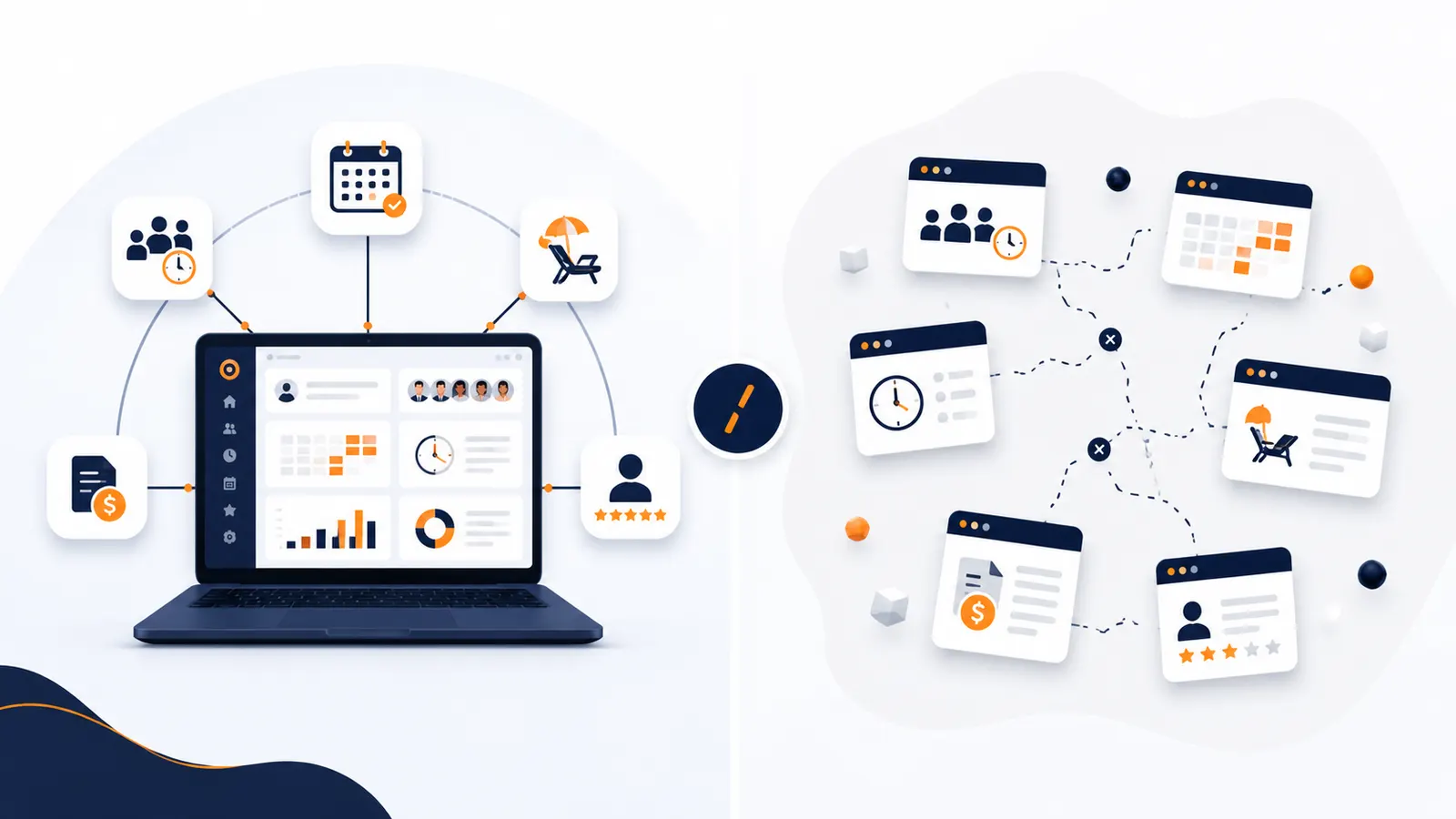
- Is it all-in-one, or will I end up with four tools? We explore that debate in All-in-one HR software vs separate tools.
And one practical recommendation: do not judge on the feature catalogue alone. Run a real trial with a small team for two weeks. Adoption shows up there, not in a guided demo.
Common mistakes when digitalising HR
- Buying on price and discovering afterwards that the working-time record cannot be exported.
- Digitalising the chaos. If your holiday approval process is badly defined, software will make it faster, not better.
- Leaving out the field team. Non-office profiles benefit most and are consulted last.
- Not training middle managers. They are the ones who approve, plan and review. If they do not use it, the system collapses.
- Ignoring the exit. Ask about data export before you sign, not when you want to switch.
Frequently asked questions
Which functions are legally mandatory in HR software in Spain?
No software function is mandatory in itself; what is mandatory are the outcomes. A company must record each employee’s working day daily and keep those records for four years (art. 34.9 of the Workers’ Statute), manage leave and holidays under the Statute and the collective agreement, hold employment documentation and process personal data in line with the GDPR. In practice, meeting all of that without a digital tool is possible but very fragile.
Is the digital working-time record already mandatory in Spain?
No. As of August 2026, the obligation in force is still article 34.9 of the Workers’ Statute, which accepts paper, spreadsheets or a digital system. The royal decree that would impose digital-only format remains in progress following the Council of State’s unfavourable opinion and has not been published in the BOE. That said, a paper or editable-spreadsheet record rarely holds up as reliable evidence in an inspection.
How much does HR software cost for a small company?
The usual model is payment per active user and month. In the Spanish market you will find everything from limited free plans for very small teams to solutions at €8–12 per user and month at the top end. What matters is not the list price but the total cost: implementation, migration, support, additional modules and what happens as the workforce grows.
What is the difference between time-tracking software and HR software?
Time-tracking software solves one specific problem: clocking in and the working-time record. HR software integrates that record with leave, shifts, documentation, performance and reporting, so data is entered once and used everywhere. If you only need to clock in, the first is enough. If you manage people, the second saves you from reconciling four systems.
Can I use geolocation to control clock-ins?
Yes, but within limits. Spain’s data protection authority requires the processing to be proportionate, disclosed in advance and limited to its purpose. Validating the location at the moment of the clock-in is acceptable; continuous tracking throughout the working day is not. Document the purpose, inform your staff and their legal representatives, and record it in your register of processing activities.
Conclusion
The ten functions on this list are not a wish list: they are the reasonable minimum for managing people in Spain without depending on spreadsheets or on anyone’s memory. A traceable working-time record, correctly calculated leave, rotas that respect the law, a portal your staff genuinely use, orderly documentation, measurable performance, properly scoped permissions, instant reports, automation that removes work, and compliance that survives an inspection.
If reading the list you spotted two or three gaps, you already have your roadmap. And if you spotted seven, the good news is that solving them all at once with an integrated platform is usually cheaper and faster than patching them one by one.
Shall we talk about your case?
At Quantummycos we built HR software designed from day one around Spanish requirements: web and mobile clock-ins, leave under the Workers’ Statute, shifts, performance reviews, documentation and analytics, on a single platform.
👉 Tell us what you need and we will show you how it fits your company
You can also go straight into the application and try it with your team. Free plan for up to 2 users, no card.
This article is informational and does not constitute legal advice. Spanish employment law is in flux; for specific cases, consult your employment adviser. Last updated: August 2026.
Frequently asked questions
No software feature is mandatory in itself; what is mandatory are the outcomes. A company must record each employee's working day daily and keep those records for four years, manage leave and holidays under the Workers' Statute and the collective agreement, hold employment documentation and process personal data in line with the GDPR.
The usual model is payment per active user and month. In the Spanish market there is everything from limited free plans for very small teams to solutions at 8 to 12 euros per user and month at the top end. What matters is the total cost: implementation, migration, support and additional modules.
Time-tracking software solves clocking in and the working-time record. HR software integrates that record with leave, shifts, documentation, performance and reporting, so data is entered once and used everywhere.
Yes, but within limits. Spain's data protection authority requires the processing to be proportionate, disclosed in advance and limited to its purpose. Validating the location at the moment of the clock-in is acceptable; continuous tracking through the working day is not.