01
What the law requires today
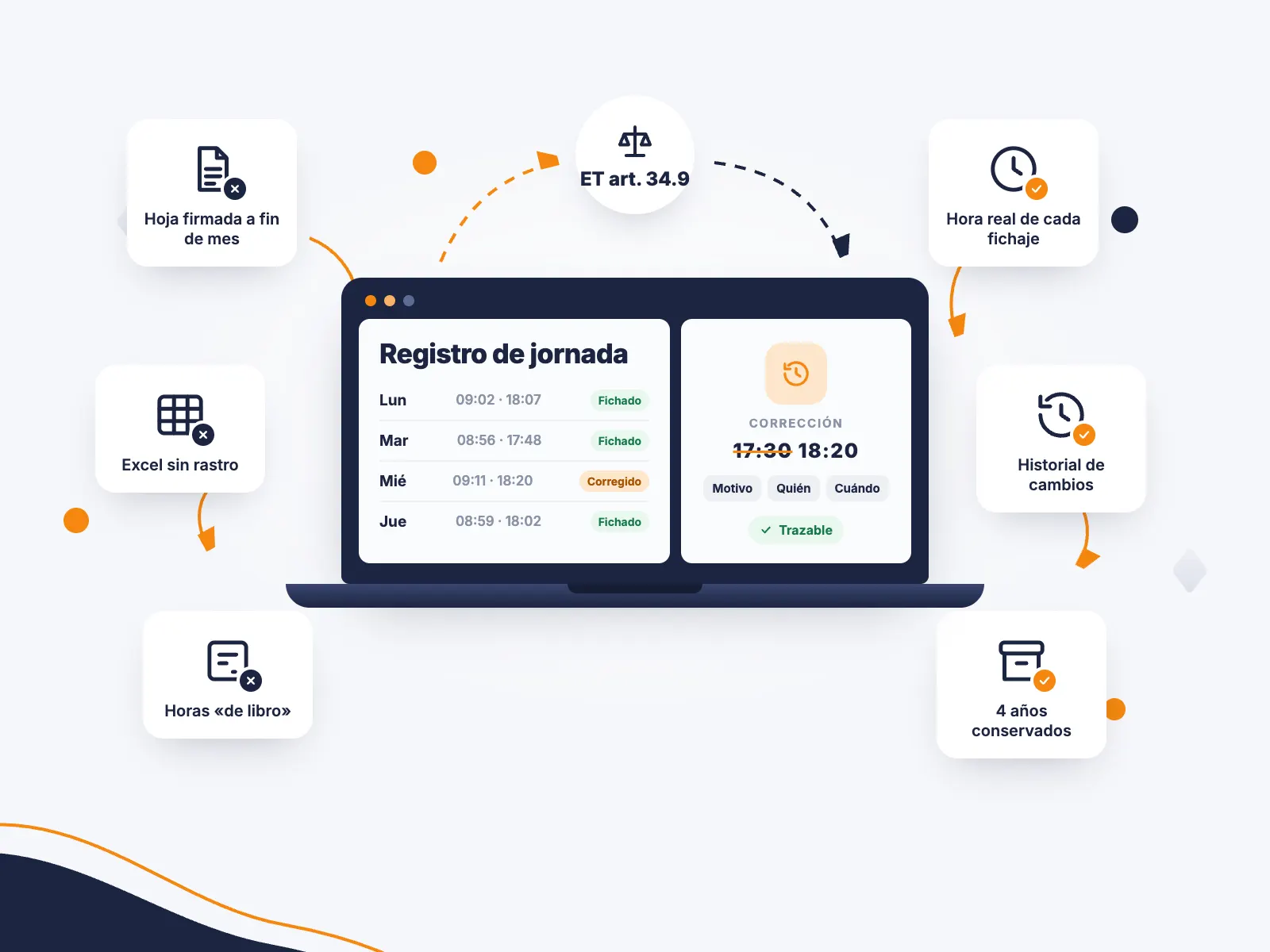
The obligation comes from Royal Decree-Law 8/2019, which amended article 34.9 of the Workers’ Statute. It applies to every company, with no headcount threshold and no sector exemption, and it requires three things: a daily record of the start and end of each person’s working day, four-year retention of those records, and availability to the employee, their legal representatives and the labour inspectorate.
02
What counts as a reliable record
The rule in force imposes no format: paper, spreadsheet or digital system are all accepted. But it does require reliability, and that is the nuance many companies miss. A spreadsheet can be edited without a trace and cannot prove when each entry was created; a sheet signed at month end cannot either. In practice, a record that cannot evidence its own integrity is a document the company will have to defend.
03
What the digital record would change
Since September 2025, Spain’s Ministry of Labour has been processing a royal decree that would make the record digital-only, with every change traceable and immediate access, remote and in person, for the inspectorate. The text received an unfavourable opinion from the Council of State in March 2026 and its approval has been postponed; as things stand it has been neither approved nor published in the BOE. Worth following, but not worth waiting for: the 2019 obligation is already in force and already enforced.
04
What the penalties are
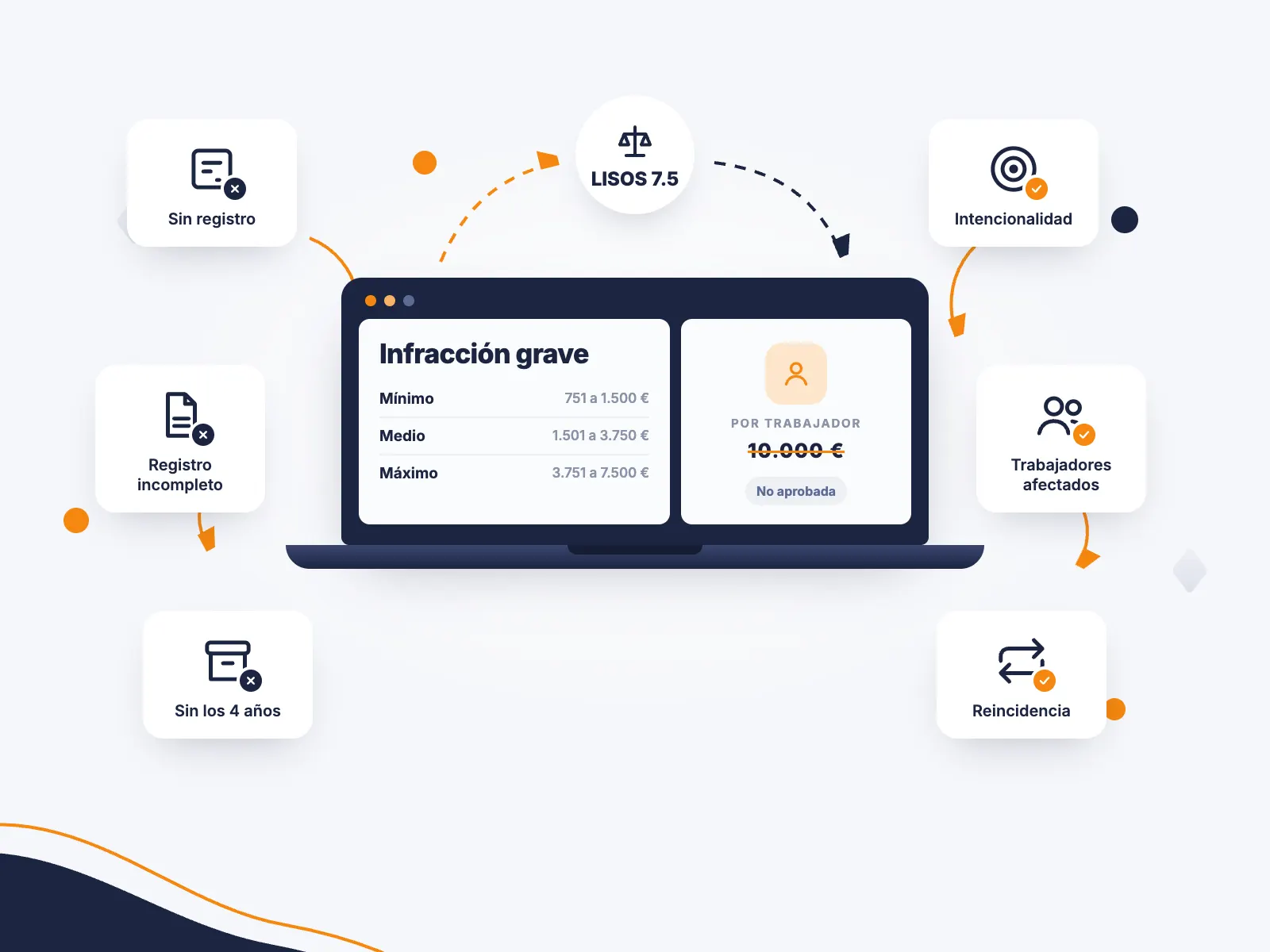
Failing to keep a reliable record is classified as a serious infringement under article 7.5 of the LISOS, and article 40 fines it €751 to €1,500 at the minimum grade, €1,501 to €3,750 at the middle grade and €3,751 to €7,500 at the maximum grade. It is penalised as one infringement, not per person: the number of employees affected is used to choose the grade. The per-employee fine was in the working-week reduction bill, which Congress rejected in September 2025, and the draft royal decree does not change the fines.
05
What your company has to do
Audit your current system, replace paper and spreadsheets with a digital record that has an immutable change history, cover remote and field work with clock-ins from mobile and desktop, verify that you can export the last four years of records in one click, look after data protection with unique identification and controlled access, and train the team: the best system fails if people do not clock in correctly and consistently.
06
The other duty: the pay register
Alongside the working-time record, article 28.2 of the Workers’ Statute and Royal Decree 902/2020 require every company, again with no headcount threshold, to keep a pay register (registro retributivo or registro salarial) with the mean and median pay of women and men by category, with base salary and complements kept apart. Companies with 50 or more staff must justify in the register itself any difference of 25 % or more. Quantummycos produces it from Reports using each person’s pay, which AI fills in by reading their payslip.
This page is informational and does not constitute legal advice. For specific cases, consult your employment adviser and always check the current consolidated text in the BOE.

 Compliance