People management
8 mistakes in the digital employee lifecycle (and how to avoid them with automation)
Only 12% of employees think their company does onboarding well, and one in three leaves within 90 days. Almost all of these failures are avoidable.
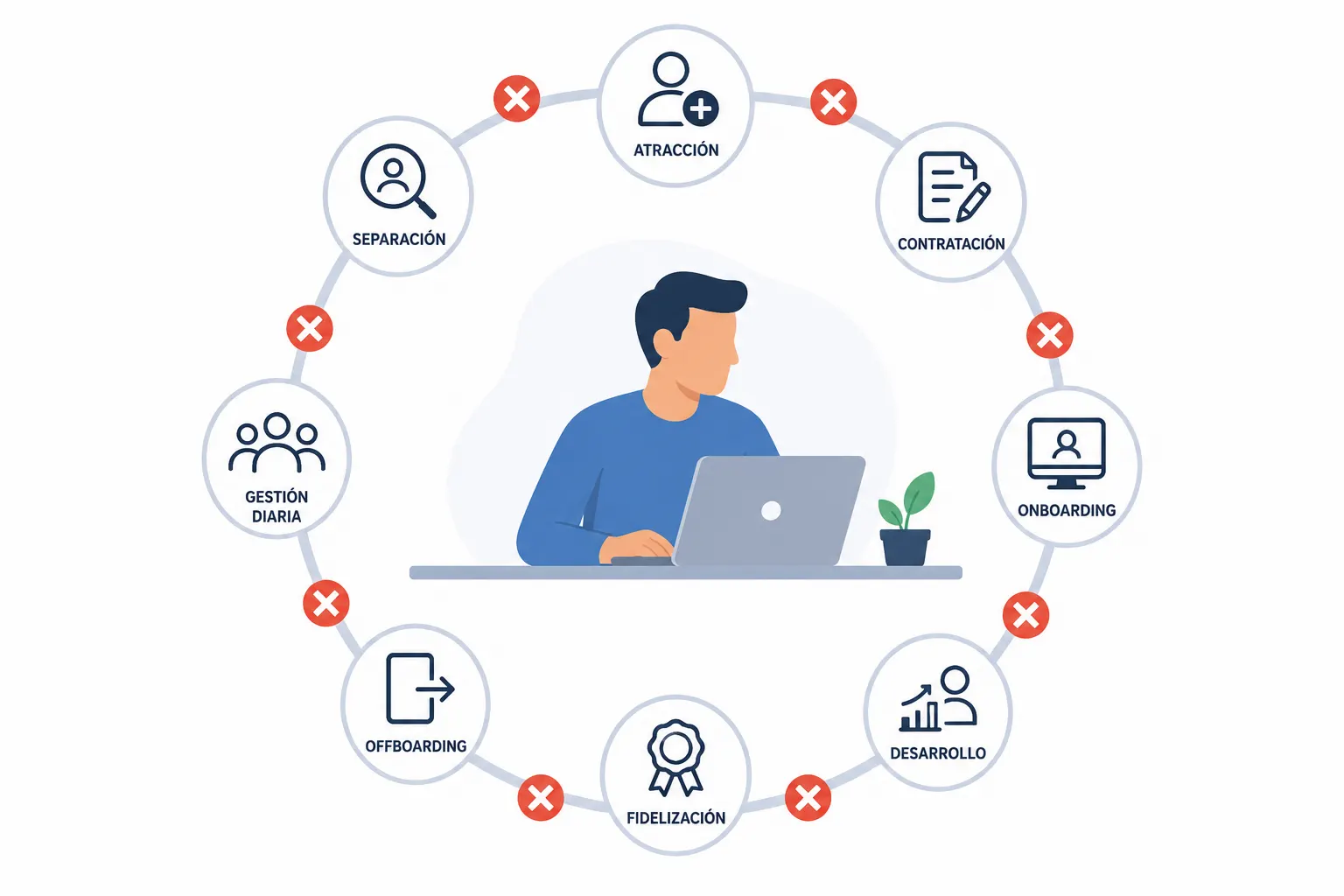
Managing the employee lifecycle covers everything that happens from the moment someone joins your company until they leave: hiring, onboarding, time tracking, leave, performance, development and exit. On paper it sounds orderly. In practice, in most small and mid-sized companies, that cycle is spread across five different tools, three spreadsheets and the memory of whoever runs HR.
And that is where money, time and, above all, talent leak away. One figure to calibrate the problem: only 12% of employees think their company does onboarding well, and roughly one in three new hires leaves within the first 90 days. The good news is that almost all of these failures are avoidable.
Below, the eight mistakes in the digital employee lifecycle and how to fix them with HR automation.
1. Managing every phase in its own silo
The most widespread mistake: one tool for clocking in, another for holidays, a spreadsheet for reviews and loose folders for contracts. The result is that the same employee detail is entered five times and never matches. Nobody has a complete view of the person.
How to avoid it: centralise the lifecycle on a single platform where data is entered once and flows between modules. A good employee management system turns five contradictory sources of truth into one reliable source.
2. Improvising onboarding (or getting it over with in a day)
Onboarding has the highest return of any phase and gets the least attention. More than half of companies wrap onboarding up in a week or less, when the data is unambiguous: structured onboarding improves new-hire retention by up to 82% and productivity by more than 70% (Brandon Hall Group). People who start lost leave early: most early attrition happens in the first 45 days.
How to avoid it: design a digital onboarding flow (documents, access, training, introductions, first-90-day objectives) that fires automatically the moment the person is created. Automating those tasks saves several days of administrative work per hire on average and dramatically reduces data-entry errors.
3. Sticking with paper and spreadsheets in critical processes
Clock-ins on a signed sheet, holidays in a shared spreadsheet, contracts in a folder on somebody’s computer. Beyond the inefficiency, this is a legal risk: as we saw with the digital working-time record, inspectors no longer accept easily manipulated records, and keeping documents locally runs straight into data-protection requirements.
How to avoid it: digitalise the processes where errors are expensive: traceable time tracking, leave requests with recorded approval, and a document manager with access control. Paper leaves no audit trail; a digital system does.
4. Making people decisions without a single data point
Many HR leads manage on intuition simply because they do not have the numbers to hand. What is your absence rate this month? Your attrition by department? How long does it take a new hire to become productive? If the answer is "we would have to look into it", there is a problem.
How to avoid it: let your digital HR platform turn daily activity into live metrics: absence, attrition, overtime, leave by team and period. Not to monitor people, but to get ahead of problems before they surface.
5. Leaving documentation scattered and uncontrolled
Contracts, payslips, certificates, reviews and permits spread across inboxes, folders and drawers. When an inspection arrives, or a complex sick leave, or a request from the employee themselves, the treasure hunt begins. And every document containing personal data outside your control is a compliance crack.
How to avoid it: a centralised document manager, with each document attached to its employee, role-based permissions and traceability of who accessed what. The right information, in the right place, reachable in seconds.
6. Reducing performance to an annual review
A once-a-year performance review is late to everything: by the time you notice somebody is disengaged, they are already updating their CV. Widely spaced feedback neither corrects in time nor makes anyone feel supported, and disengagement is one of the biggest drivers of attrition.
How to avoid it: replace the annual ritual with continuous follow-up. Regular one-to-ones, visible objectives and frequent feedback keep a real pulse on the team. It is the difference between reacting to a resignation and preventing one.
7. Automating for the sake of it (and forgetting the person)
The opposite mistake, and just as damaging: automating a badly designed process, or depersonalising the experience so much that the employee feels like a number. Automation does not replace human judgement; it frees up the time to exercise it.
How to avoid it: automate the administrative and repetitive parts of HR (onboarding, day calculations, reminders, approvals) precisely so your team can spend the recovered time on the conversations that do require a person. Fix the process first; then automate it.
8. Forgetting about offboarding
The lifecycle does not end with a goodbye. A badly handled exit leaves access rights unrevoked (a security risk), knowledge walking out of the door undocumented, and zero learning about why people leave.
How to avoid it: define an exit flow as carefully as the entry one: a checklist for returning equipment and revoking access, a knowledge handover, and an exit interview whose data feeds your attrition metrics. The last impression builds your employer brand too.
The common root: a fragmented cycle
Look closely and almost all of these mistakes share the same underlying cause: an employee lifecycle broken into pieces, managed in fragments and with no overall view. HR automation is not about adding more tools, it is about joining up what is currently scattered.
At Quantummycos we built exactly that: one place where time tracking, leave management, performance reviews, document management, departments and analytics live together. Data is entered once and follows the employee the whole way, from the first day to the last. Less administration, fewer errors and more time for what actually matters: the people.
How many different tools do you use today to manage your team? If the count is above two, you are probably making several of these mistakes without knowing. Book a demo and we will show you how it looks in one place.
Sources
- Why the Onboarding Experience Is Key for Retention (Gallup): only 12% of employees rate their onboarding well; replacement cost per SHRM.
- Retention (+82%) and productivity (+70%) improvements with structured onboarding: Brandon Hall Group study for Glassdoor.
- Early attrition (one in three within the first 90 days): Jobvite and SHRM data.
Figures may vary by source and sector. This article is informational.
- HR automation
Frequently asked questions
It covers everything from the moment someone joins the company until they leave: hiring, onboarding, time tracking, leave, performance, development and exit. Managing it on a single platform stops the same detail being entered five times and never matching.
According to a Brandon Hall Group study, structured onboarding improves new-hire retention by up to 82% and productivity by more than 70%. Most early attrition happens within the first 45 days.