People management
Holiday entitlement in Spain 2026: how many days, how to calculate them and what happens if they are not taken
Thirty calendar days, 2.5 per month worked, two months' notice of the calendar and up to 18 months to recover them after sick leave. The full calculation, with the legal basis for each rule.
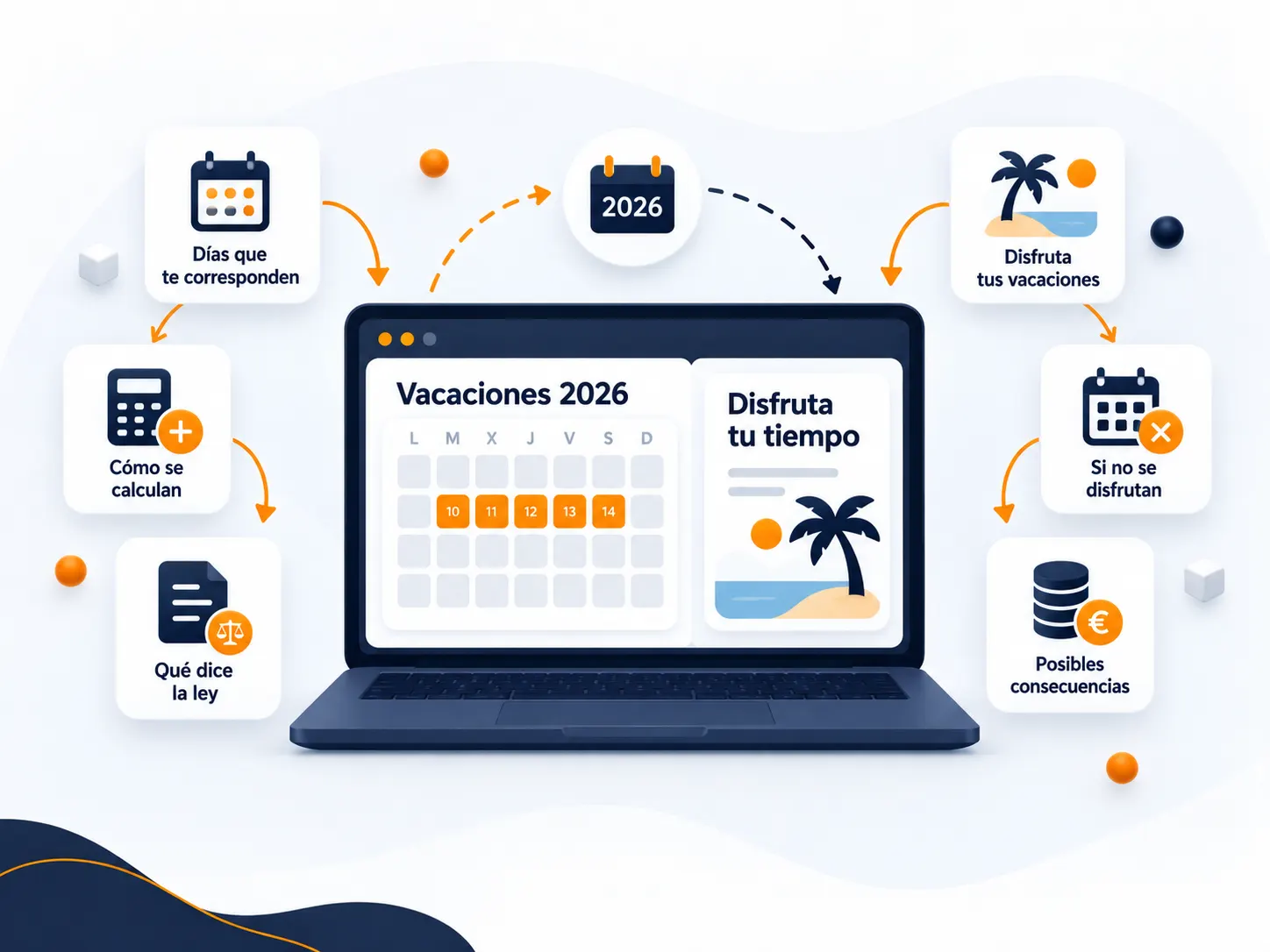
Thirty calendar days. That is the short answer, and also the source of nearly every argument, because thirty calendar days are not thirty working days, they are not the same as the twenty-two working days many collective agreements express instead, and they are not lost as easily as people tend to think.
Here is the full picture: how many days apply, how they are pro-rated when the year has not been worked in full, what happens when they overlap with sick leave, and what really becomes of the days that reach December untaken.
In short. The legal minimum is 30 calendar days a year, which is 2.5 days per month worked (article 38 of the Spanish Workers' Statute). They cannot be exchanged for money while the contract is alive, only when it ends. The holiday calendar must be known at least two months in advance. If sick leave prevents them from being taken they are not lost: there are up to 18 months from the end of the year they were accrued in, and for pregnancy, birth or breastfeeding there is no such limit at all.
How many holiday days apply in 2026
| Situation | Days | Detail |
|---|---|---|
| Full year worked | 30 calendar days | Legal minimum. A collective agreement can improve it, never reduce it |
| Per month worked | 2.5 calendar days | 30 divided by 12 |
| Part time | 30 calendar days | The same days: the hours are reduced, the rest is not |
| Expressed in working days | About 22 working days | The usual equivalence in agreements for Monday to Friday |
| Public holidays | 14 a year | Not holiday: separate rest (art. 37.2 Workers' Statute) |
The difference between calendar and working days causes half the confusion. Thirty calendar days include any Saturdays, Sundays and public holidays that fall inside the period. That is why many agreements prefer to set holiday in working days: twenty-two working days is roughly thirty calendar days for somebody working Monday to Friday, and it is far easier to understand.
What can never happen is a collective agreement landing below the legal minimum. If it says twenty-one working days and that works out below thirty calendar days, the law prevails.
How to calculate a partial year
The rule is proportionality: 2.5 calendar days per month worked, counted from the registration date.
| Start date | Months worked in the year | Holiday accrued |
|---|---|---|
| 1 January | 12 | 30 days |
| 1 April | 9 | 22.5 days |
| 1 July | 6 | 15 days |
| 15 September | 3.5 | 8.75 days |
| 1 November | 2 | 5 days |
Fractions are not rounded down as a matter of course. The usual practice is to round up or pay the fraction in the final settlement, and many agreements say so explicitly.
- Holiday accrues while working, and during some absences too. Sick leave, parental leave with the job held open or paid statutory leave do not interrupt accrual.
- The reference year is the calendar year unless the agreement says otherwise. Some sectors use a season or the contract anniversary, and then the agreement prevails.
Who picks the dates
Neither the company alone nor the employee alone. Article 38.2 sets the period by agreement between the two, within whatever the collective agreement establishes for annual planning.
There is one specific duty that is often missed: the holiday calendar must be set and the employee must know their dates at least two months before the holiday starts. That is not guidance, it is article 38.3.
Where there is no agreement, the dispute goes to the social courts under a summary and priority procedure, and the ruling cannot be appealed. It is built that way so it is resolved before the disputed date arrives.
Holiday and sick leave: what happens when they overlap
If the leave is for pregnancy, birth or breastfeeding
The holiday is taken on different dates once the suspension ends, even if the calendar year is over. There is no expiry here. The same applies when holiday coincides with birth and childcare leave.
If the leave is for anything else
Where temporary incapacity makes it impossible to take the holiday during the year it belongs to, it can be taken once the leave ends provided no more than 18 months have passed since the end of the year it was accrued in.
An example: 2026 holiday that could not be taken because of sick leave can be taken until 30 June 2028. Eighteen months from 31 December 2026.
And if the sick leave starts during the holiday
The holiday is interrupted. The remaining days are recovered afterwards, because rest and incapacity serve different purposes and cannot run at the same time.
What happens if holiday is not taken
The general rule is strict: holiday not taken within the calendar year is lost, and it cannot be exchanged for money while the contract is alive. It is a health and safety rule, not an accounting one: rest exists to be rested.
There are three exceptions, and in practice they are the ones that matter:
- Sick leave, with the deadlines above.
- The agreement or the company allowing carry-over into the first months of the following year, which is fairly common.
- The company never gave a real chance to take it. European case law is firm here: the right does not lapse automatically because nobody asked for it. The employer has to have informed the worker and given them the opportunity, and if it did not, the right survives.
When the contract ends, it is paid
That is the one situation where holiday turns into money. Accrued and untaken days are settled in the final payment and, on top of that, they attract social security contributions: registration is extended for those days.
One detail many employers miss. The Spanish Supreme Court, in judgment 743/2022 of 15 September, held that on settlement an employee can claim holiday accrued during sick leave without the 18-month limit: that period applies to taking the holiday, not to cashing it out once the contract has ended.
Questions HR gets every year
Can holiday be split into several periods?
Yes, by agreement. The law does not require it to be taken in one block. What European rules do require, and many agreements reflect, is that at least part of it allows a continuous rest of some length, usually two weeks.
What about single days or half days?
They work if the company accepts them or the agreement provides for them. Put the criterion in writing, because mixing calendar days with single working days makes the arithmetic fall apart quickly.
Can a company change holiday it has already approved?
Only with justified cause, with enough notice and, according to case law, covering the costs the change causes: a non-refundable flight or booking is real, provable damage.
Is the pay the same during holiday?
Holiday pay must be the normal remuneration, not just base salary. The Supreme Court has included the supplements received in the ordinary course of the job. Those compensating a circumstance that does not occur during holiday, such as an actual travel allowance or occasional overtime, are excluded.
Does holiday count for seniority and contributions?
Yes. During holiday the employment relationship is fully alive: contributions continue, seniority accrues and next year's holiday keeps building.
The five mistakes that generate most claims
1. Publishing the calendar with less than two months' notice. It breaches article 38.3 and leaves the company badly placed in any dispute.
2. Counting public holidays as holiday. The fourteen annual public holidays are separate rest.
3. Paying holiday instead of granting it. Outside the end of a contract it is void: the right to rest survives the payment.
4. Writing off the holiday of somebody who has been on sick leave. The most expensive mistake, because it ends in a claim the company loses.
5. Settling without the pro rata share. Somebody leaving in September has accrued 22.5 days and has probably taken fewer. The difference is paid.
How to run this without a spreadsheet per person
With ten people a spreadsheet works. With fifty it stops working, and not because of the number: because of the edge cases. The one who joined in March with 25 days, the one carrying five over from last year's sick leave, the one who took three odd days in April that nobody deducted.
What you need is for the balance to calculate itself: days accrued from the start date, days taken from approved absences, days outstanding and their deadline. And for both the approver and the requester to see the same number, because half of these disputes are two different counts.
At Quantummycos that is the absence module: every person with an up-to-date balance, the team calendar to spot overlaps before approving, and approvals with their audit trail. You can open the app and try it with your team. Free plan up to 2 users, no card.
Keep reading
- Paid leave in Spain 2026: the full table of days, the absences that are not holiday.
- The hidden cost of absenteeism in Spain, what happens when absence is not measured.
- Onboarding and offboarding: checklist and legal deadlines, including holiday in the final settlement.
Sources
- Spanish Workers' Statute, consolidated text (BOE), article 38 (annual holiday) and article 37.2 (public holidays).
- Spanish Supreme Court, Social Chamber, judgment 743/2022 of 15 September, on compensating holiday untaken because of sick leave when the contract ends.
- Directive 2003/88/EC on the organisation of working time, article 7, the source of the rule that the right does not lapse if the employer gave no chance to use it.
This article is for information only and is not legal advice. Your collective agreement may improve these minimums and count them differently: always check the consolidated text in force in the BOE and consult your employment adviser. Last reviewed: September 2026.
- Vacaciones
- Ausencias
- Normativa laboral
- RRHH
Frequently asked questions
A minimum of 30 calendar days a year under article 38 of the Workers' Statute. A collective agreement can improve it, never reduce it. Thirty calendar days is roughly 22 working days for somebody working Monday to Friday.
Pro rata: 2.5 calendar days for every month worked, counted from the registration date. Somebody joining on 1 July accrues 15 days that year, and somebody joining on 1 April accrues 22.5.
As a general rule yes, because the reference year is the calendar year and it cannot be exchanged for money while the contract is alive. There are three exceptions: sick leave prevented it, the agreement or the company allow carry-over, or the employer never gave a real chance to take it, in which case the right does not lapse.
It is not lost. For pregnancy, birth or breastfeeding it is taken once the leave ends even if the calendar year is over, with no limit. For any other contingency it can be taken once the leave ends, provided no more than 18 months have passed since the end of the year it was accrued in.
At least two months before the holiday starts. Article 38.3 of the Workers' Statute requires it, and the period is set by agreement between employer and employee.
Yes. It is the only situation where holiday becomes money: accrued and untaken days are settled in the final payment and also attract social security contributions. The Supreme Court, in judgment 743/2022, allowed claiming days accrued during sick leave without the 18-month limit, because that period applies to taking the holiday rather than to cashing it out.