
HR
What an employee really costs a company in Spain in 2026: from gross salary to total cost
A salary of 30,000 euros costs 39,645. Here is the full calculation with the 2026 contribution rates, three worked examples and everything that never reaches a payslip.
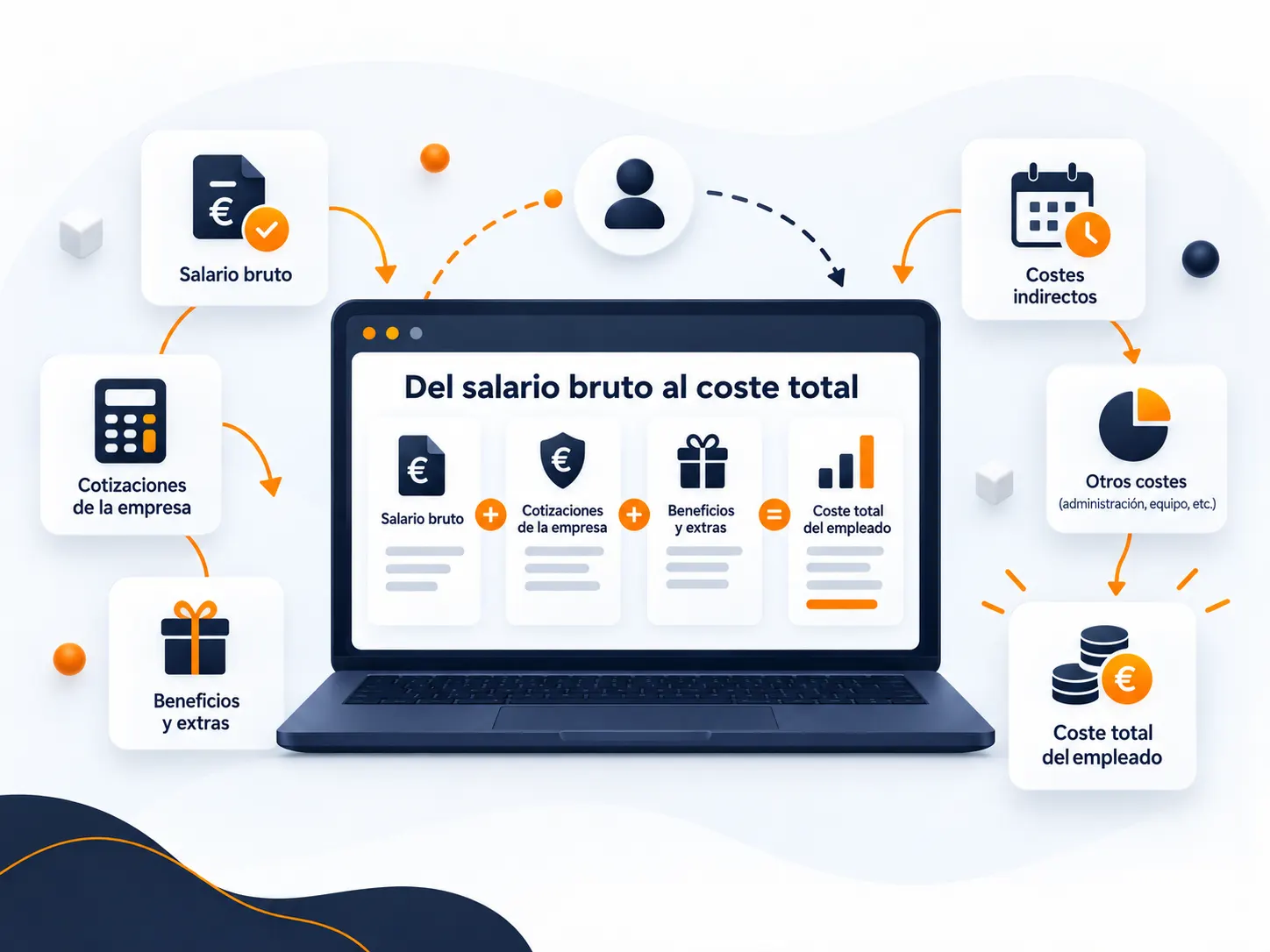
A gross salary of 30,000 euros does not cost 30,000 euros. It costs 39,645, and that gap of almost ten thousand euros is what makes a hiring budget fall short in its first year.
Here is the full calculation with the 2026 contribution rates published in Order PJC/297/2026. First the percentages, then three worked examples, and at the end the costs that appear on no payslip and still have to be paid.
In short. On top of gross salary, a Spanish company pays roughly 32 % in social security contributions for a permanent office role in 2026: 23.60 % common contingencies, 5.50 % unemployment, 1.50 % work accidents depending on the activity, 0.75 % for the Intergenerational Equity Mechanism, 0.60 % vocational training and 0.20 % for the wage guarantee fund. The quick rule is to multiply gross by 1.32. It stops holding at the top, once the monthly salary passes the maximum base of 5,101.20 euros, and never at the bottom: the minimum base applies even part time.
The six items the employer pays in 2026
| Item | Employer | Employee | Total |
|---|---|---|---|
| Common contingencies | 23.60 % | 4.70 % | 28.30 % |
| Unemployment, permanent contract | 5.50 % | 1.55 % | 7.05 % |
| Unemployment, fixed-term contract | 6.70 % | 1.60 % | 8.30 % |
| Work accidents and occupational illness | Per the premium table for the activity (1.50 % for office work) | — | Variable |
| Intergenerational Equity Mechanism (MEI) | 0.75 % | 0.15 % | 0.90 % |
| Vocational training | 0.60 % | 0.10 % | 0.70 % |
| Wage guarantee fund (FOGASA) | 0.20 % | — | 0.20 % |
Adding up the employer side in the most common case (permanent contract, office activity): 32.15 %. With a fixed-term contract it rises to 33.35 %, because unemployment costs 1.20 points more.
- The work accident rate depends on your activity, not your preference. The premium table has been aligned since 2026 with the new CNAE-2025 classification, and the 1.50 % used here is office work. Construction, transport and manufacturing are considerably higher.
- The MEI rises every year. In 2026 it is 0.90 % (0.75 % employer) and the law expects it to keep growing until 2029. Do not treat it as fixed in a three-year plan.
- The contribution base is not the month's salary, it is the month's salary plus the pro rata share of the extra payments. Whether those are paid monthly or in June and December makes no difference to contributions.
From gross to total cost: three real examples
All with a permanent contract, office activity (1.50 % accident rate) and full time.
| Gross annual salary | Monthly contribution base | Employer contributions | Total annual cost | Multiplier |
|---|---|---|---|---|
| €17,094 (2026 minimum wage) | €1,424.50 | €5,495.72 | €22,589.72 | ×1.32 |
| €20,000 | €1,666.67 | €6,430.00 | €26,430.00 | ×1.32 |
| €30,000 | €2,500.00 | €9,645.00 | €39,645.00 | ×1.32 |
| €45,000 | €3,750.00 | €14,467.50 | €59,467.50 | ×1.32 |
| €60,000 | €5,000.00 | €19,290.00 | €79,290.00 | ×1.32 |
The multiplier stays flat as long as the monthly salary is below the maximum base. That is why multiplying by 1.32 works for the vast majority of Spanish payslips.
And what the employee pays
A further 6.50 % is withheld from their gross pay in contributions (4.70 % common contingencies, 1.55 % unemployment, 0.15 % MEI and 0.10 % vocational training), on top of income tax withholding, which depends on their personal circumstances. On 30,000 euros that is around 162.50 euros a month before tax.
The calculation, step by step
- 1. Work out the monthly contribution base. Gross annual salary divided by 12, extra payments included. On 30,000 euros a year in fourteen payments the base is still 2,500 euros a month, not 2,142.86.
- 2. Compare it with the caps. Below the minimum base for the contribution group, you pay on the minimum. Above 5,101.20 euros, you pay on the maximum and apply the solidarity contribution to the excess.
- 3. Apply the employer rate. 32.15 % for a permanent office role. Swap the 1.50 % accident rate for the one matching your CNAE and add 1.20 points if the contract is fixed-term.
- 4. Multiply by 12 and add it to the gross. That is the social security cost for the year, not the total cost: what never reaches the payslip is still missing.
Minimum bases and part-time work
In 2026 the minimum monthly base is 1,424.40 euros for contribution groups 4 to 7 and 1,989.30 euros for group 1, in line with the minimum wage rising to 1,221 euros a month in fourteen payments.
Part-time contracts contribute in proportion to the contracted hours, so half a day does not pay the full minimum base. What does not change is the percentage: 32.15 % applies the same on a smaller base. Two half-time hires cost practically the same in contributions as one full-time hire on the same combined salary.
A note on reductions
Some hires carry reductions on the employer's contribution: people with a disability, workers over 52 in certain cases, converting training contracts into permanent ones, cover during parental leave. They change often and nearly all of them require the job to be maintained, with the money repayable plus a surcharge if it is not. Worth confirming with your adviser before counting on them in a budget, not after.
The maximum base: why high salaries cost proportionally less
In 2026 the maximum contribution base is 5,101.20 euros a month. Above that nothing more is contributed under the general scheme, and the multiplier starts to fall.
There is, however, the solidarity contribution, which charges the part of the salary above the maximum base at small, rising rates:
| Monthly salary band | Total rate | Employer | Employee |
|---|---|---|---|
| €5,101.21 to €5,611.32 | 1.15 % | 0.96 % | 0.19 % |
| €5,611.33 to €7,651.80 | 1.25 % | 1.04 % | 0.21 % |
| Above €7,651.80 | 1.46 % | 1.22 % | 0.24 % |
In numbers: a gross salary of 80,000 euros a year contributes on the maximum base plus 190.47 euros a year of solidarity contribution. The total cost to the employer is 99,870.90 euros, a multiplier of ×1.25 rather than ×1.32.
Put another way: every extra euro above 61,214 euros gross a year costs the company about one euro and one cent, not one euro thirty-two. That changes the maths when weighing a raise against a new hire.
Permanent or fixed-term: the real difference
A fixed-term contract costs 1.20 points more in unemployment contributions (6.70 % against 5.50 %). On a 30,000 euro salary that is around 360 euros a year.
On top of that there is the additional contribution for contracts under 30 days: 33.62 euros per contract in 2026, payable by the employer when each one ends. It does not apply to replacement contracts, alternating training contracts or some special schemes, but it does apply to most short casual contracts. A campaign covered with fifteen one-week contracts is 504 euros nobody budgeted.
And the piece most often forgotten: when a fixed-term contract ends, 12 days of salary per year worked are payable as compensation, except for training and replacement contracts.
What never reaches the payslip and still gets paid
- Equipment and workspace. Laptop, phone, software licences, desk and chair, and replacing them every three or four years.
- Occupational health and safety. The external prevention service, the medical check and the mandatory training for the role.
- Training and other people's time. The first weeks of any new hire consume hours from whoever is teaching, and those hours are already paid for.
- Absence. In sick leave for common contingencies the company pays from the fourth to the fifteenth day and keeps contributing throughout.
- Severance. 33 days per year for unfair dismissal, 20 for an objective one, 12 when a fixed-term contract ends. Deferred, but still a cost.
- Benefits and the collective agreement. Health insurance, meal vouchers, travel allowance or any improvement the agreement sets, which often raises base salary above what was negotiated.
How to know what each person really costs
The table above answers "what does hiring cost". The question that comes next is harder: what each person, each team and each worked hour actually costs, with real absence and real hours rather than theoretical ones.
That number does not come from a spreadsheet built in January, because it changes every month: somebody joins, somebody goes on leave, a team works extra hours. It comes from crossing each person's cost with the hours recorded and the absence in the period.
At Quantummycos that is the cost module: cost per person, per department and per effective hour, calculated on the actual clock-ins and absences of the period you choose. You can open the app and see it with your own team. Free plan up to 2 users, no card.
Keep reading
- The hidden cost of absenteeism in Spain, the part of the cost nobody budgets.
- Onboarding and offboarding: checklist and legal deadlines, what a badly run hire costs.
- Paid leave in Spain 2026, the absences the company pays for.
Sources
- Order PJC/297/2026 of 30 March (BOE), contribution bases and rates for 2026, solidarity contribution and the surcharge on short contracts.
- Royal Decree 126/2026 of 18 February (BOE), the 2026 minimum wage: 1,221 euros a month in fourteen payments.
- Spanish Workers' Statute, consolidated text (BOE), articles 49, 52, 53 and 56 on termination payments.
- Spanish Social Security Treasury, premium table for occupational contingencies aligned with CNAE-2025.
This article is for information only and is not tax or employment advice. Accident rates depend on each company's actual activity and the collective agreement may add further items: always check the text in force in the BOE and consult your adviser. Last reviewed: September 2026.
- Costes laborales
- Cotizaciones
- Nóminas
- Normativa laboral
Frequently asked questions
39,645 euros a year on a permanent contract in an office activity in 2026. On a contribution base of 2,500 euros a month the employer pays 32.15 % in contributions: 9,645 euros a year on top of the 30,000 gross.
Around 32 % of gross salary for a permanent office role: 23.60 % common contingencies, 5.50 % unemployment, 1.50 % work accidents depending on activity, 0.75 % for the Intergenerational Equity Mechanism, 0.60 % vocational training and 0.20 % for the wage guarantee fund. A fixed-term contract rises to 33.35 %.
5,101.20 euros a month. Above that nothing more is contributed under the general scheme, but the solidarity contribution applies to the excess: 1.15 % up to 5,611.32 euros, 1.25 % up to 7,651.80 euros and 1.46 % beyond that.
1.20 percentage points more in unemployment contributions (6.70 % against 5.50 %), about 360 euros a year on a 30,000 euro salary. Contracts under 30 days also carry an extra 33.62 euro contribution when they end, and ending a fixed-term contract triggers 12 days of salary per year worked.
1,221 euros a month in fourteen payments, that is 17,094 euros gross a year, under Royal Decree 126/2026. With employer contributions that salary costs 22,589.72 euros a year.
The annual gross divided by 12, because the contribution base always includes the pro rata share of extra payments, whether they are paid monthly or in June and December. On 30,000 euros in fourteen payments the monthly base is 2,500 euros, not 2,142.86.