Compliance
Are paper or spreadsheet time records legal in Spain in 2026? What is valid today and what will change
Paper and spreadsheet time records are still legal in Spain in 2026, but only if the record is reliable. What the law says, why they tend to fail an inspection and what would change if digital records become mandatory.
Is it legal to record working time on paper or in a spreadsheet in Spain in 2026? Yes. As of 29 September 2026, no rule in force prohibits keeping the working-time record on a signature sheet or in Excel. But the full answer carries a “provided that” most people skip, and that is exactly where the labour inspectorate looks.
This guide separates what the law requires today, why paper and spreadsheets tend to fail an inspection, and what would change if the royal decree making the record digital-only is approved.
In short. Paper or spreadsheet records are legal today if the record is reliable: daily, with each person’s start and finish time, kept for four years and available to employees, their representatives and the inspectorate. The Ministry of Labour puts it this way: any system is valid if it provides information that is “reliable, unmodifiable and not open to later manipulation”. The draft royal decree would require digital means and leave paper for technical incidents only, but as of this date it has not been published in the BOE.
What the current law says about format
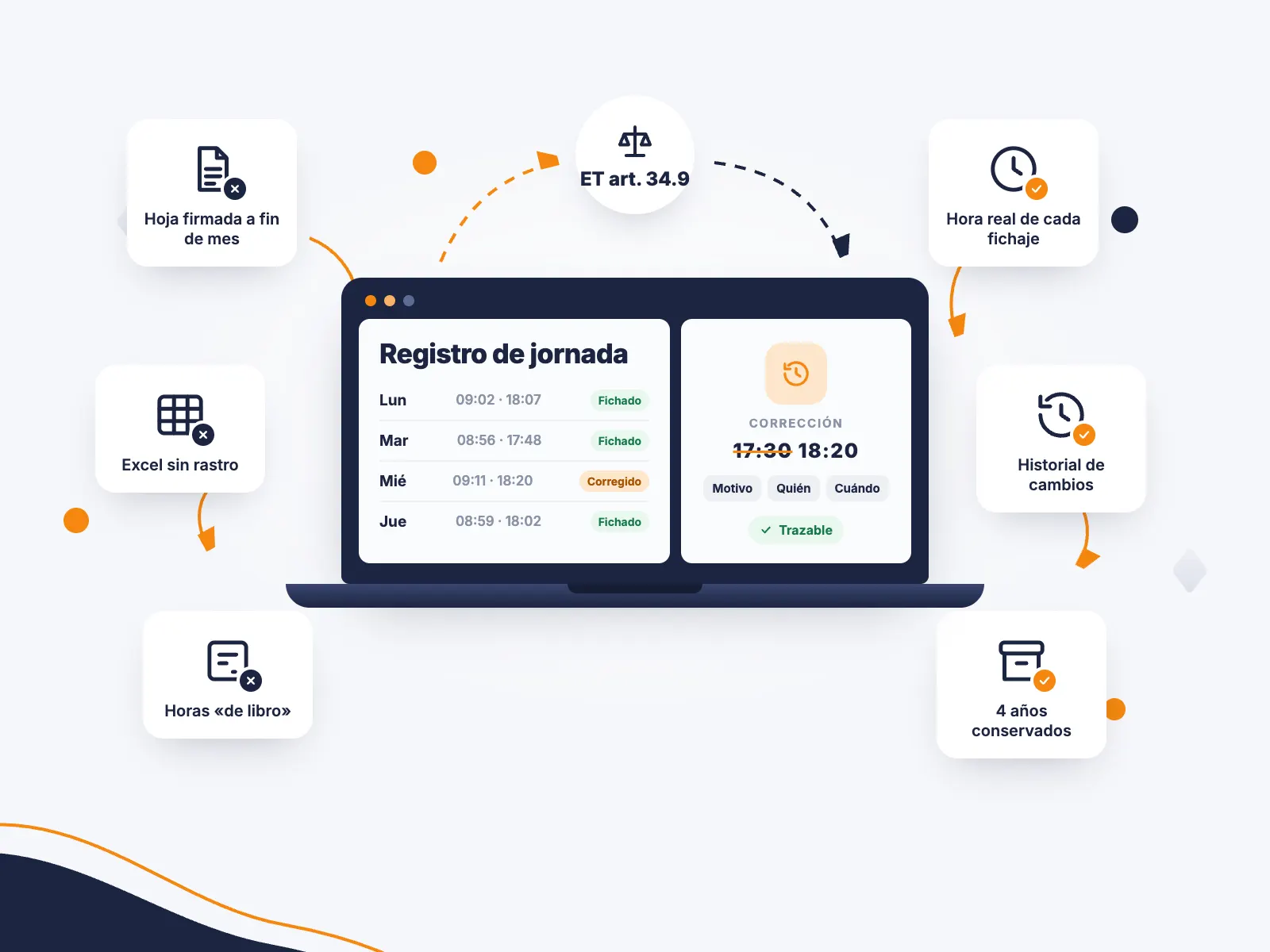
Article 34.9 of the Workers’ Statute requires companies to record working time day by day, with the actual start and finish times, keep the records for four years and make them available to employees, their legal representatives and the Labour and Social Security Inspectorate. It says nothing about the medium.
The Ministry of Labour’s guide on the working-time record clarified this in 2019 in a sentence worth reading slowly:
“Any system or means, on paper or electronic, will be valid if it is fit to meet the legal aim, that is, to provide information that is reliable, unmodifiable and not open to manipulation after the fact, whether by the employer or by the employee.” (our translation)
Paper is allowed. What is not allowed is a record that can be rewritten afterwards. That standard comes from the Court of Justice of the European Union, which in its judgment of 14 May 2019 (case C-55/18) required Member States to make employers set up an objective, reliable and accessible system for measuring each worker’s daily working time.
Two further obligations affect the format directly:
- Part-time contracts (art. 12.4.c of the Statute): hours are recorded daily and totalled monthly, and the employee receives a summary of all the month’s hours, ordinary and supplementary, with their payslip.
- Overtime (art. 35.5): recorded daily, totalled per pay period, and a copy of the summary goes to the employee with their payslip.
Where paper and spreadsheets fall short
Neither is prohibited, but neither proves on its own that it is reliable. The difference is clearest in a table:
| What gets checked | Signature sheet | Shared spreadsheet | Digital system with history |
|---|---|---|---|
| Who wrote down the time? | Inferred from the signature, if any | Not recorded | Each person is recorded |
| When was it written? | Unknown: it can be filled in at month end | Unknown | The exact time of the clock-in |
| Was anything changed later? | Crossings-out or a new sheet | Overwritten without a trace | Who, when and why is kept |
| Can it be checked on the spot? | Only at the office, if it can be found | Depends on who has the file | Yes, by person and period |
| Are the four years there? | Archive boxes | Scattered versions | Kept and exportable |
The problem with Excel is not that it is a spreadsheet, but that anyone with access can change a cell without anyone knowing. The signature sheet has the opposite problem: it tends to be signed in one go at the end of the week or month, with textbook times that match the theoretical schedule to the minute. When every start is 9:00 and every finish is 18:00, the record describes the contract, not the working day.
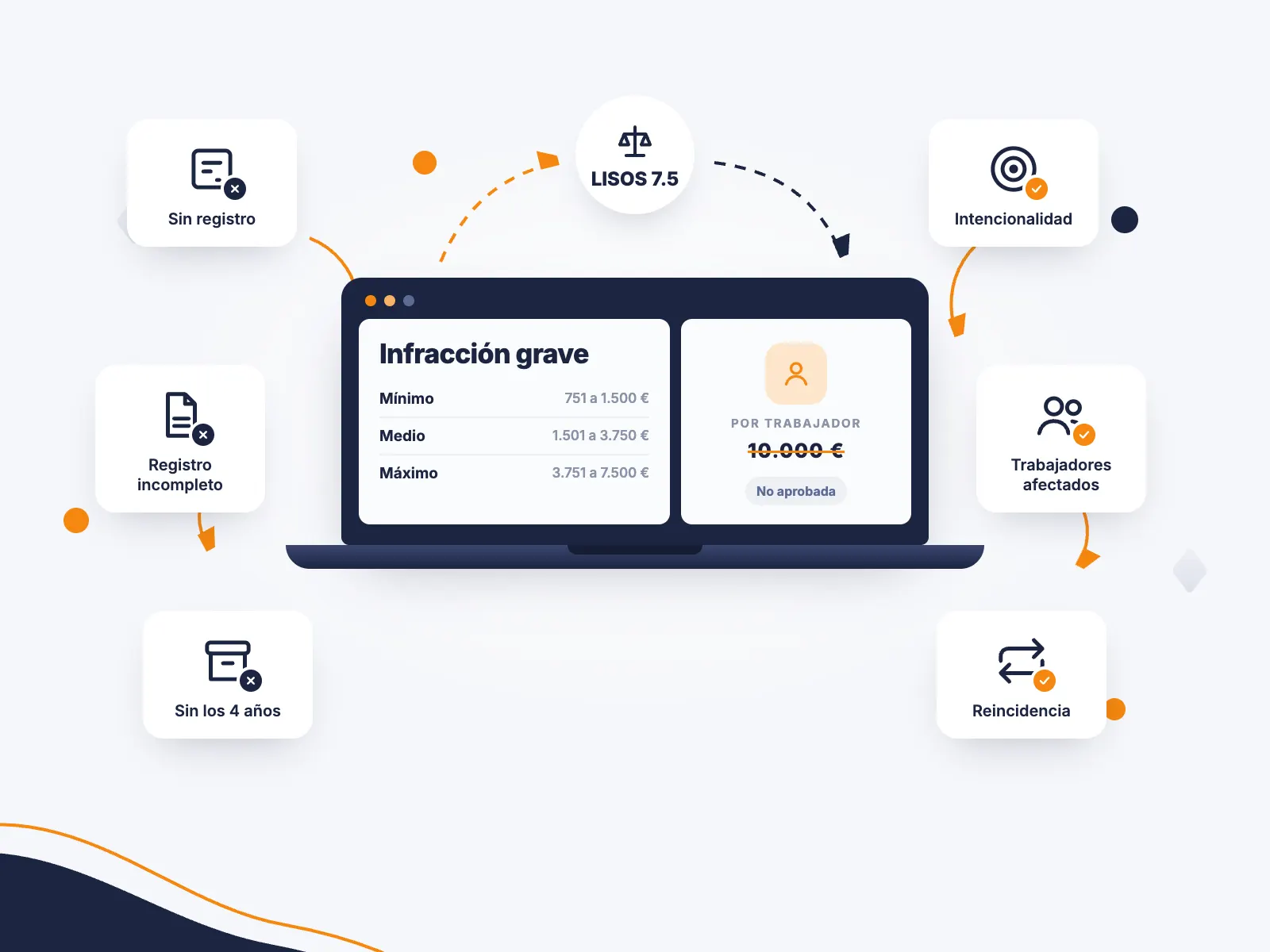
In an inspection, a record like that is a document the company has to defend, not evidence that backs it up. And failing to keep a reliable record is a serious infringement, with fines of €751 to €7,500 (see how much the fines for not keeping a time record are).
What the digital royal decree would change
On 9 October 2025 the Ministry of Labour opened a public hearing on a draft royal decree developing the working-time record. These are the points of that text that affect paper and spreadsheets. It is a draft: the Council of State issued an unfavourable opinion on 23 March 2026 and the Government has not yet approved it.
- Digital means (art. 2.1): every company would guarantee the daily record of each person’s working time “by digital means”.
- Personal, immediate entries (art. 4.a): each entry would be made freely, personally, directly and immediately at the start and end of work. Filling in the week on Friday would no longer count.
- Changes leave a trace (arts. 2.2.b and 4.b): an entry could not be changed without authorisation from both the company and the employee, and the record would have to show a clear, indelible trace of each change and who made it.
- Paper for emergencies only (art. 4.d): if a justified technical incident prevents digital clocking, the entry would be made another way and moved into the digital system as soon as possible.
- Entry into force (fifth final provision): twenty days after publication in the BOE. The Council of State found that period too short, so it is one of the points that may change.
If the final text keeps article 2.1, signature sheets and spreadsheets will stop being a valid system. Until then they are valid, subject to the reliability standard the law already sets. Our guide on where the digital time-record royal decree stands keeps the timeline up to date.
If you record on paper or in Excel today
You do not need to change everything tomorrow, but you should stop relying on good faith. While you stay on paper or spreadsheets, this lowers the risk:
- Daily entries, not monthly. Each person writes down their start and finish the same day, with the real time.
- Numbered sheets with no gaps, so they cannot be swapped or completed later.
- No round numbers. If every start is 9:00 sharp, the record loses credibility.
- Breaks and overtime recorded, not just start and finish.
- Copies for the employee and their representatives on request, and the monthly summary with the payslip for part-time contracts.
- Four years on file, sorted by person and month.
Moving to digital in five steps
- Inventory. Who clocks in, from where (office, mobile, remote) and on what schedules.
- A system with a change history that records who corrects a clock-in and why, and exports by person and period.
- Protocol. How people clock in, how a missed clock-in is fixed and who authorises it. The 2019 rule already requires the record to be organised by collective agreement, company agreement or, failing that, by the employer after consulting the legal representatives.
- Training. Ten minutes per person is enough if the system is simple.
- Keep the old records. Paper or spreadsheet records from the last four years remain mandatory even after you switch systems.
How Quantummycos handles it
In Quantummycos each person clocks in from their phone or computer, and the time is stored at that moment, with nothing filled in by hand. Nobody can edit their own clock-ins. If someone forgets, an administrator corrects it with a mandatory reason, and the clock-in keeps what it was before, what it is now, who changed it and when. Nothing is overwritten.
The working-time report comes out as a PDF per person and month, with starts, finishes, breaks, each day’s overtime, how each day was recorded (clocked, corrected or manual), an annex listing every correction and signature boxes. And as Excel for working with the data. It is ready the day someone asks for it, royal decree or not.
You can see how time tracking works or open the app and try it with your team.
Keep reading
- Spain’s working-time record: what is mandatory today and where the royal decree stands, with the full timeline.
- Fines for not keeping a working-time record in Spain in 2026, with the amounts and how they are graded.
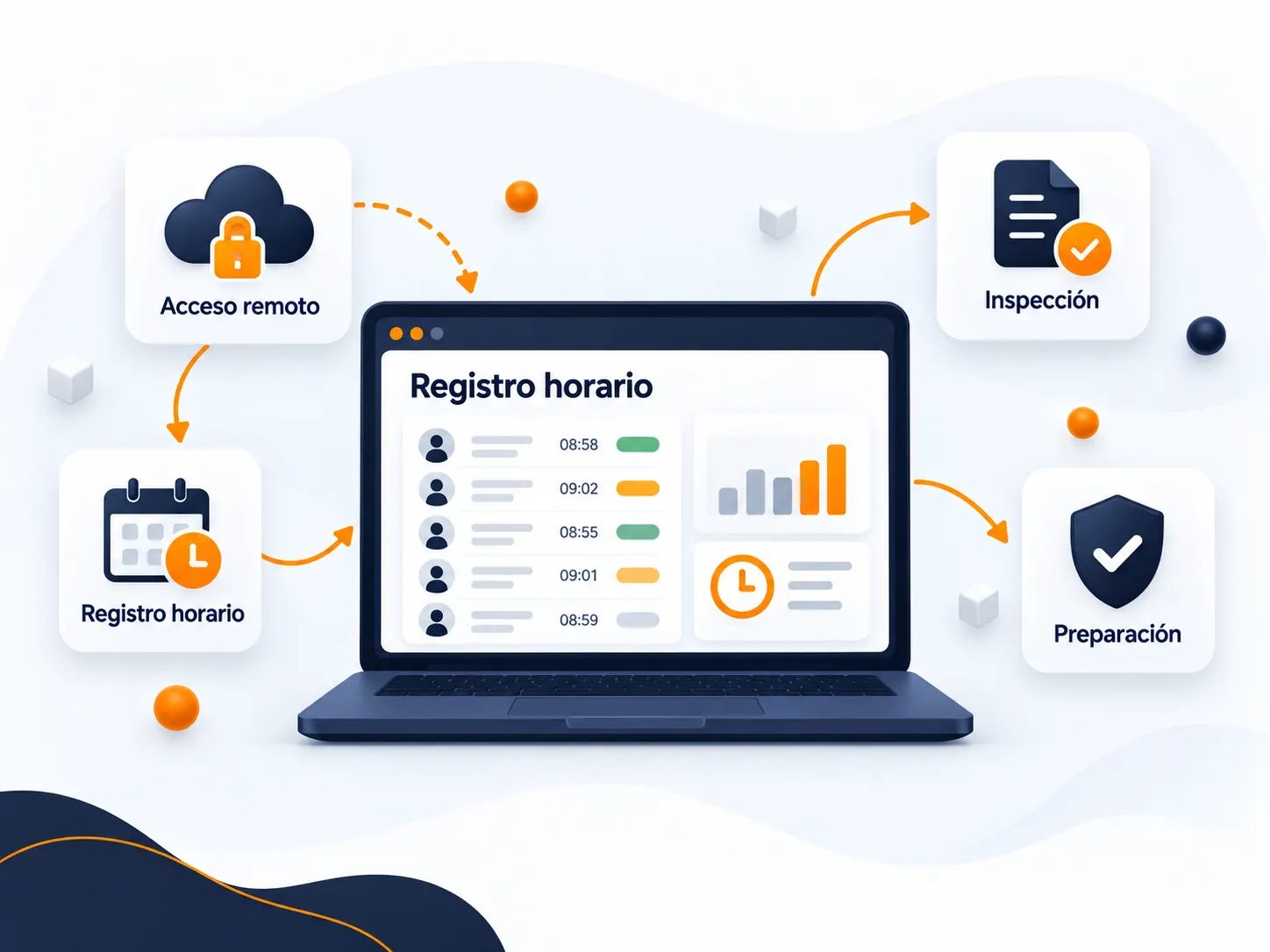
- Remote access by the labour inspectorate to the time record, what the draft asks for and what to prepare now.
- 10 mistakes when managing clock-ins in HR, the ones almost every company repeats.
- Time record, in the HR dictionary, the definition in one sentence.
Sources
- Royal Legislative Decree 2/2015, consolidated Workers’ Statute (BOE, in Spanish), articles 12.4.c, 34.9 and 35.5.
- Guide on the working-time record (Ministry of Labour, in Spanish).
- Judgment of the Court of Justice of the EU of 14 May 2019, case C-55/18.
- Draft royal decree on the working-time record, public hearing text (Ministry of Labour, October 2025, in Spanish), articles 2 and 4 and third and fifth final provisions.
- Royal Legislative Decree 5/2000, Law on Social Order Infringements and Penalties (BOE, in Spanish), articles 7.5 and 40.1.b.
This article is for information only and is not legal advice. The digital time-record legislation is still in progress: always check the consolidated text in force in the BOE and consult your employment adviser. Last reviewed: 29 September 2026.
- Working-time record
- Time tracking
- Clock-ins
- Employment law
Frequently asked questions
Yes, until the royal decree requiring digital means is published. Article 34.9 of the Workers’ Statute does not set the medium, but it requires a daily record of start and finish times, kept for four years and available to staff, their representatives and the inspectorate. A sheet signed every day with the real time complies; one filled in at month end hardly does.
It is if it is reliable, and that is the problem: a spreadsheet can be changed without a trace and cannot show when each time was entered. The Ministry of Labour’s guide requires information that is reliable, unmodifiable and not open to later manipulation, which a shared spreadsheet does not guarantee on its own.
When the digital-record royal decree is published in the BOE and its entry-into-force period passes, which was twenty days in the public hearing text. As of 29 September 2026 it has not been published. Even then, the draft allows entries by other means during a justified technical incident, to be moved into the digital system afterwards.
Failing to keep a reliable record is a serious infringement under article 7.5 of the LISOS, with a fine of €751 to €7,500 depending on the grade. The grade depends on criteria such as intent, the number of employees affected and whether the company had already ignored a requirement from the inspectorate.
No. Records are kept for four years, so sheets or spreadsheets from before the switch must be kept until that period has passed for each month.
Not under the draft. Its third final provision allows the record in domestic employment to be kept by any means proportionate to the employer’s and employee’s capacities and resources, provided it effectively meets the obligation.