Compliance
Fines for not keeping a working-time record in Spain in 2026: how much and how they are calculated
Not recording working time in Spain is a serious infringement of €751 to €7,500. We explain how it is graded, what counts as a repeat offence and where the well-known €10,000-per-employee fine comes from, which was never approved.
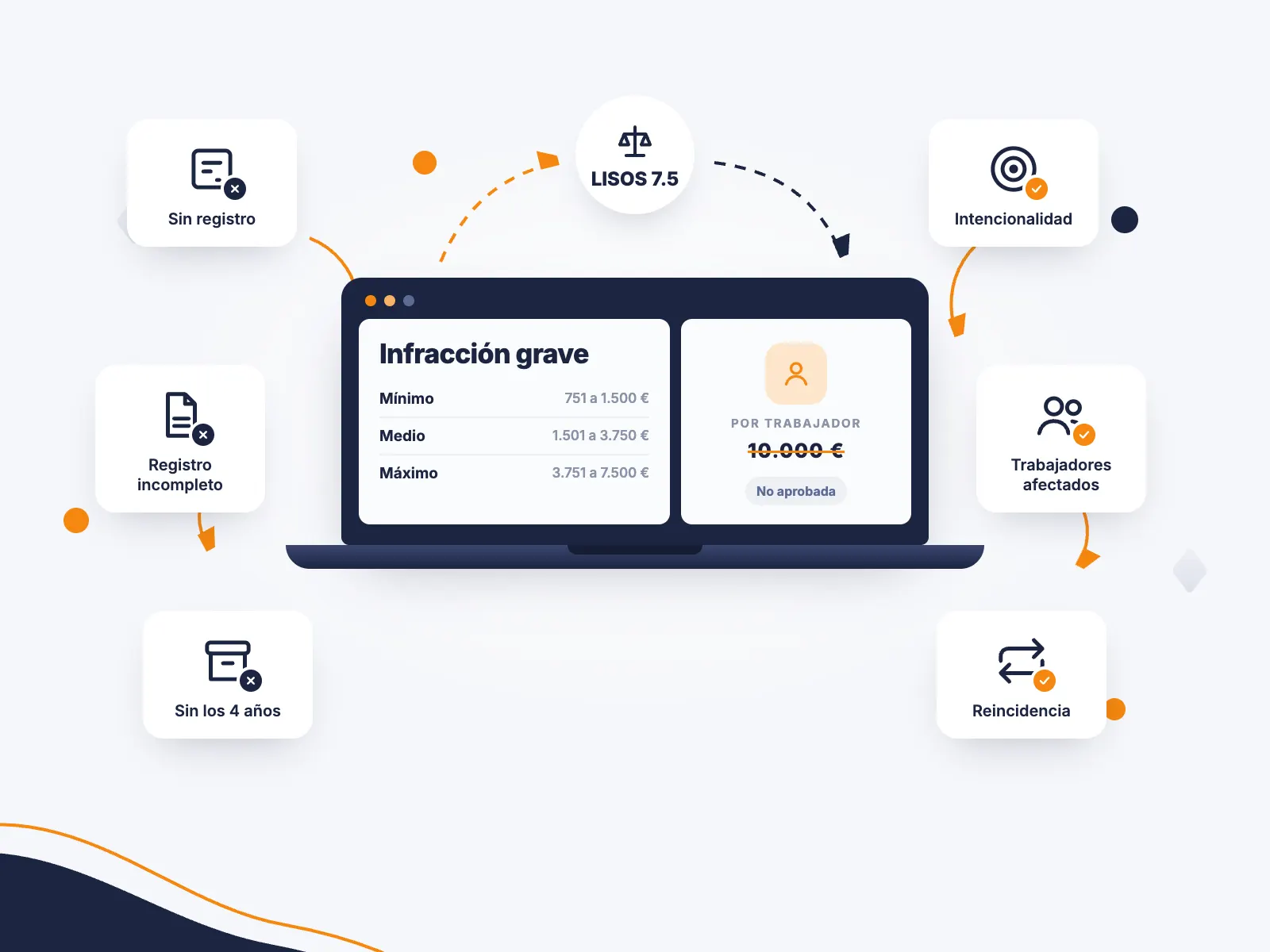
How much is the fine for not keeping a working-time record in Spain? Between €751 and €7,500 per infringement, depending on the grade. Not keeping the record, or keeping one that is not reliable, is a serious infringement under article 7.5 of the Law on Social Order Infringements and Penalties (LISOS), and that is how it is penalised today, 29 September 2026.
Much higher figures are circulating, €10,000 per employee, and they are not made up: they come from a reform the Government took to Congress in 2025 that did not go through. This guide separates the fine that applies today from the one that was proposed, explains how the grade is decided and what you can do to avoid getting there.
In short. Not recording working time is a serious infringement: €751 to €1,500 at the minimum grade, €1,501 to €3,750 at the middle grade and €3,751 to €7,500 at the maximum grade. The law in force does not multiply it per person: the number of employees affected is used to choose the grade. The per-employee fine (€1,000 to €10,000 each) was in the working-week reduction bill, which Congress rejected on 10 September 2025. The draft royal decree on digital records does not change the fines.
What infringement it is
Article 7.5 of the LISOS classes as serious:
“Breach of the statutory or agreed rules and limits on working hours, night work, overtime, supplementary hours, rest, holidays, leave, the working-time record and, in general, working time as referred to in articles 12, 23 and 34 to 38 of the Workers’ Statute.” (our translation)
The “working-time record” is named expressly, and the rules that can be breached are those of article 34.9 of the Statute and, for part-time contracts and overtime, articles 12.4.c and 35.5. In practice, situations like these fit there:
- No record at all, or a record for only part of the workforce. The obligation also covers full-time staff.
- An incomplete record: missing start or finish times, or blank days.
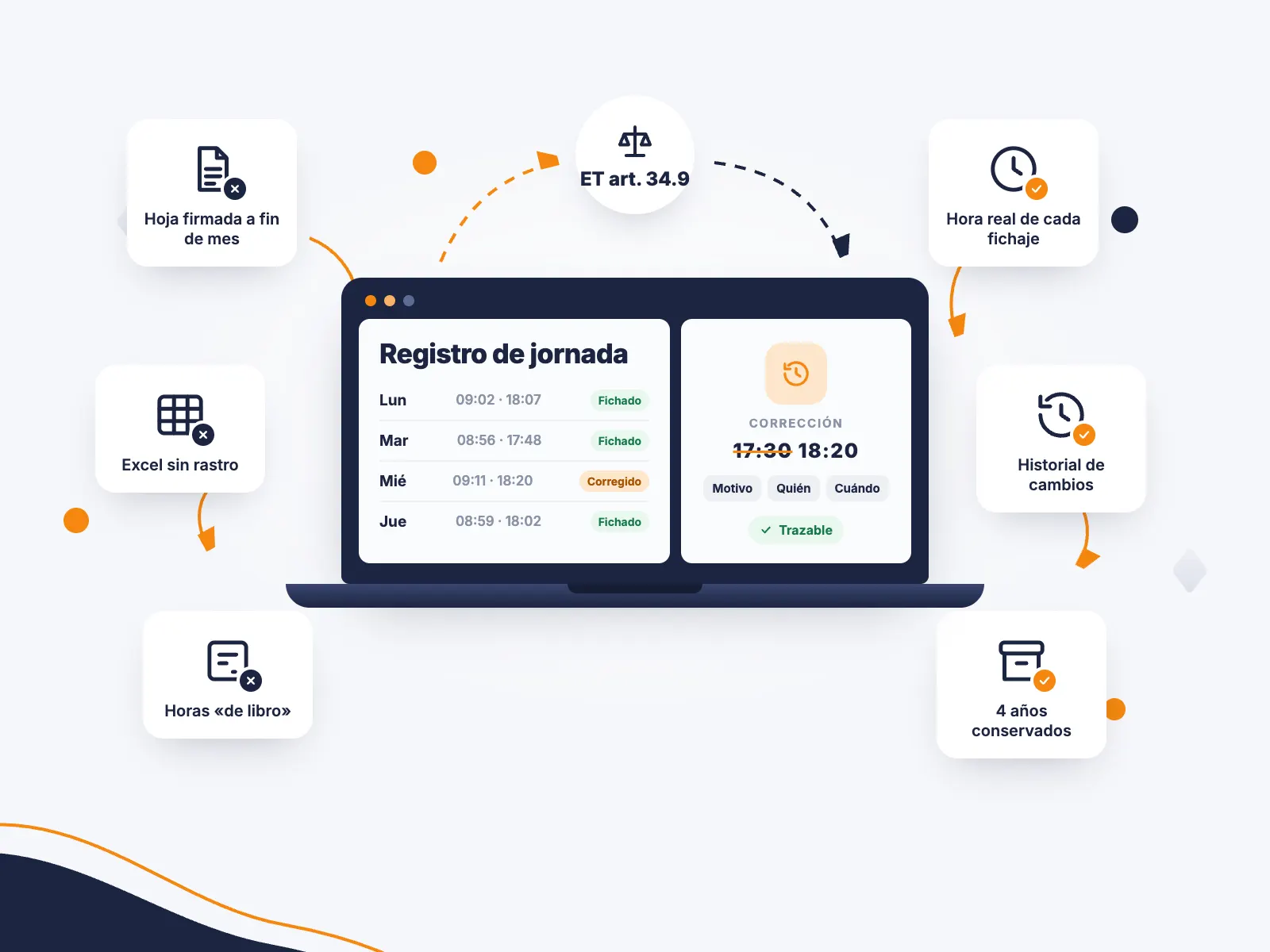
- An unreliable record: identical times every day, sheets signed at month end, a spreadsheet anyone can change without a trace.
- Not keeping it for four years, or not making it available to employees, their representatives or the inspectorate.
- Not handing over the summary of hours with the payslip to part-time staff or those who work overtime.
How much the fine is in 2026
Article 40.1.b of the LISOS sets the fine for serious infringements in three grades:
| Grade | Fine |
|---|---|
| Minimum | €751 to €1,500 |
| Middle | €1,501 to €3,750 |
| Maximum | €3,751 to €7,500 |
The range is the same for a company of five people as for one of five hundred. What changes is the grade, and that is decided by the criteria below.
How the grade is decided
Article 39.2 of the LISOS lists the circumstances that aggravate or mitigate the fine:
- The company’s negligence or intent.
- Fraud or collusion.
- Ignoring earlier warnings or requirements from the inspectorate.
- The company’s turnover.
- The number of employees affected.
- The harm caused and any amount defrauded.
A record that exists but has gaps is not judged the same as no record at all, and a company that fixes things after the first warning is not judged the same as one that had already received a formal requirement.
Repeat offences
It counts as a repeat offence when an infringement of the same kind is committed within 365 days of notice of a final penalty for the previous one (art. 41). The fine can then reach double the applicable grade, but never above the maximum for serious infringements: €7,500.
Not always a fine the first time
After checking, the inspectorate can warn and require the company to comply instead of opening penalty proceedings, when the circumstances advise it and there is no direct harm to employees (art. 22 of Law 23/2015 on the Labour Inspectorate). It can also set a deadline to fix what is missing. This is not a right of the company but the inspector’s decision, and ignoring that requirement is precisely one of the criteria that aggravate the fine if one follows.
The per-employee fine: the reform that did not pass
On 6 May 2025 the Council of Ministers approved the bill reducing the working week to 37.5 hours, published in the Parliamentary Gazette on 16 May. Beyond working hours, it changed the fines for the record:
- It added to article 7.5 that there would be one infringement for each employee affected where there was no record or the recorded data had been falsified.
- It raised the fine for that infringement to €1,000 to €2,000 at the minimum grade, €2,001 to €5,000 at the middle grade and €5,001 to €10,000 at the maximum grade.
Under that wording, a company of 25 people with no record would have faced between €25,000 and €250,000. That is why the figure became so well known. But on 10 September 2025 Congress passed the amendments to the whole and sent the bill back to the Government, so that part never came into force.
What about the digital royal decree? It does not change the fines. Infringements and penalties can only be set by law, and the draft the Ministry put to public hearing in October 2025 regulates what the record must look like, not what it costs not to have one. If the per-employee fine ever returns, it will have to be by law. We follow the process in where the digital time-record royal decree stands.
How to avoid the fine
- Record the whole workforce, including full-time staff, remote workers and people away from the office.
- Real start and finish time every day, entered by the person at that moment, not filled in later.
- Breaks and overtime, recorded and totalled per pay period.
- Corrections with a trail: who changed what, when and why. A missed clock-in fixed with a reason is normal; a time changed without a trace is a problem.
- Monthly summary with the payslip for part-time contracts and overtime.
- Four years kept and retrievable by person and month.
- Available on the spot to staff, their representatives and the inspectorate. If you keep it digitally, in a readable, processable format, which is what article 13.3.c of Law 23/2015 already requires.
If you use paper or spreadsheets today, read first whether paper or Excel time records are legal in 2026: they are, but it is where most records fail.
How Quantummycos handles it
Quantummycos is built so that the record stands up to an inspection. Each person clocks in from their phone or computer, with the time stored at that moment. Nobody edits their own clock-ins: corrections are made by an administrator with a mandatory reason, and each one stays in the clock-in’s history with what it was before, what it is now, who and when.
Before exporting, the working-time report flags the period’s points to review (open days, open breaks, short rest periods, overtime) so you see them before anyone else. And the PDF comes out per person and month, with each day’s overtime, the corrections annex and signature boxes, ready to hand over with the payslip or to whoever asks for it.
You can see how time tracking works or open the app and try it with your team.
Keep reading
- Spain’s working-time record: what is mandatory today and where the royal decree stands, with the full timeline.
- Are paper or spreadsheet time records legal in Spain in 2026?, what is valid today and what would stop being valid.
- Remote access by the labour inspectorate to the time record, what the draft asks for and what to prepare now.
- 10 mistakes when managing clock-ins in HR, the ones that end in a fine.
- Overtime, in the HR dictionary, how much is allowed and how it is recorded.
Sources
- Royal Legislative Decree 5/2000, Law on Social Order Infringements and Penalties (BOE, in Spanish), articles 7.5, 39.2, 40.1.b and 41.
- Law 23/2015 on the Labour and Social Security Inspectorate (BOE, in Spanish), articles 13.3.c and 22.
- Royal Legislative Decree 2/2015, consolidated Workers’ Statute (BOE, in Spanish), articles 12.4.c, 34.9 and 35.5.
- Bill to reduce the maximum ordinary working week and guarantee the working-time record and the right to disconnect (Congress Gazette, 16 May 2025, in Spanish), first final provision.
- Draft royal decree on the working-time record, public hearing text (Ministry of Labour, October 2025, in Spanish).
This article is for information only and is not legal advice. Amounts are those of the consolidated LISOS in force on the review date: always check the BOE and consult your employment adviser. Last reviewed: 29 September 2026.
- Working-time record
- Compliance
- Employment law
- SMEs
Frequently asked questions
Between €751 and €7,500. It is a serious infringement under article 7.5 of the LISOS, penalised at the minimum grade (€751 to €1,500), middle grade (€1,501 to €3,750) or maximum grade (€3,751 to €7,500) according to the criteria in article 39.2.
Not under the law in force. Today it is penalised as one infringement and the number of employees affected is used to choose the grade. The per-employee fine of €1,000 to €10,000 was in the working-week reduction bill that Congress rejected on 10 September 2025.
No. Infringements and penalties can only be set by law. The draft royal decree regulates what the record must look like (digital, reliable and accessible), not the fines, which remain those of the LISOS.
The LISOS penalises the company, which is responsible for guaranteeing the record. If someone does not clock in, the company can remind them and, if it continues, apply the disciplinary rules in its collective agreement.
Yes. Law 23/2015 allows the inspectorate to warn the company and require compliance instead of opening penalty proceedings when circumstances advise it and there is no direct harm to employees. Ignoring that requirement aggravates the fine if one follows.
If the second infringement is of the same kind and committed within 365 days of notice of a final penalty, it is a repeat offence and the fine can reach double the grade, capped at €7,500.