
People management
How to calculate the final settlement in Spain in 2026: formula, examples and calculator
The final settlement and severance pay are not the same thing, and almost everyone mixes them up. What goes into each, the formula for every part, a worked example and a calculator to check your own case.
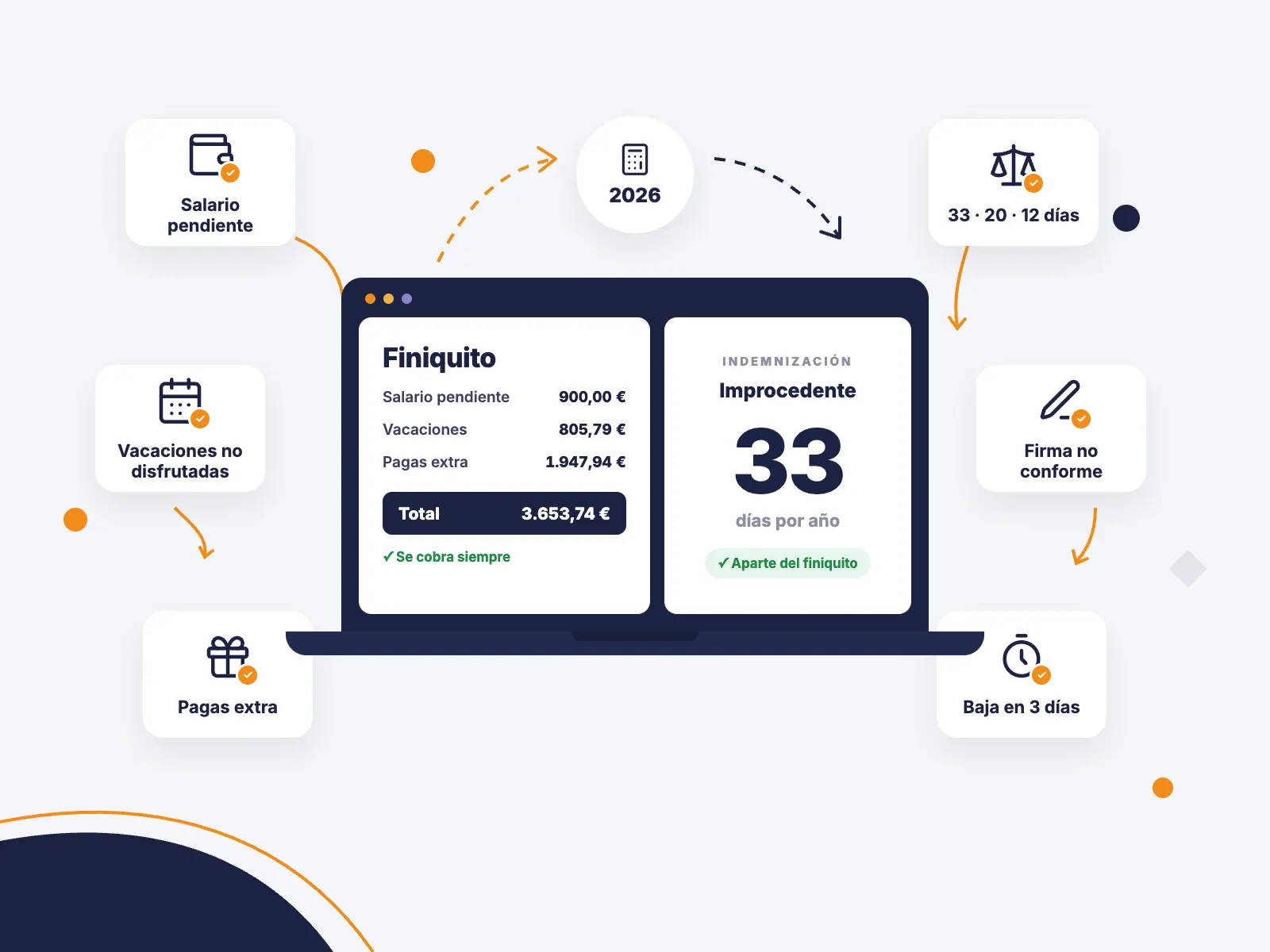
Every time a contract ends in Spain, two people sit down to do the same sum. The person leaving wants to know how much they are owed, and the employer wants to know how much it will cost. Both usually get it wrong for the same reason: they mix up two things the law keeps apart, the final settlement (finiquito) and severance pay (indemnización).
Here is what goes into each one, the formula for every part, a worked example with real figures and a calculator to check your own case.
In short. The final settlement is what has already been earned and not yet paid: salary for the days worked in the last month, holiday not taken and the pro rata share of the extra payments. It is due however the contract ends. Severance pay is something else and only applies in some cases: 33 days’ salary per year of service for an unfair dismissal, 20 for an objective dismissal and 12 when a temporary contract ends. Resigning, or a fair disciplinary dismissal, means a settlement but no severance pay.
Final settlement and severance pay: what each one is
The word finiquito does not appear as such in the Workers’ Statute (Estatuto de los Trabajadores). Article 49.2 talks about the document settling the amounts owed, which the employer must propose when it notifies the termination. It is a settlement of debts: everything the person has already earned by working and has not yet been paid.
Severance pay is not a debt for work done. It is compensation for losing the job, which is why it depends on how and why the contract ends.
| Final settlement | Severance pay | |
|---|---|---|
| What it is | What was earned and not paid | Compensation for losing the job |
| When it is paid | Whenever a contract ends | Only for some types of termination |
| What it depends on | Salary and dates | Salary, length of service and type of termination |
| Legal basis | Articles 31, 38 and 49.2 ET | Articles 49.1.c, 53 and 56 ET |
| Tax | Taxed under IRPF, with social security | Tax free up to the statutory minimum and €180,000 |
What the final settlement includes
- Salary for the days worked in the last month that has not been paid yet.
- Holiday earned and not taken. This is the only point at which it can be exchanged for money: while the contract lasts, that is forbidden (article 38.1 ET).
- The pro rata share of the extra payments earned since the last one was paid, unless they are spread across every monthly payslip (article 31 ET).
- Anything else outstanding: overtime, commission, incentives already earned, allowances or expenses to be reimbursed.
- Any deductions that apply: advances, holiday taken in excess or, if the collective agreement provides for it, the days of notice the person did not give when leaving.
How to calculate the final settlement step by step
1. Salary for the days of the last month
Gross monthly salary ÷ 30 × days worked that month. The month is settled as a 30-day commercial month, so someone who works the whole month is paid the same in February as in August. The monthly salary is the gross annual salary divided by 14 if there are two separate extra payments, or by 12 if they are spread monthly.
2. Holiday not taken
First, the days earned in the year the contract ends: holiday days per year × days worked in the year ÷ 365. With the legal minimum of 30 calendar days, that is 2.5 days per month worked. Take away the days already taken, and pay the result at the daily salary: the gross annual salary, extra payments included, divided by 365.
If the person took more days than they had earned, the difference is negative and it is usually deducted from the settlement.
3. Pro rata share of the extra payments
Amount of the payment × days earned since the last one was paid ÷ 365. When each payment accrues is set by the collective agreement. Most commonly, the Christmas payment accrues from January to December and the summer one from July to June, so the summer payment made in July has already covered the previous twelve months. If the extra payments are spread across the monthly payslip, nothing is outstanding under this heading.
4. Everything else
Overtime, commission or allowances are added at their amount. And in an objective dismissal, if the employer does not give the 15 days’ notice required by article 53.1.c, it must pay the salary for those days.
A worked final settlement example
Someone on a gross annual salary of €25,200 in 14 payments (€1,800 a month), on a permanent contract since 1 March 2021, last day worked 15 October 2026, 30 calendar days of holiday a year and 12 already taken. From 1 January to 15 October there are 288 days, and the daily salary is 25,200 ÷ 365 = €69.04.
| Item | Calculation | Amount |
|---|---|---|
| October salary | 1,800 ÷ 30 × 15 days | €900.00 |
| Holiday not taken | 30 × 288 ÷ 365 = 23.67 days earned; 23.67 − 12 = 11.67 days × €69.04 | €805.79 |
| Christmas payment | 1,800 × 288 ÷ 365 (January to October) | €1,420.27 |
| Summer payment | 1,800 × 107 ÷ 365 (July to October) | €527.67 |
| Settlement total | €3,653.74 gross |
That €3,653.74 is paid whether the person resigns, is dismissed or reaches the end of their contract. What changes from one case to another is what comes next.
Settlement and severance pay calculator 2026
The example above is already loaded. Change the salary, the dates, the holiday or the way the contract ends, and you will see the final settlement, which is always paid, separately from the severance pay, which depends on the case.
Including the extra payments.
Set by your collective agreement.
The date seniority counts from.
Calendar days. The legal minimum is 30.
This is only a rough guide and is not valid as a final calculation. For the definitive amount, check with your payroll or employment adviser.
Final settlement (finiquito)
What has been earned and not yet paid. Due however the contract ends.
- Salary for the last month (15 days)
- €900.00
- Holiday not taken (11.67 days)
- €805.79
- Pro rata Christmas payment
- €1,420.27
- Pro rata summer payment
- €527.67
Severance pay (indemnización)
Only for some ways of ending the contract, and on top of the settlement.
- 33 days per year × 5.67 years of service
- Days of salary
- 187
A gross estimate under the general rules of the Workers’ Statute, with each extra payment worth one monthly salary. Your collective agreement may improve them. The settlement is taxed under IRPF; statutory severance pay is tax free up to €180,000. What you type is calculated in your browser and is not sent anywhere.
The calculator also has its own page, to keep it handy without the article.
When severance pay applies, and how much
| How the contract ends | Severance pay | Cap | Legal basis |
|---|---|---|---|
| Resignation | None | Not applicable | Art. 49.1.d ET |
| Fair disciplinary dismissal | None | Not applicable | Art. 55.7 ET |
| Not passing the probation period | None | Not applicable | Art. 14 ET |
| End of a temporary contract | 12 days per year | No cap | Art. 49.1.c ET |
| Fair objective dismissal | 20 days per year | 12 months’ pay | Art. 53.1.b ET |
| Collective dismissal (ERE) | At least 20 days per year | 12 months’ pay | Arts. 51 and 53.1.b ET |
| Substantial change not accepted | 20 days per year | 9 months’ pay | Art. 41.3 ET |
| Unfair dismissal | 33 days per year | 24 months’ pay | Art. 56.1 ET |
| Termination for the employer’s serious breach | 33 days per year | 24 months’ pay | Art. 50.2 ET |
Two exceptions at the end of a temporary contract: training contracts and the substitution contract do not carry the 12 days.
How severance pay is calculated
Daily salary × days per year × years of service, up to the applicable cap.
- The daily salary is the gross annual salary, with the extra payments and salary supplements, divided by 365. Items that are not salary, such as allowances or the transport supplement, do not count.
- Years of service run from the seniority date to the last day worked. Periods of less than a year are prorated by months (article 56.1 ET), and the Supreme Court counts a part of a month as a whole month.
- The cap is measured in months’ pay, each one twelfth of the annual salary: 24 for an unfair dismissal (two years’ salary), 12 for an objective one (one year) and 9 for a substantial change. Only contracts older than 2012 have a cap in days, explained next.
Contracts older than 12 February 2012
The 2012 labour reform cut unfair dismissal pay from 45 to 33 days per year, but it kept what had already been earned. For a contract older than that date, the time worked up to 11 February 2012 counts at 45 days per year and the time after it at 33. The total cannot exceed 720 days, unless the older period alone already does: then that period is paid, up to 42 months’ pay (eleventh transitional provision of the Statute). The calculator applies this rule by itself when the start date is earlier.
A worked severance pay example
The same person as before: from 1 March 2021 to 15 October 2026 there are 5 years, 7 months and 15 days. The part of October counts as a whole month, so the service counted is 5 years and 8 months, or 5.67 years.
| Type of dismissal | Days of salary | Severance pay | Settlement + severance |
|---|---|---|---|
| Unfair | 33 × 5.67 = 187 days | €12,910.68 | €16,564.42 |
| Fair objective | 20 × 5.67 = 113.33 days | €7,824.66 | €11,478.40 |
| Fair disciplinary | 0 | €0.00 | €3,653.74 |
The gap between the first row and the last is exactly the confusion this article started with: the settlement is the same in all three cases, while the severance pay ranges from zero to almost €13,000.
Signing the settlement: «not in agreement», a representative and deadlines
- The employer must propose the settlement together with the termination notice or the advance notice (article 49.2 ET).
- The person can ask for a workers’ legal representative to be present when signing, and the receipt must state whether one was there or the option was not used.
- Signing «not in agreement» (no conforme) lets the person collect what is offered and claim the difference later. Signing does not mean giving anything up, and the courts do not treat a settlement as a waiver when it does not set out clearly what is being settled.
- Deadlines to claim: 20 working days to challenge a dismissal (article 59.3 ET) and one year to claim amounts owed (article 59.1 ET).
- When it is paid: the law sets no general deadline. It is usually paid with the last payslip or on the last day, and many collective agreements regulate it.
- Deregistration from social security is filed within three calendar days of the termination.
What is taxed and what is not
The final settlement is salary: it is taxed under IRPF and carries social security contributions, holiday not taken included.
Severance pay is exempt from IRPF up to the compulsory amount set by the Statute, with a limit of €180,000 (article 7.e of the IRPF Act), and carries no contributions. Anything agreed above the statutory minimum is taxed. For an unfair dismissal, the exemption requires it to be recognised at the conciliation hearing or in a court ruling.
Common mistakes when calculating the settlement
1. Mixing up settlement and severance pay. Someone who resigns gets no severance pay, but does get their whole settlement.
2. Forgetting the pro rata extra payments. With 14 payments it is usually the largest item in the settlement.
3. Working out holiday over the contract rather than the year. What counts is the holiday earned in the year the contract ends, minus what was taken that same year.
4. Using only the base salary for the daily salary. Extra payments and salary supplements count too.
5. Rounding service down. Fifteen days of a month count as the whole month.
6. Not knowing how many holiday days were really taken. It is the figure that causes the most arguments, and the one fewest people have to hand on the last day.
The figure that is almost always missing: the holiday balance
Of everything above, the salary and the dates are in the contract. What is rarely to hand is how many holiday days each person has earned and taken this year, including half days, requests approved late and days nobody deducted. And it is exactly the item of the settlement that gets disputed most.
In Quantummycos every person has their balance up to date: days earned, approved, awaiting approval and left. On the Enterprise plan, every departure also gets its own offboarding checklist, person by person, with the steps your company sets: the settlement, social security deregistration within three days, the employment certificate, returning equipment or removing access. You can open the app and try it with your team. Free plan for up to 2 users, no card needed.
Keep reading
- Employee onboarding and offboarding in Spain 2026: checklist and deadlines, everything to do when someone leaves, in order.
- Holiday entitlement in Spain 2026, where the balance paid in the settlement comes from.
- What an employee really costs a company in Spain in 2026, from gross salary to total cost.
- Paid leave in Spain 2026: days by situation, the absences that are not holiday.
Sources
- Workers’ Statute, consolidated text (BOE): articles 14, 31, 38, 41, 49, 50, 51, 53, 55, 56 and 59, and the eleventh transitional provision.
- Act 35/2006 on Personal Income Tax (BOE): article 7.e, on the exemption for dismissal compensation.
This article is for information only and is not legal advice. Your collective agreement may improve these minimums and set a different accrual for the extra payments: always check the current consolidated text in the BOE and speak to your employment adviser. Last reviewed: October 2026.
- Final settlement
- Dismissal
- Offboarding
- Holidays
- Employment law
Frequently asked questions
The final settlement (finiquito) is what has been earned and not yet paid: salary for the days worked in the last month, holiday not taken and the pro rata share of the extra payments. It is due whenever a contract ends. Severance pay (indemnización) is compensation for losing the job and only applies in some cases: 33 days per year for an unfair dismissal, 20 for an objective dismissal and 12 when a temporary contract ends.
Unpaid salary for the days worked in the last month, holiday earned and not taken, the pro rata share of the extra payments if they are not spread monthly, and anything else outstanding, such as overtime, commission or allowances. Advances and, where relevant, holiday taken in excess are deducted.
Multiply the holiday days per year by the days worked in the year the contract ends and divide by 365. Subtract the days already taken, and pay the rest at the daily salary, which is the gross annual salary including extra payments divided by 365. With 30 days a year that is 2.5 days per month worked.
33 days’ salary per year of service, up to 24 months’ pay. Periods under a year are prorated by months and part of a month counts as a whole month. For contracts older than 12 February 2012, the time up to that date counts at 45 days per year.
Yes. The settlement is always paid, including on resignation or a fair disciplinary dismissal, because it is what has already been earned. What there is not in those cases is severance pay. If the collective agreement provides for it, days of notice not given can be deducted.
Yes. The settlement is salary: it is taxed under IRPF and carries social security contributions, holiday not taken included. Severance pay, by contrast, is exempt up to the compulsory amount set by the Workers’ Statute, with a limit of €180,000.
Signing does not mean giving anything up. It can be signed «not in agreement» to collect what is offered and claim the difference later, and the person is entitled to have a workers’ legal representative present. The deadline to challenge a dismissal is 20 working days, and one year to claim amounts owed.
The law sets no general deadline. The employer must propose the settlement when it notifies the termination, and it is usually paid with the last payslip or on the last day. Many collective agreements set the deadline.