Compliance
Leave of absence in Spain 2026: types, duration, requirements and job protection (comparison table)
How long each type of leave of absence lasts, what it takes to request it, whether your job is held open and whether it counts towards seniority and a pension. All four from the Workers’ Statute in one table, with the small print of each.
An excedencia, the Spanish leave of absence, is a long pause in the employment contract: the employee stops working, the company stops paying them and stops paying social security for them, and the contract stays alive waiting for them to come back. Almost everything else changes from one type to another: how long it can last, what it takes to ask for it, whether the job is held open and whether the time counts towards seniority and towards a pension.
Here are the types of leave of absence in the Spanish Workers’ Statute in a single table, followed by the small print of each. If you are after short, paid absences, such as marriage leave or leave for a relative’s hospitalisation, they are in the 2026 paid leave table.
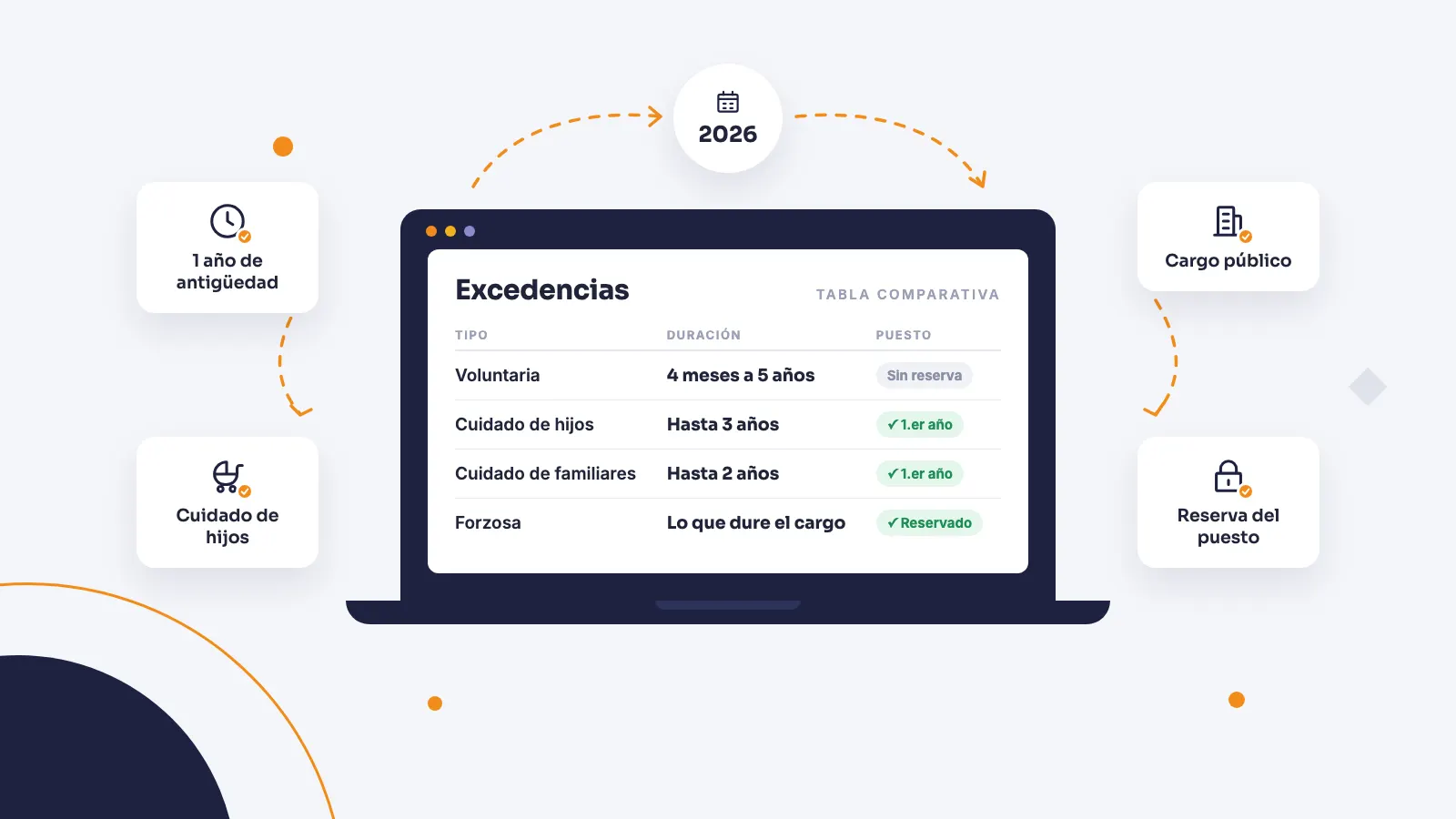
In short. Voluntary leave of absence lasts from 4 months to 5 years, requires one year of service and does not hold the job open: it only gives priority for a vacancy. Childcare leave lasts up to 3 years per child and care of relatives leave up to 2; neither requires any length of service, both count towards seniority and both hold the same job open for the first year. Compulsory leave, for a public or trade union office, lasts as long as the office and keeps the job. None of them pays a salary or unemployment benefit, and only the care ones count as contributions towards a pension.
Types of leave of absence in Spain in 2026, compared
| Type | Duration | Requirement | Job held open | Counts towards seniority | Legal basis |
|---|---|---|---|---|---|
| Voluntary | 4 months to 5 years | 1 year of service, and 4 years since the previous one | No: only priority for a vacancy | No | Art. 46.2 ET |
| Childcare | Up to 3 years per child | None | Yes, for the first year | Yes | Art. 46.3 ET |
| Care of relatives | Up to 2 years, or longer by agreement | None | Yes, for the first year | Yes | Art. 46.3 ET |
| Compulsory | As long as the office lasts | A public or trade union office | Yes, while the office lasts | Yes | Art. 46.1 and 46.4 ET |
| Agreed | Whatever is agreed | Whatever is agreed | As agreed | As agreed | Art. 46.6 ET |
For both types of care leave, the job is held for up to 15 months in a large family of the general category and 18 in the special category, and for childcare also 18 if both parents take it for the same length of time and on the same terms. After that, what is held is a job in the same professional group or an equivalent category. Childcare leave also covers adoption, pre-adoptive placement and permanent foster care.
Two rules apply across the whole table:
- A collective agreement can improve any of these: hold the job open for longer, extend care of relatives leave or create new types. It can never make what the Statute gives any worse.
- During any leave of absence the contract is suspended. Nobody works, no salary is paid and the company pays no social security, but the employee stays on the workforce: there is no final settlement or severance pay when it starts.
Voluntary leave of absence: one year of service and no job held open
This is the one you can take for any reason without justifying it: to study, travel, try another job or start a business. Article 46.2 of the Statute grants it to anyone with at least one year at the company, for between four months and five years.
- The company cannot refuse it if the requirements are met: it is a right, not a favour. What it can require is a written request with the notice set by the collective agreement.
- It cannot be taken back to back. Another voluntary leave of absence requires four years to have passed since the end of the previous one.
- It counts neither towards seniority nor towards a pension: nobody pays contributions for the employee during that time.
- The job is not held open. Article 46.5 only gives a priority right to return to vacancies in the same or a similar category that exist or arise at the company.
What happens on the way back
That priority right is what surprises people most. If there is no vacancy in your category when you ask to return, there is no dismissal and no unemployment benefit: the employee waits, with the contract suspended, until one comes up.
If the company says there is no vacancy and then fills one in your category with somebody else, or flatly denies that you have a right to return, you can make a claim. An outright refusal can be treated as a dismissal, with 20 working days to challenge it, so it is worth speaking to an employment adviser straight away.
And a practical detail: the return has to be requested, in writing and before the leave ends, with the notice set by the collective agreement. Anyone who fails to ask in time risks the company assuming they do not want to come back.
Can you work for another company during voluntary leave?
Generally, yes: that is why many people take it. The limits are whatever is agreed when it is granted and the collective agreement, which sometimes bans working for a competitor while it lasts. If in doubt, put it in writing before you start.
Childcare leave of absence: up to three years, with the job held open for the first
Article 46.3 grants it to care for each child, by birth or adoption, and in pre-adoptive placement or permanent foster care. It lasts up to three years, counted from the birth or from the court or administrative decision, and requires no length of service: it can be requested even by someone who has just joined.
- The same job, held open for the first year. After that, what is held is a job in the same professional group or an equivalent category. In a large family the job is held for up to 15 months (general category) or 18 (special), and also for 18 if both parents take it for the same length of time and on the same terms.
- It counts towards seniority, and the company has to invite the employee to training courses, especially when they come back.
- It can be split into several periods within those three years.
- It is an individual right. If two people at the same company ask for it for the same child, the company can only limit them taking it at the same time for operational reasons justified in writing, and by offering an alternative plan that lets both take it.
- A new child opens a new leave of absence, and its start ends any leave already under way.
For pension purposes, up to three years of this leave per child count as contributions for retirement, permanent disability, death and survivors and birth and childcare benefits, even though nobody actually paid them (article 237 of the General Social Security Act).
Leave of absence to care for a relative: up to two years
It works the same way, but to care for another person who cannot look after themselves because of age, accident, illness or disability, and who has no paid work. Since Royal Decree-Law 5/2023 it covers a spouse and a civil partner, as well as relatives up to the second degree by blood or marriage, including the civil partner’s blood relatives: parents, children, grandparents, grandchildren and siblings, and the same relatives of a spouse, such as parents-in-law or siblings-in-law.
- It lasts up to two years, unless the collective agreement allows longer.
- It requires no length of service, counts towards seniority and holds the same job open for the first year (15 or 18 months in a large family), just like childcare leave.
- For pension purposes the first three years count as contributions, since Royal Decree-Law 2/2023; before that only the first one did. As the law gives two years, in practice the whole period counts, unless a collective agreement extends it beyond three.
Compulsory leave of absence: a public or trade union office
This is the only one that does not depend on wanting to leave: it is granted because the employee is elected or appointed to a public office that prevents them from going to work, such as a full-time mayoralty or a seat in parliament (article 46.1). The same applies to anyone holding an elected trade union office at provincial level or above in one of the most representative unions (article 46.4 of the Statute and 9.1.b of the Organic Law on Freedom of Association).
- It lasts as long as the office and keeps both the job and seniority.
- The return must be requested within a month of leaving office. Asking late puts the job at risk.
- The company can also decide on it in one specific case: when a public duty, such as sitting on a jury in a long trial, prevents work for more than 20% of the hours over three months (article 37.3.d).
Agreed leave of absence
Article 46.6 lets a collective agreement, or an agreement with the company, create other types of leave of absence with their own rules: for study, for volunteering or to care for someone outside the cases the law provides for. Before asking for voluntary leave it is worth checking the collective agreement, because there may be a type with better terms.
What is not a leave of absence
Several arrangements look alike and get confused every day, and each has its own rules:
- Paid leave. Short absences paid by the company, such as 15 days for marriage or 5 for a relative’s hospitalisation. They are all in the paid leave table.
- Parental leave. Up to eight weeks per child, in one go or not, until the child turns eight (article 48 bis). It suspends the contract and holds the job open, but it is unpaid. It is shorter and more flexible than a leave of absence.
- Reduced hours for care. The employee keeps working, just fewer hours, with pay reduced in proportion (article 37.6), until the child turns twelve or for as long as a relative needs care.
- Birth and childcare leave. 19 weeks for each parent since Royal Decree-Law 9/2025, paid by social security: the company does not pay it and it is not a leave of absence.
- Suspension for victims of gender-based or sexual violence. The victim can leave the job with it held open for six months, which a judge can extend up to 18 (article 48.8), and that time counts as contributions and gives the right to unemployment benefit.
- Unpaid time off. A few days or weeks the company grants by agreement, with no specific rules in the Statute.
During the leave: pay, contributions, unemployment and holidays
- No salary and no employer contributions. Social security counts the time on care leave as contributions, within the limits above, but not the time on voluntary leave.
- No unemployment benefit. A leave of absence is not a legal unemployment situation, so it gives no right to the benefit while it lasts.
- No holidays or extra payments building up. Both are earned with time worked. The part of an extra payment already earned is still paid, and outstanding holiday is best taken before the leave starts, because while the contract is alive it cannot be swapped for money.
How to request a leave of absence and how to come back, step by step
- Check the collective agreement. It sets the notice, sometimes improves the duration or how long the job is held, and may have its own types.
- Ask in writing, stating the type, the start date and the end date, and keep a signed copy or proof of receipt.
- For care leave, keep the supporting document: the family book or adoption decision, or the report showing the relative cannot look after themselves.
- Request your return in writing and in time, before the leave ends, or for compulsory leave within a month of leaving office.
- If the company does not answer or says no, get advice straight away from an employment adviser: some deadlines to claim are only 20 working days.
Frequently asked questions
How long does voluntary leave of absence last in Spain?
Between four months and five years. You need at least one year at the company, and four years must pass from the end of one voluntary leave before you can take another.
Is your job held open during voluntary leave of absence?
No. It only gives a priority right to return to a vacancy in the same or a similar category as yours, when there is one. If there is none, you wait with the contract suspended, with no dismissal and no unemployment benefit.
How long is the job held open on childcare leave of absence?
The same job for the first year. After that, a job in the same professional group or an equivalent category. In a large family the job is held for up to 15 months (general) or 18 (special), and also for 18 if both parents take it for the same length of time and on the same terms.
Can you claim unemployment benefit during a leave of absence?
No. A leave of absence suspends the contract, but it is not a legal unemployment situation, so it gives no right to the benefit while it lasts.
Does childcare leave of absence count towards a pension?
Yes. Up to three years per child count as contributions for retirement, permanent disability, death and survivors and birth and childcare benefits, even though nobody actually pays them. For care of relatives, the first three years count.
Do you need a length of service to take leave to care for a relative?
No. Neither care of relatives nor childcare leave requires any length of service. Only voluntary leave requires one year at the company.
Keeping track of leave of absence without spreadsheets
A long leave of absence is easy to lose sight of: it starts one year, ends three years later, and by then whoever approved it may have left. What you need in one place is who asked for it, what type it is, when it starts and ends, who approved it and the document that supports it.
In Quantummycos a leave of absence is just another absence type, like parental leave or care of a relative: it is requested from a phone or a computer, the manager approves it and the record shows who did so and when, and the supporting document is attached to the request itself. While it lasts, the employee shows as absent on the team calendar and nobody marks them as a no-show at Monday’s clock-in.
Do you know how many people on your team are on leave of absence today, and when they come back? If the answer is in an email from two years ago, start for free and have it in view this very week.
Keep reading
- Paid leave in Spain 2026: the full table of days by situation, the short absences the company pays for.
- Holiday entitlement in Spain in 2026, how many days apply and when they expire.
- The hidden cost of absenteeism in Spain, what unmeasured absence costs.
Sources
- Workers’ Statute, consolidated text (BOE), articles 37, 45, 46, 48 and 48 bis.
- General Social Security Act, consolidated text (BOE), articles 165 and 237.
- Organic Law 11/1985 on Freedom of Association (BOE), article 9.
- Royal Decree-Law 5/2023 (BOE), which extends care leave of absence to spouses and civil partners.
- Royal Decree-Law 2/2023 (BOE), which counts the first three years of leave to care for a relative as contributions.
This article is for information only and does not constitute legal advice. A collective agreement may improve these types of leave or create others: always check the consolidated text in force in the BOE and speak to your employment adviser. Last reviewed: October 2026.
- Leave of absence
- Employment law
- Absences
- HR
Frequently asked questions
Between four months and five years. You need at least one year at the company, and four years must pass from the end of one voluntary leave before you can take another.
No. It only gives a priority right to return to a vacancy in the same or a similar category as yours, when there is one. If there is none, you wait with the contract suspended, with no dismissal and no unemployment benefit.
The same job for the first year. After that, a job in the same professional group or an equivalent category. In a large family the job is held for up to 15 months (general) or 18 (special), and also for 18 if both parents take it for the same length of time and on the same terms.
No. A leave of absence suspends the contract, but it is not a legal unemployment situation, so it gives no right to the benefit while it lasts.
Yes. Up to three years per child count as contributions for retirement, permanent disability, death and survivors and birth and childcare benefits, even though nobody actually pays them. For care of relatives, the first three years count.
No. Neither care of relatives nor childcare leave requires any length of service. Only voluntary leave requires one year at the company.