Compliance
Spain’s pay transparency law (Royal Decree-law 39/2026): what every company must do now, with checklist
RDL 39/2026, in force since 19 November 2026, obliges every company to state the pay in job offers, not ask about pay history and answer its workforce within two months. With a template reply, the gap report by headcount, fines and a checklist.
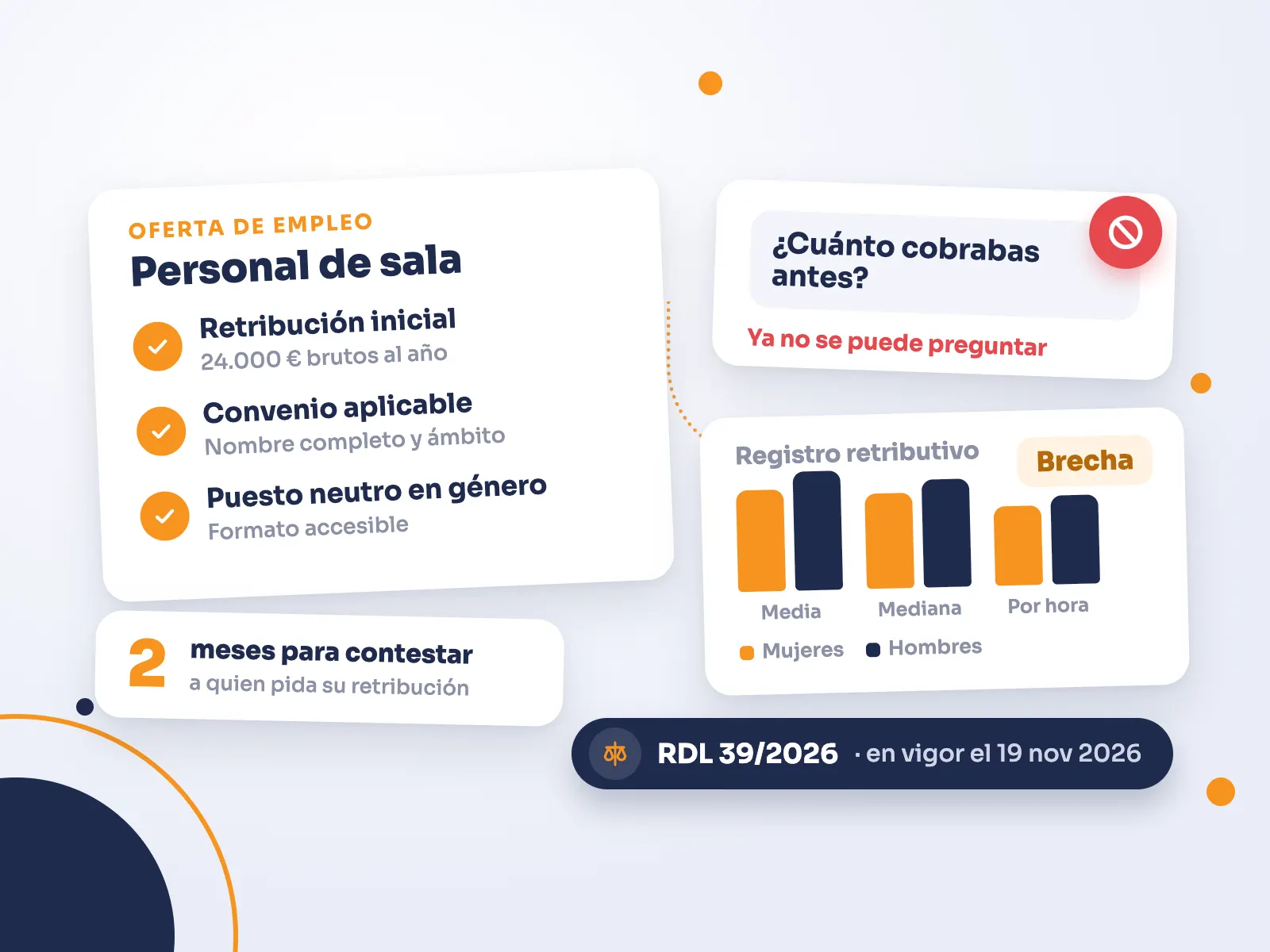
Spain’s pay transparency law is Royal Decree-law 39/2026 (RDL 39/2026) of 17 November, published in the BOE on 18 November and in force since the 19th. It obliges all companies, including those with three employees, to put the pay (the initial remuneration) and the collective agreement in every job offer, not to ask anyone how much they earn or earned, to make known the criteria they use to set pay and to answer in writing, within two months at most, anyone who asks for their pay and the averages for their category by sex.
From 50 employees companies must also report on the pay gap: before 8 June 2027 those with 150 or more and before 8 June 2031 those with 50 to 149.
In short. Since 19 November 2026 every company has to include the initial pay and the collective agreement in job offers, not ask candidates about their pay history, make available to the workforce the criteria it uses to set pay, keep the pay register with the mean and the median also per hour and answer in writing within two months anyone who asks for their pay and the averages for their category. The LISOS punishes as a very serious infringement requesting prohibited data in an intermediation or placement process, with fines of €7,501 to €225,018; it is not confirmed that this covers the question about previous pay.
What is Spain’s pay transparency law (RDL 39/2026) and since when does it apply?
It is the decree-law that transposes Directive (EU) 2023/970 on pay transparency and completes the one on transparent working conditions (2019/1152). To do so it amends the Workers’ Statute (ET), Royal Decree 902/2020 on equal pay, Employment Act 3/2023, Royal Decree 723/2026, the Law on Infringements and Sanctions in the Social Order (LISOS) and the Public Sector Contracts Act.
It has been in force since 19 November 2026 (seventh final provision) and gives no adaptation period for job offers, pay criteria, the register or the right to information (the heading of the first transitional provision speaks of “registers”, but its text only covers audits). The gap report, the pay audits of equality plans already in force and the written information for employment relationships of less than four weeks in force on 19 November have their own rules.
Like any decree-law, it has to be validated by the Congress within thirty working days of its promulgation (article 86.2 of the Constitution). Until it is validated or repealed it is in force; the up-to-date status is in the box above.
What obligations do all companies already have?
| Obligation | What it requires | Where it is |
|---|---|---|
| Job offers | Include the initial pay of the position and the applicable collective agreement. | Art. 5.g of Employment Act 3/2023 |
| Selection | Do not ask about pay history, current or previous. Gender-neutral job ads and job titles, in an accessible format. | Art. 5.g of Employment Act 3/2023 |
| Pay criteria | Make available to the workforce and to their representatives the criteria used to set pay and pay levels, and keep them up to date. | Art. 3.4 of Royal Decree 902/2020 |
| Pay register | Mean and median of what is paid by sex and component, compulsory since 2021. What is new is that they are now also calculated per hour. | Art. 5 of Royal Decree 902/2020 |
| Right to information | Answer in writing, within two months at most, anyone who asks for their pay and the averages by sex for their category. Remind the whole workforce of that right at least once a year. | Art. 10 of Royal Decree 902/2020 |
| Pay secrecy | Clauses that prevent a person from telling what they earn are void. | Art. 28.4 of the Workers’ Statute |
| No retaliation | Any decision that harms someone for claiming their employment rights is void. | Arts. 4.2.h and 17.1 of the Workers’ Statute |
Do job offers have to state the salary?
Yes. The new letter g) of article 5 of the Employment Act says that “job offers must include the initial pay for the position, based on objective and gender-neutral criteria, and the collective agreement that applies”. There are two items and they go in the offer: how much is paid at the start and which agreement governs.
| Not like this | Like this |
|---|---|
| “Salary negotiable” or “competitive pay”. | “Initial pay: €24,000 gross a year (€21,000 base salary and €3,000 position supplement).” |
| Not saying which agreement applies. | “Applicable agreement: [full name of the collective agreement and its scope].” |
| “Waiters wanted.” | “Floor staff wanted.” |
| A form field that asks for current pay. | The form without that field. |
The article speaks of “the initial pay for the position” and does not mention ranges. The Council of Ministers’ note of 17 November says “the initial pay or pay level”, and the European Directive allows a band. As of 20 November there is no criterion from the Labour Inspectorate or official guidance; at least one law firm recommends publishing the amount or a narrow, objective band. The safest course is a gross annual figure, with fixed and variable pay shown separately.
Can you ask a candidate about their previous salary?
No. The same letter g) forbids companies and public or private agents involved in any intermediation or placement process from “asking applicants questions about their pay history in their current or previous employment relationships”. Neither how much they earn nor how much they earned: not in the interview, not in the form, not by email, and not through the agency or consultancy that sends you candidates.
The rule does not mention salary expectations and there is no official criterion: if you decide to ask about them, do so after publishing the initial pay and with a wording that does not ask for pay history, never what they earn or earned.
Neither the law nor the Labour Inspectorate has yet said which infringement applies to asking about pay history. The LISOS classifies as very serious requesting prohibited or personal data in an intermediation or placement process (art. 16.1.c), with fines of €7,501 to €225,018 (art. 40.1.c), but it is not confirmed that this covers this question: it could also fit article 7.11 (serious, €751 to €7,500). Until there is a criterion, treat it as a prohibited question: it is easy to break without noticing, because a single form field is enough. Not giving a job seeker the information the law requires, initial pay included, is a serious infringement (art. 15.1).
How to answer an employee who asks for their pay: deadline and template
Anyone in the workforce can ask for their pay and the averages for their group, category or level by sex, of those doing the same work or work of equal value, and has the right to receive them in writing (art. 10 of Royal Decree 902/2020):
- Who can ask: the person themselves, their legal representatives or the Women’s Institute, once a year or when there are changes that justify it, and someone who has left, in the year after leaving.
- What you answer: their pay broken down (base salary and each supplement) and the averages for their group by sex, annual and per hour.
- Deadline: reasonable and, in any case, within two months of the first request. If they ask for clarification, you have fifteen days.
- Once a year you have to remind the whole workforce that they have this right and how to exercise it.
Template reply to a request for pay information
[First name and surname]:
In reply to your request of [date], we provide in writing the pay information set out in article 10 of Royal Decree 902/2020 and, in addition, the pay criteria of article 3.4.
1. Your individual pay ([period]). Base salary: [amount] euros gross a year. Each salary supplement and each non-salary payment: [amount]. Total: [amount] euros gross a year, [amount] euros gross per hour.
2. Average pay for your [group, category or pay level], made up of the people who do the same work or work of equal value. Women: [amount] euros a year and [amount] euros per hour. Men: [amount] euros a year and [amount] euros per hour.
3. Pay criteria. The pay and level of your position are determined according to [criteria or articles of the collective agreement], which you can consult at [place].
Information about other people may only be used to exercise your right to equal pay. If you consider that this information is inaccurate or incomplete, you may ask us for clarification and we will reply within a maximum of fifteen days.
[Place, date, signature and position]
In a position with only one woman, “the average for women” is her salary under another label: decide with your adviser how to answer without identifying anyone (art. 15 of Royal Decree 902/2020).
Pay register: what changes with RDL 39/2026
Who must keep it and what it contains is in the pay register guide. What is new is this:
- Mean and median per hour, as well as annual, for each component and for each group, category, pay level or position (art. 5.2).
- A new threshold from 100 employees: justification in the register is required from a difference of 5 % (from 50 to 99 employees it remains 25 %) (art. 28.3 of the Statute).
- Four years of retention of the register and the data behind it (art. 5.7).
- Its own infringement: failing to meet its obligations is serious (art. 7.15 of the LISOS).
Who has to produce the pay gap report and when?
| Workforce | What is added to what everyone already has | Gap report to the Commission |
|---|---|---|
| Fewer than 50 | Nothing more: offers, selection, criteria, register and right to information. | No |
| 50 to 99 | Make known the pay progression criteria, if the company has any. Justify in the register a difference of 25 % or more. | Every three years. The first one, before 8 June 2031. |
| 100 to 149 | The progression criteria. Justify in the register a difference of 5 % or more (instead of 25 %). | Every three years. The first one, before 8 June 2031. |
| 150 to 249 | The progression criteria and the justification of a difference of 5 % or more. | Every three years. The first one, before 8 June 2027. |
| 250 or more | The progression criteria and the justification of a difference of 5 % or more. | Every year. The first one, before 8 June 2027. |
The report (art. 11 of Royal Decree 902/2020) is delivered to the Commission for monitoring pay transparency, which the decree-law itself creates, after consulting the legal representatives. It covers the previous calendar year (the annual one) or the previous three years (the three-yearly one), but the decree-law does not say which period the first one covers: confirm it with your adviser before the deadline.
It contains seven items: the gender pay gap, the gap in salary supplements, the median gap, the median gap in supplements, the proportion of women and men who receive supplements, the proportion of each sex in each quartile of the pay band and the gap by category. The last one is also given to the whole workforce, and any difference that is not justified by objective, neutral criteria is corrected within a reasonable period of no more than six months.
Penalties for breaching the pay transparency law
| Conduct | Classification | Fine |
|---|---|---|
| Requesting prohibited or personal data in an intermediation or placement process (art. 16.1.c of the LISOS) | Very serious | €7,501 to €225,018 |
| Harming someone for claiming their rights (art. 8.12 bis) | Very serious | €7,501 to €225,018 |
| Not giving a job seeker the required information (art. 15.1) | Serious | €751 to €7,500 |
| Failing to meet the obligations of the pay register (art. 7.15) | Serious | €751 to €7,500 |
| Failing to meet the reporting obligations to the Commission: the gap and, if there is an audit, its notification (art. 7.16) | Serious | €751 to €7,500 |
These are the amounts in article 40.1 of the LISOS, which grades each band into minimum, medium and maximum. The decree-law does not classify separately failing to answer a request for information, not making the criteria available or signing a pay secrecy clause (void, but with no fine of its own): the most reasonable reading is article 7.11 (serious, failing the duty to inform the workforce), although the Labour Inspectorate and the courts have not yet confirmed it. And a company that contracts with the public sector can lose the contract if a final decision establishes pay discrimination affecting those who carry it out, or if, after a formal notice, it does not correct repeated non-compliance with transparency (art. 211.1.j of the Public Sector Contracts Act).
What else changes in the same decree-law
The decree-law also reforms the written information about the contract (no four-week minimum and a serious infringement, in the guide to Royal Decree 723/2026), the probationary period (art. 14 of the Statute) and the move to a more stable job in the cases covered by the new article 21 bis, which the company answers with reasons and in writing within one month (three if the workforce has no more than ten people).
Checklist: what to do now
- Review your open job offers and your offer template: initial pay, collective agreement and a neutral job title.
- Remove from forms and interviews any question about current or previous pay, and tell those who interview and the agencies you work with.
- Gather the criteria you use to set pay and levels and make them available to the workforce (if the collective agreement sets them, it is enough to cite its articles).
- Prepare the pay register with annual and per-hour mean and median and, from 50 employees, check whether the difference reaches 25 % (50 to 99) or 5 % (from 100).
- Decide who answers requests, within what time and with what template, and note the date of each one.
- Tell the workforce that they can ask for their pay and the averages, and how.
- Review contracts and agreements: a clause that prevents people from telling what they earn is void.
- From 50 employees, put the date of your first gap report in the calendar.
How Quantummycos handles it
Quantummycos does not publish job offers or select candidates: that stays with the company or its job board. What it does is calculate the pay register from the payslips you already have and prepare your replies to the workforce, with the Professional plan:
- The register, without spreadsheets. Each person’s pay is stored by component in their record: the AI fills in almost everything by reading the payslip your payroll adviser already produces (variable pay is typed in by hand) and you review it before saving. In Reports you get the mean and the median by sex and position for each component (base salary, supplements, variable pay and benefits in kind) in annual figures and, for the total, also per hour, in PDF for the legal representatives and in Excel. It flags the 25 % difference in companies with 50 or more employees; the 5 % threshold from 100 employees is not yet flagged by the report, so check it yourself.
- The reply to each employee. By choosing the person in the report, you get their written reply: their pay (base hourly rate, supplements and total) and the mean and median per hour of their position for their sex and for the other, calculated with the people who have salary and hours in their record. If the position has fewer than three women or three men the averages are not printed and you have to reply by hand.
- The data for the gap report. The internal export calculates the mean and median gap, the supplements gap, the quartiles and the gap by category, without names.
The rest is still up to the company: writing the offers, not asking about pay history, drafting the criteria (with the file repository you can leave them where the whole workforce can read them), consulting the legal representatives and sending the report to the Commission, which Quantummycos does not do.
The pay register is in the Professional plan (the free plan does not include it). Book a demo and we will set it up with the payslips you already have, see the pricing or see how the pay register works.
Keep reading
- Spain’s pay register 2026: who must keep it and how to do it step by step.
- Royal Decree 723/2026: the written information you must give each employee.
- Employer obligations in Spain by headcount (2026).
Sources
- Royal Decree-law 39/2026 of 17 November amending the Workers’ Statute, Royal Decree 902/2020, Employment Act 3/2023 and Royal Decree 723/2026 (BOE).
- Royal Decree 902/2020 on equal pay between women and men, consolidated text (BOE), articles 2 bis, 3, 5, 6, 10, 11, 14 and 15.
- Workers’ Statute, consolidated text (BOE), articles 4.2.h, 8.5, 14, 17.1, 21 bis, 28 and 59.3.
- Employment Act 3/2023, consolidated text (BOE), article 5.g.
- Law on Infringements and Sanctions in the Social Order, consolidated text (BOE), articles 7, 8, 15, 16 and 40.
- Spanish Constitution (BOE), article 86.
- Directive (EU) 2023/970 on strengthening the application of the principle of equal pay (EUR-Lex).
- Council of Ministers briefing of 17 November 2026 (La Moncloa).
This article is for information only and is not legal advice. The collective agreement and rules still being processed can change what is explained here: always check the current text in the BOE and consult your labour adviser. Last reviewed: 20 November 2026.
- Employment law
- Pay register
- Equal pay
- Compliance
Frequently asked questions
It is Royal Decree-law 39/2026 of 17 November, published in the BOE on the 18th and in force since 19 November 2026. It transposes Directive (EU) 2023/970 and amends the Workers’ Statute, Royal Decree 902/2020, the Employment Act and other rules. It has to be validated by the Congress (now, with the Cortes dissolved, the Standing Committee); if repealed, it would stop applying going forward.
Since 19 November 2026, with no adaptation period for job offers, the register, pay criteria or the right to information. The gap report (before 8 June 2027 from 150 employees and before 8 June 2031 for 50 to 149) and the audits of equality plans already in force have their own calendar, and those audits adapt when the plan expires or has to be reviewed.
Yes, in every company and with no headcount threshold: job offers must include the initial pay for the position, based on objective and gender-neutral criteria, and the applicable collective agreement (article 5.g of Law 3/2023). The text does not mention ranges: the safest option is to publish a gross annual amount.
No. It is forbidden to ask about pay history, current or previous, of anyone applying for a position, for companies and for agents involved in any intermediation or placement process alike (article 5.g of Law 3/2023). The LISOS (Law on Infringements and Sanctions in the Social Order) classifies as very serious requesting prohibited data in an intermediation or placement process (€7,501 to €225,018), but there is not yet an official criterion on whether it includes this question.
Almost everything: job offers with initial pay and agreement, not asking about pay history, keeping the pay criteria available to the workforce, keeping the pay register with annual and per-hour mean and median and answering in writing anyone who asks for their pay. From 50 employees come making known the pay progression criteria, justifying in the register a difference of 25 % or more between sexes and the gap report; from 100, the justification is required from 5 %.
A reasonable period and, in any case, the two months following the first request (article 10 of Royal Decree 902/2020). If the person asks for clarification, fifteen days. You must give their pay broken down and the averages for their group by sex, annual and per hour.
Those with 50 or more employees: every year for those with 250 or more and every three years for those with 50 to 249. The first one is due before 8 June 2027 from 150 employees and before 8 June 2031 for 50 to 149. It is delivered to the Commission for monitoring pay transparency, after consulting the legal representatives.
Serious, €751 to €7,500: not giving a job seeker the required information (article 15.1 of the LISOS), failing to meet the pay register obligations (article 7.15) or failing to meet the reporting obligations to the Commission (article 7.16). Very serious, €7,501 to €225,018: requesting prohibited data in an intermediation or placement process (article 16.1.c) and harming someone for claiming their rights (article 8.12 bis). The LISOS is the Law on Infringements and Sanctions in the Social Order.
One that stores each person’s pay by component and calculates the mean and median gap, the supplements gap, the quartiles and the gap by category. Quantummycos does it with the payslips you have already uploaded (Professional plan): pay is largely filled in by reading the payslip with AI and reviewed before saving; sending the report to the Commission remains the company’s job.