Compliance
Spain’s pay register 2026 (registro retributivo): what it is, who needs one and how to build it
Royal Decree 902/2020 requires it from every company in Spain, from the first hire, and hardly any SME keeps it up to date. What it contains, who can see it, the 25 % gap, the fines and what changes with the EU Pay Transparency Directive.
The pay register (registro retributivo) is the document in which a Spanish company records, broken down by sex, what its staff are paid: the mean and the median of each pay component (base salary, each complement and each non-salary payment), by professional group, category or job. Article 28.2 of the Workers’ Statute and Royal Decree 902/2020 require it from every company in Spain, including those with a single employee.
Here is what it contains, who can see it, when a 25 % difference has to be justified, the fines for not having one and what changes with the EU Pay Transparency Directive, with an example and the steps to build it.
In short. The pay register has been mandatory for every company in Spain since 14 April 2021, covering the whole workforce, managers included. It records the mean and the median of what was actually paid, broken down by sex, by group, category or job and by each pay component. It is normally prepared per calendar year, the workers’ legal representatives must be consulted beforehand (at least ten days), and in companies with 50 or more staff a difference of 25 % between the sexes must be justified in the register itself.
What the pay register is (registro retributivo or registro salarial)
It is the tool through which the law wants it to be visible whether women and men are paid the same for the same work or for work of equal value. It is not a list of salaries with names: it is averages grouped by category and split by sex, which reveal a difference without singling anyone out.
The duty was added to article 28.2 of the Workers’ Statute by Royal Decree-law 6/2019 and is developed by Royal Decree 902/2020 on equal pay between women and men, in force since 14 April 2021. In practice it is called both registro retributivo and registro salarial: it is the same document.
Who must keep one
Every company, with no headcount threshold and no sector exemption. Article 5.1 of Royal Decree 902/2020 is unambiguous: the register must cover the whole workforce, including managers and senior executives. A company of three needs it just as much as one of three thousand.
What changes with size is what is required on top:
- From 50 staff, a difference of 25 % or more between the sexes must be justified in the register itself (article 28.3 of the Workers’ Statute).
- Companies with an equality plan, also mandatory from 50 staff, keep a more detailed register, by work of equal value, and carry out a pay audit.
What it must include
The register records the average values of salaries, salary complements and non-salary payments, broken down by sex (article 5.2 of Royal Decree 902/2020). For each component it shows the arithmetic mean and the median of what was actually paid, in each professional group, category, level, job or whatever classification system the collective agreement uses.
| Component | What it covers | Examples |
|---|---|---|
| Base salary | The fixed pay the collective agreement sets for each group or category | The base salary of group 3 of the agreement |
| Salary complements | Each complement separately, not added into a single figure | Seniority, night work, shift work, agreement bonus, incentives, extra payments |
| Non-salary payments | What is paid but is not salary, each one separately | Allowances, transport bonus, relocation compensation |
| Mean and median | Both figures for each component, for women and for men | A mean of €24,300 and a median of €24,100 |
| Grouping | The company’s or the collective agreement’s classification system | Professional group, category, level or job |
| Period | As a rule, the calendar year | 1 January to 31 December 2025 |
The median matters as much as the mean: a couple of very high salaries push a group’s mean up while the median stays put. When the two tell different stories, that difference already says something.
One detail changes the result: part-time work. If a category has more women working part time, the annual average of what was paid comes out lower even if they earn the same per hour. That is why the usual practice is to convert amounts to full time and a full year, as the tool provided to companies by the Ministry of Labour and the Women’s Institute allows, or to compare per hour directly.
A pay register example
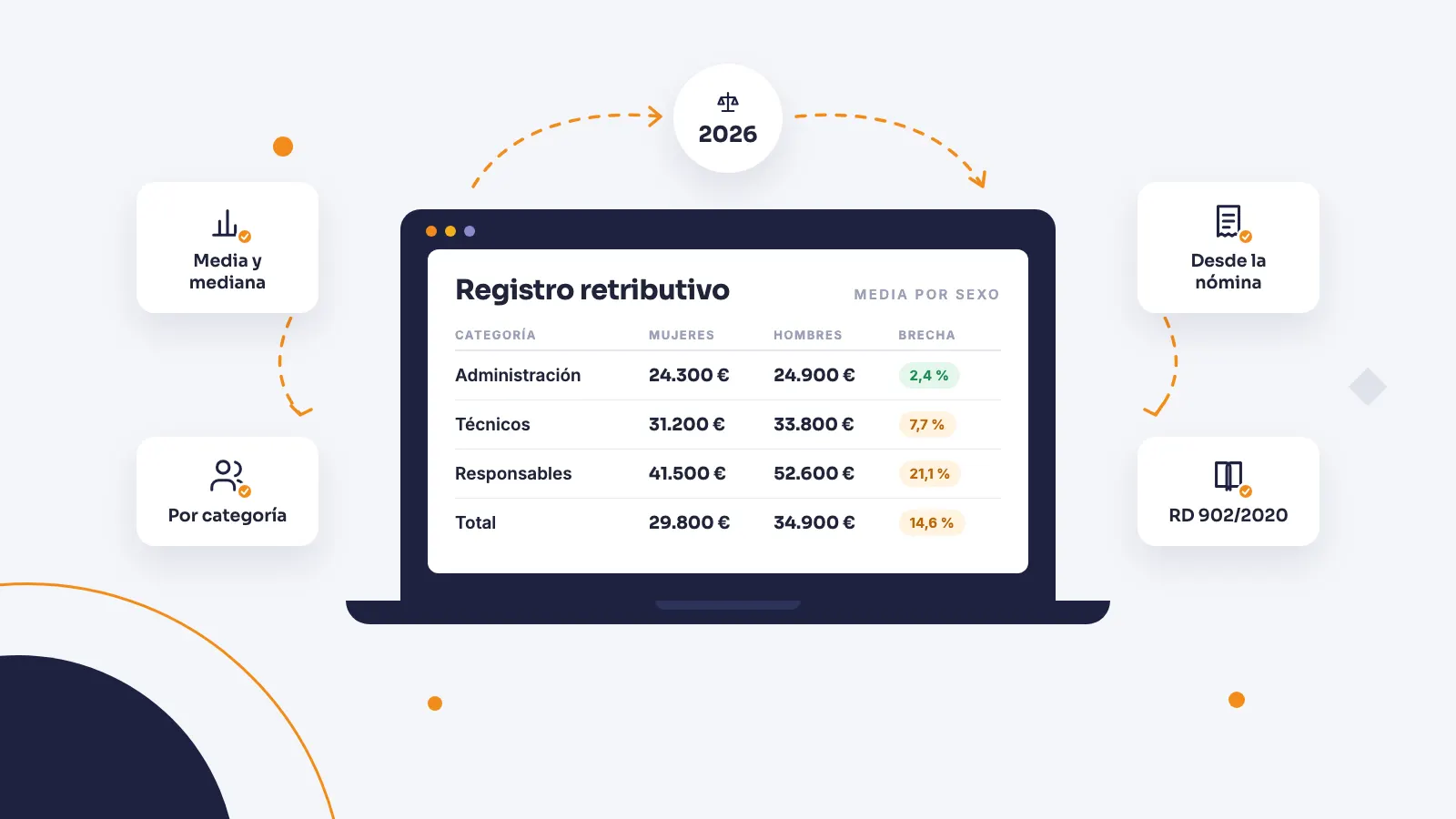
This is the summary for a company of 60 staff, with total annual pay already converted to full time. The figures are illustrative; in a real register each component has its own table.
| Category | Women, mean | Men, mean | Women, median | Men, median | Gap in the mean |
|---|---|---|---|---|---|
| Administration | €24,300 | €24,900 | €24,100 | €24,600 | 2.4 % |
| Technical staff | €31,200 | €33,800 | €30,900 | €33,100 | 7.7 % |
| Managers | €41,500 | €52,600 | €40,800 | €50,900 | 21.1 % |
| Total | €29,800 | €34,900 | €27,600 | €32,500 | 14.6 % |
The gap is expressed as a percentage of the men’s mean, which is how the EU Directive defines it. In this example the overall gap is 14.6 %: below 25 %, so it does not have to be justified, but the managers’ category deserves a careful look. If that difference comes from seniority or a job-specific complement, it is worth being able to explain it before anyone asks.
The 25 % gap: when it has to be justified
Article 28.3 of the Workers’ Statute provides that, in a company with at least 50 staff, when the average pay of one sex exceeds that of the other by 25 % or more, taking the total payroll or the average of what was paid, the company must include in the register a justification that the difference is due to reasons unrelated to sex.
Justifying it does not mean writing “we pay according to the agreement”. It means explaining what causes the difference (seniority, the complements of a specific job, more contracted hours) and showing that the cause does not hide discrimination. If it cannot be explained, it has to be corrected.
With an equality plan: the register with a pay audit
Companies required to have an equality plan, all those with 50 or more staff, must also carry out a pay audit (Royal Decree 901/2020 and articles 7 and 8 of Royal Decree 902/2020). Their pay register is more demanding: on top of the above, it records the means and medians of groupings of work of equal value, which come from a job evaluation (article 6).
A job evaluation compares what each job demands (training, responsibility, effort, conditions) using sex-neutral criteria. It is what makes it possible to argue that two jobs with different names are worth the same and should therefore be paid the same.
Who can see it and how it is handed over
- The workers’ legal representatives are entitled to access the full register, and must be consulted at least ten days before it is prepared (article 5.6 of Royal Decree 902/2020).
- Where there are no representatives, the person who asks receives only the percentage differences between the average pay of women and men, broken down by component and category (article 5.3).
- The Labour Inspectorate can ask for it at any time.
Because this is salary data, small groups need care: in a category with a single woman, “the women’s average” is her salary under another label. Grouping those figures or withholding them protects that person without making the register any less useful.
How often it is updated
The reference period is, as a rule, the calendar year (article 5.4), and the register must be redone whenever one of its elements changes substantially: a collective agreement pay rise, a reorganisation of categories or a large change in the workforce. Throughout 2026, then, what a company should have is the register with its 2025 data.
The fines for not having one
Not having a pay register, or having an incomplete one, is usually sanctioned as a serious infringement under article 7.13 of the LISOS, which penalises breaching the equality duties of the Workers’ Statute: €751 to €7,500. If what lies behind it is pay discrimination on grounds of sex, the infringement is very serious (article 8.12), with fines of €7,501 to €225,018, on top of any pay differences that have to be paid.
What is coming: the EU Pay Transparency Directive
Directive (EU) 2023/970 strengthens equal pay through transparency measures, and Member States had until 7 June 2026 to transpose it. Spain has not yet transposed it in full: the Ministry of Labour is processing a draft royal decree amending Royal Decree 902/2020, dated 3 August 2026 and under public consultation as of October 2026, which may still change. Until it is approved, what can be required of a private company is what the Workers’ Statute and Royal Decree 902/2020 already say, but it is worth preparing, because the draft provides, among other things, for:
- A right to information: each person will be able to request in writing their own pay and the average pay of those doing the same work or work of equal value, broken down by sex, per year and per hour. The company will have two months to reply and must remind staff of that right every year.
- Clear pay criteria: the company will have to explain to staff the objective, gender-neutral criteria it uses to set pay and, from 50 staff, its progression criteria too.
- An end to pay secrecy clauses: nobody will be able to stop a person from disclosing what they earn.
- Gender pay gap reports: the Directive requires them from 100 staff (every year from 250 and every three years below that, with the first reports due on 7 June 2027 from 150 staff and on 7 June 2031 for 100 to 149), and the Spanish draft plans to extend them to companies with 50 or more.
For now the draft leaves out two measures of the Directive that will have to arrive by another route: publishing the pay range in job adverts and banning questions about a candidate’s pay history. It should not be confused with Royal Decree 723/2026, applicable since 5 October 2026, which requires every person to be told in writing the amount and composition of their pay: that transposes a different directive, the one on transparent working conditions.
How to build the pay register, step by step
- Gather what was paid during the year to each person, the whole workforce and managers included, with each component kept separate.
- Classify each component as base salary, salary complement or non-salary payment, without merging them into a single figure.
- Group people according to the collective agreement’s classification system: professional group, category, level or job.
- Convert part-time work to full time and a full year, or compare per hour, so that working hours are not mistaken for pay.
- Work out the mean and the median of each component, for women and for men, in each grouping.
- Check the overall gap: with 50 or more staff, if it reaches 25 %, write the justification into the register itself.
- Consult the legal representatives at least ten days before finalising it, and keep a record.
- Keep it and update it every calendar year and whenever something substantial changes, and hand it to whoever is entitled to see it on the terms of article 5.3.
Frequently asked questions
What is the pay register (registro retributivo)?
It is the document that records, broken down by sex, the mean and the median of what staff are paid for each component (base salary, each complement and each non-salary payment) and by group, category or job. Article 28.2 of the Workers’ Statute and Royal Decree 902/2020 require it.
Which companies must keep a pay register?
Every company in Spain, whatever its size, covering the whole workforce including managers and senior executives. A company with a single employee needs one too.
How often must the pay register be prepared?
The reference period is, as a rule, the calendar year, and it must be redone whenever something substantial changes, such as a collective agreement pay rise or a reorganisation of categories.
Can employees see the pay register?
The workers’ legal representatives have access to the full register and must be consulted at least ten days before it is prepared. Where there are no representatives, the person who asks receives the percentage differences between the average pay of women and men, not each individual figure.
When does the gender pay gap have to be justified?
In companies with 50 or more staff, when the average pay of one sex exceeds that of the other by 25 % or more, whether over the total payroll or the average of what was paid. The justification goes in the register itself and must explain why the difference has nothing to do with sex.
What is the fine for not having a pay register?
The Labour Inspectorate usually treats it as a serious infringement under the LISOS (article 7.13), with fines of €751 to €7,500. If there is pay discrimination on grounds of sex behind it, the infringement is very serious (article 8.12), from €7,501 to €225,018.
What is the difference between a pay register and a pay audit?
Every company needs the register, which shows the averages by sex. The pay audit is only mandatory for companies with an equality plan (50 or more staff); it is part of that plan and adds a job evaluation and a plan to correct the differences.
What software helps prepare the pay register?
One that keeps each person’s pay split by component and works out the mean and the median by sex and category from it. In Quantummycos pay is filled in by reading, with AI, the payslip your accountant already produces, and the register comes out of Reports as a PDF for the workers’ representatives and in Excel.
The pay register, without spreadsheets
The hard part of the pay register is not the formulas but having the data: salaries live in the payslips the accountant sends as PDFs, and copying them every year into a spreadsheet by component is an afternoon of typing figures that go stale as soon as someone gets a new complement.
In Quantummycos each person’s pay is stored by component on their profile, and nobody has to type it in: you upload the payslip your accountant already produces and AI fills in the base salary, complements, pay in kind, gross, net and company cost for you to check. From that data, Reports produces the register: the mean and the median by sex, per hour and per year, with base salary and complements kept apart, by category, with quartiles, the gap and the 25 % and 5 % thresholds flagged, as a PDF ready to hand to the workers’ representatives and in Excel to work with. The document names nobody, categories with fewer than three people of one sex are withheld, and salaries are only seen by whoever runs the company. And every employee has their payslips on the portal and their phone.
Could you show your 2025 pay register today if the Labour Inspectorate asked for it? If the answer is “we would have to put it together”, have it ready from the payslips you already have.
Keep reading
- What an employee really costs a company in Spain in 2026, from gross salary to total cost.
- Gender pay gap and pay audit, explained in the HR dictionary.
- 7 HR software options for SMEs in Spain in 2026, compared on criteria built for a Spanish SME.
Sources
- Workers’ Statute, consolidated text (BOE), article 28.
- Royal Decree 902/2020 on equal pay between women and men (BOE), articles 4 to 8.
- Royal Decree 901/2020 on equality plans (BOE).
- Law on Infringements and Penalties in the Social Order (LISOS), consolidated text (BOE), articles 7.13, 8.12 and 40.
- Directive (EU) 2023/970 on pay transparency (EUR-Lex).
- Draft Royal Decree amending Royal Decree 902/2020 (Ministry of Labour, 3 August 2026).
This article is for information only and is not legal advice. Collective agreements and rules still being processed can change what is explained here: always check the text in force in the BOE and consult your employment adviser. Last reviewed: October 2026.
- Pay register
- Equal pay
- Payroll
- Employment law
Frequently asked questions
It is the document that records, broken down by sex, the mean and the median of what staff are paid for each component (base salary, each complement and each non-salary payment) and by group, category or job. Article 28.2 of the Workers’ Statute and Royal Decree 902/2020 require it.
Every company in Spain, whatever its size, covering the whole workforce including managers and senior executives. A company with a single employee needs one too.
The reference period is, as a rule, the calendar year, and it must be redone whenever something substantial changes, such as a collective agreement pay rise or a reorganisation of categories.
The workers’ legal representatives have access to the full register and must be consulted at least ten days before it is prepared. Where there are no representatives, the person who asks receives the percentage differences between the average pay of women and men, not each individual figure.
In companies with 50 or more staff, when the average pay of one sex exceeds that of the other by 25 % or more, whether over the total payroll or the average of what was paid. The justification goes in the register itself and must explain why the difference has nothing to do with sex.
The Labour Inspectorate usually treats it as a serious infringement under the LISOS (article 7.13), with fines of €751 to €7,500. If there is pay discrimination on grounds of sex behind it, the infringement is very serious (article 8.12), from €7,501 to €225,018.
Every company needs the register, which shows the averages by sex. The pay audit is only mandatory for companies with an equality plan (50 or more staff); it is part of that plan and adds a job evaluation and a plan to correct the differences.
One that keeps each person’s pay split by component and works out the mean and the median by sex and category from it. In Quantummycos pay is filled in by reading, with AI, the payslip your accountant already produces, and the register comes out of Reports as a PDF for the workers’ representatives and in Excel.