Compliance
Spain’s minimum wage in 2027: how much it is, when it is approved and what your company should check
Spain’s minimum wage is €1,221 a month in 14 payments today. The 2027 draft proposes a 5.3 % rise, to €1,286, and has not been approved yet. The monthly, daily and hourly figures, part-time examples, how bonuses absorb the rise and what your company should check.
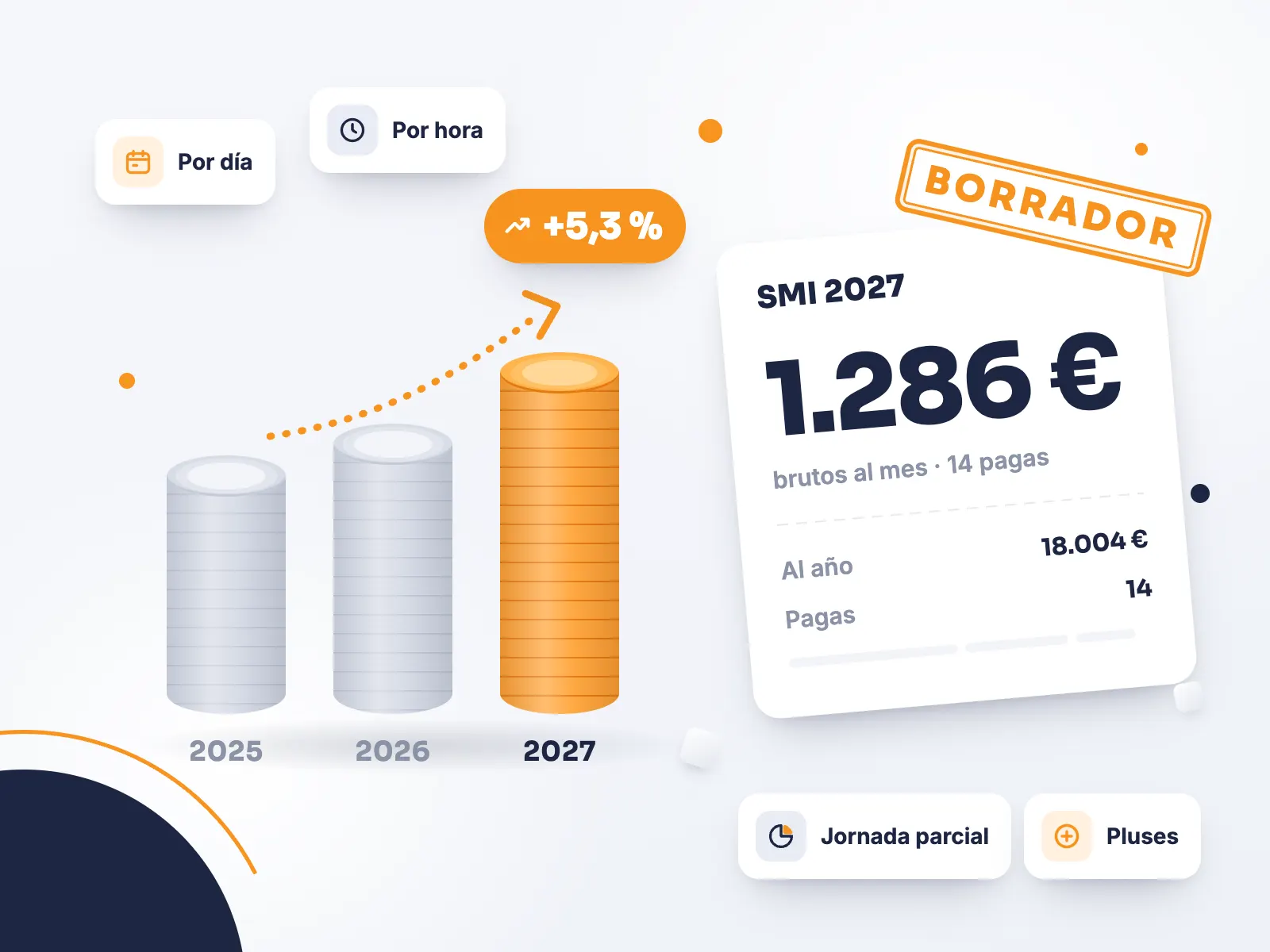
The minimum wage in Spain (salario mínimo interprofesional, SMI) is currently €1,221 gross a month in 14 payments, €17,094 a year, under Royal Decree 126/2026, and it applies until 31 December 2026. For the 2027 minimum wage, the government proposes €1,286 a month in 14 payments, €18,004 a year, a 5.3 % rise, but it is only a draft: it has not been approved yet and it is open to public hearing until 16 November.
The government wants to approve it before the general election on 29 November. If it goes ahead as drafted, it will apply from 1 January 2027, even if it is published later; until then, the minimum is the 2026 one. We will update this page on the day it is published in the BOE.
In short. Today the minimum wage in Spain is €1,221 a month in 14 payments (€1,424.50 with the extra payments spread over 12 months), €40.70 a day and €17,094 a year. For 2027, the draft, not yet approved, proposes €1,286 a month (€1,500.33 with the extra payments spread out), €42.87 a day and €18,004 a year from 1 January. Under the draft, fixed-term contracts of up to 120 days would pay at least €60.88 per working day and domestic work paid by the hour, €10.06 an hour. Part-time work is paid pro rata, and a rise would only be needed for someone who, on a full-time basis, does not reach €18,004 adding up their base salary and salary complements for the year.
What is the minimum wage in Spain now?
The one in force is the 2026 minimum wage, set by Royal Decree 126/2026 with effect from 1 January 2026:
- Per month, in 14 payments: €1,221 gross.
- Per month, with the extra payments spread over 12: €1,424.50.
- Per day: €40.70.
- Per year: €17,094.
That is the minimum that must be paid until 31 December 2026. What the draft proposes for 2027 comes right below.
Minimum wage 2027: how much will it be under the draft?
The draft sets the 2027 minimum wage at €42.87 a day or €1,286 a month, and the annual minimum against which every salary is compared at €18,004 (articles 1 and 3). Compared with the 2026 minimum wage, which is in force:
| Item | 2026 (in force) | 2027 (under the draft) | Difference |
|---|---|---|---|
| Per month, 14 payments | €1,221 | €1,286 | +€65 |
| Per month, 12 payments (extras spread out) | €1,424.50 | €1,500.33 | +€75.83 |
| Per year | €17,094 | €18,004 | +€910 |
| Per day | €40.70 | €42.87 | +€2.17 |
| Per hour (1,826 hours a year) | €9.36 | €9.86 | +€0.50 |
| Fixed-term contracts of up to 120 days, per working day | €57.82 | €60.88 | +€3.06 |
| Domestic work paid by the hour | €9.55 | €10.06 | +€0.51 |
The 12-payment and hourly rows are calculations from the annual minimum. Article 1 also sets three rules: pay in kind can never reduce the minimum paid in money, the daily figure does not include the share of Sundays and public holidays, and a working day shorter than the legal one is paid pro rata.
Fixed-term contracts of up to 120 days and domestic work
For fixed-term contracts of up to 120 days with the same company (what are usually called casual and seasonal workers, eventuales y temporeros), the draft sets a minimum of €60.88 per legal working day, with the share of Sundays, public holidays and extra payments already included; annual leave not taken during the contract is paid separately. For live-out domestic workers paid by the hour, €10.06 per hour actually worked, everything included (article 4).
When will the 2027 minimum wage be approved?
There is no official date. What is known as of 8 November 2026:
- 3 November. The advisory committee of experts proposes a 4.9 % rise, to €1,281 a month.
- 4 November. The government puts 5.3 % to the unions and employers’ organisations and publishes the draft.
- 16 November. The period for comments ends.
- 17 November. The first possible Council of Ministers after that period, according to the press, with no official notice. The last Tuesday before the election on the 29th is the 24th.
- 1 January 2027. Entry into force set in the draft.
It does not have the support of the unions, which wanted 7 %, or of the employers’ organisations, which called it electioneering. It does not need it: article 27.1 of the Workers’ Statute only requires the government to consult them.
Why a 5.3 % rise?
The government starts from the 4.9 % the experts proposed, which is the flash inflation figure for October, and adds 0.4 points for the purchasing power lost in 2026: average inflation up to October (3.5 %) was higher than that year’s rise (3.1 %). Applied to €1,221, it gives €1,285.71, rounded to €1,286.
And if it is not approved before the election?
A caretaker government can approve it too: that is how the 2016 minimum wage was approved, on 29 December 2015. If it came after 1 January, the precedent is 2026: the decree appeared in the BOE on 19 February with effect from 1 January, and the arrears had to be paid. In the meantime, the prudent course is to pay at least the 2026 minimum wage.
How much will the 2027 minimum wage be per hour?
There is no general official figure: the decree sets pay per day and per month, and only domestic work has an hourly rate. It is worked out like this:
Minimum wage per hour = €18,004 ÷ annual full-time hours in your collective agreement
For 40 hours a week, 1,826 hours a year is the usual figure, which gives €9.86 gross an hour, with the share of the extra payments included. If your agreement sets fewer hours, the hourly rate goes up:
| Annual full-time hours in the agreement | 2027 minimum wage per hour, under the draft |
|---|---|
| 1,826 hours (40 a week) | €9.86 |
| 1,800 hours | €10.00 |
| 1,780 hours | €10.11 |
| 1,760 hours | €10.23 |
| 1,720 hours | €10.47 |
| 1,700 hours | €10.59 |
How much is the 2027 minimum wage for part-time work?
With fewer hours than full time, the minimum wage is paid pro rata:
Part-time minimum wage = minimum wage × contracted hours ÷ full-time reference hours
With a 40-hour full-time week, under the draft:
| Hours a week | Per month, 14 payments | Per month, 12 payments | Per year |
|---|---|---|---|
| 10 | €321.50 | €375.08 | €4,501 |
| 15 | €482.25 | €562.63 | €6,751.50 |
| 20 (half time) | €643 | €750.17 | €9,002 |
| 25 | €803.75 | €937.71 | €11,252.50 |
| 30 | €964.50 | €1,125.25 | €13,503 |
| 35 | €1,125.25 | €1,312.79 | €15,753.50 |
Example 1. 20 hours a week in a company with a 40-hour full-time week: 1,286 × 20 ÷ 40 = €643 a month in 14 payments, €9,002 a year.
Example 2. The Workers’ Statute compares part-time work with a comparable full-time employee or, if there is none, with the full-time hours in the collective agreement (article 12.1). With a 37.5-hour agreement, the prudent course is to divide by 37.5: with 30 hours, 1,286 × 30 ÷ 37.5 = €1,028.80 a month, €64.30 more than on 40.
Without a daily record, full time is presumed
Part-time working hours are recorded day by day and totalled each month, and the summary is handed over with the payslip. Without that record, the contract is presumed to be full time unless proven otherwise (article 12.4.c of the Workers’ Statute), and the employee can claim the whole minimum wage. In Quantummycos, the daily record is on every plan: each person clocks in on the web or in the app, and with Analytics and reporting (Professional and Enterprise plans) each person’s monthly summary comes out as a PDF with a “Received” box for their signature.
Training contracts cannot pay less than the minimum wage in proportion to the time actually worked either (article 11).
Can bonuses absorb the minimum wage rise?
Yes. Under the current rules, which the draft keeps, the rise does not affect anyone already paid more than the minimum “as a whole and on an annual basis” (article 27.1 of the Workers’ Statute): everything they earn “for all items” is added up, on a full-time basis, and compared with €18,004. The pay tables in the collective agreement stay in force, and only those who fall short get a rise, by whatever they are missing (article 3 of the draft).
- What counts: base salary, extra payments and salary complements, seniority included, unless the collective agreement clearly and expressly excludes them for minimum wage purposes too (Supreme Court rulings 74/2022 of 26 January and 200/2025 of 25 March).
- What does not count: non-salary items, such as subsistence allowances or a travel allowance that covers expenses (Supreme Court ruling of 7 March 2024).
- Nor does pay in kind, because the minimum is paid in money.
An example with three payslips
With the draft’s annual minimum, €18,004:
| Full time | Ana | Luis | Marta |
|---|---|---|---|
| Base salary | €1,100 × 14 = €15,400 | €1,100 × 14 = €15,400 | €1,150 × 14 = €16,100 |
| Salary complements | Agreement bonus: €150 × 14 = €2,100 | Agreement bonus: €150 × 14 = €2,100 | Seniority (€80) and agreement bonus (€100): €180 × 14 = €2,520 |
| Travel allowance (non-salary) | None | €100 × 11 = €1,100 | None |
| What counts for the minimum wage | €17,500 | €17,500 | €18,620 |
| Would they need a rise in 2027? | Yes: €504 a year, €36 per payment | Yes: €504 a year, the travel allowance does not count | No: already above €18,004 |
Under the 2026 minimum wage none of them needed a rise. If the draft is approved, Ana and Luis would not get €65 more a month, but whatever they are missing to reach the annual minimum. If Marta’s collective agreement excluded seniority, she would also be €504 short.
The pending reform
A draft royal decree that the Ministry of Labour put to public hearing in March 2026 would take out of this comparison, among others, night, shift and hazard bonuses, seniority, incentives and commissions. It has not been approved or published in the BOE, the government postponed it to 2027 in September and it is not in the minimum wage draft. If it goes ahead, it will change who has to get a rise.
How much is the 2027 minimum wage net, and what does it cost the company?
In 2027 the Intergenerational Equity Mechanism (MEI) rises by law to 1 %: 0.83 % paid by the company and 0.17 % by the employee, who on a permanent contract contributes 6.52 % in total on the annual minimum divided by 12, €1,500.33. With the other 2026 rates:
| Item | 2026 | 2027 (under the draft) |
|---|---|---|
| Employee contributions per month | €92.59 | €97.82 |
| Net pay in each ordinary month, 14 payments, before income tax | €1,128.41 | €1,188.18 |
| Net pay in each extra payment, before income tax | €1,221 | €1,286 |
| Employer contributions per year | €5,495.72 | €5,802.69 |
| Total cost to the company per year | €22,589.72 | €23,806.69 |
The cost assumes office work (1.50 % for work accidents): the company pays 32.23 %, €1,216.97 more a year for each person on the minimum wage. The minimum contribution base is the minimum wage plus one sixth (article 19.2 of the General Social Security Act), so it will be around €1,500 a month; the exact figure will be set by the 2027 contributions order. The full calculation is in what an employee really costs a company in Spain, and for any other salary there is the gross to net calculator and the net to gross one.
Does the 2027 minimum wage pay income tax?
It is not known yet. In 2026, a tax credit of up to €590.89 for employment income of up to €17,094 (sixty-first additional provision of the Personal Income Tax Act) is designed so that the minimum wage pays no income tax. If it is not updated, at €18,004 it would fall to €408.89 and would not be enough. The government wants it to stay tax-free, but that needs a rule with the rank of law, which does not exist yet. Anything over-withheld on the payslip is recovered in the tax return.
What your company should check before 1 January
With the draft’s figures, which may change until it is published in the BOE:
- Who falls short. Each person’s base salary plus salary complements for the year, without pay in kind or non-salary items, against €18,004 or the pro rata share for part time.
- The collective agreement. Whether its pay tables fall below the minimum wage and whether any clause expressly prevents a complement from being absorbed.
- Part-time work. The contracted hours, the full-time reference hours and the daily record with its monthly summary.
- Short fixed-term contracts and domestic work. €60.88 per working day on contracts of up to 120 days and €10.06 an hour for domestic work paid by the hour.
- The written information on the contract. If the document gives the salary figure, or refers to pay tables in the collective agreement that fall below the new minimum wage, the rise must be notified in writing at the latest on the day it takes effect. It can only be left out if the document referred precisely to the rule that changes (articles 5 and 7.3 of Royal Decree 723/2026). We explain it in the written information every employee must receive.
- Wage attachments. If the draft is approved, the part of a salary that cannot be seized will rise to €1,286 a month; under the usual criterion, €2,572 in a month with an extra payment and €1,500.33 with the extras spread out (article 27.2 of the Workers’ Statute and article 607 of the Civil Procedure Act).
- The budget. Around €1,217 more a year for each full-time person on the minimum wage.
- Income tax. Tell staff that how the 2027 minimum wage will be taxed is still pending.
- A plan in case it is delayed. Pay at least the 2026 minimum wage and prepare the back pay from 1 January.
How Quantummycos helps
The first point on the list is easier to check if each person’s pay is broken down by component rather than sitting inside a PDF. In Quantummycos, the Pay section of each profile keeps the annual base salary, salary complements, variable pay, pay in kind and payments per year separately. With Upload latest payslip, AI reads the payslip as a PDF or a photo and fills in the base salary, complements, pay in kind and number of payments for you to check. If your collective agreement also pays the complements in the extra payments, add that part when you check: the reading works out the complements as the month’s amount times twelve. On the Professional and Enterprise plans, the copy is filed in that person’s Payslips folder, which only they and the company’s administrators can see, and that data produces the pay register.
When you upload the January payslips, cost analysis on the Enterprise plan recalculates each person’s cost from their latest payslip, by department and by contract type, and flags who is missing a base salary or a payslip.
You can see how payroll management works, compare plans and pricing or open the app and try it with your team.
Keep reading
- What an employee really costs a company in Spain in 2026, from gross salary to total cost.
- Royal Decree 723/2026: the written information every employee must receive, also when pay changes.
- Spain’s pay register 2026, with base salary and complements kept apart.
- Statutory minimum wage, salary complements and part-time contract, in the HR dictionary.
Sources
- Draft royal decree setting the minimum wage for 2027 (Ministry of Labour, 4 November 2026).
- Regulatory impact assessment of the draft (Ministry of Labour, 4 November 2026), with the 5.3 % calculation.
- Open public hearings at the Ministry of Labour, with the comment period.
- Royal Decree 806/2026 of 5 October dissolving the Congress of Deputies and the Senate and calling elections (BOE), general election on 29 November 2026.
- Royal Decree 126/2026 of 18 February (BOE), the 2026 minimum wage.
- Workers’ Statute (BOE), articles 11, 12, 26 and 27.
- Civil Procedure Act 1/2000 of 7 January (BOE), article 607.
- Royal Decree 723/2026 of 9 September (BOE), articles 5 and 7.
- General Social Security Act (BOE), article 19 and forty-third transitional provision.
- Personal Income Tax Act (BOE), sixty-first additional provision.
- Royal Decree 1171/2015 of 29 December (BOE), the 2016 minimum wage.
- Draft royal decree transposing Directive (EU) 2022/2041 and implementing the rules for applying the minimum wage (Ministry of Labour, 27 February 2026, hearing from 2 to 20 March), article 4.
- EFE on RTVC (5 November 2026), on the position of the unions and employers, and Qué! (7 November 2026), on the 17 November date.
- Diario de León (4 September 2026), on the government postponing the salary complements reform to 2027.
This article is for information only and is not employment or tax advice. The 2027 figures come from a draft that may change before it is approved, and the collective agreement may set its own pay and rules: always check the text published in the BOE and consult your adviser. Last reviewed: November 2026.
- Payroll
- Labour costs
- Social security contributions
- Employment law
- Compliance
Frequently asked questions
Today it is €1,221 gross a month in 14 payments, which is €1,424.50 with the extra payments spread over 12 months, €40.70 a day and €17,094 a year, under Royal Decree 126/2026. For 2027 the government proposes €1,286 a month and €18,004 a year, but it is a draft that has not been approved yet.
If the draft the Ministry of Labour published on 4 November 2026 is approved, €1,286 gross a month in 14 payments, €1,500.33 with the extra payments spread out, €42.87 a day and €18,004 a year, a 5.3 % rise. Until it comes into force the 2026 minimum still applies: €1,221 a month and €17,094 a year.
There is no official date. The draft is open to public hearing until 16 November 2026 and the government wants to approve it before the general election on 29 November: the press points to the Council of Ministers of 17 November, the first one after that period. The text provides for it to come into force on 1 January 2027.
There is no general official figure. It is worked out by dividing the draft’s annual minimum, €18,004, by the annual full-time hours in the collective agreement. With 1,826 hours, those of a 40-hour week, it comes to €9.86 gross an hour; with 1,760, €10.23. The only fixed hourly rate is for domestic work paid by the hour: €10.06, everything included.
Under the draft, €643 gross a month in 14 payments, €750.17 with the extra payments spread out and €9,002 a year. The minimum wage is paid pro rata: multiply it by the contracted hours and divide by the full-time reference hours, which are best taken from the collective agreement when it sets fewer than 40 a week.
Yes. The draft keeps offsetting and absorption: if someone already earns at least €18,004 a year full time adding up their base salary and salary complements, seniority included, they need no rise. Non-salary items, such as a travel allowance that covers expenses, do not count, and neither does pay in kind or anything the collective agreement expressly excludes.
€23,806.69 a year on a permanent contract in office work, under the draft: €18,004 in salary plus €5,802.69 in employer contributions, 32.23 % with the 2027 MEI. That is €1,216.97 more than in 2026. The exact figure will depend on the 2027 contributions order.