Compliance
Employer obligations in Spain by number of employees (2026)
Almost every obligation applies from the first hire; the whistleblowing channel, the equality plan and the 2% quota arrive at 50, and LGTBI measures above 50. How headcount is counted, which law requires each obligation and what is still up to the company.
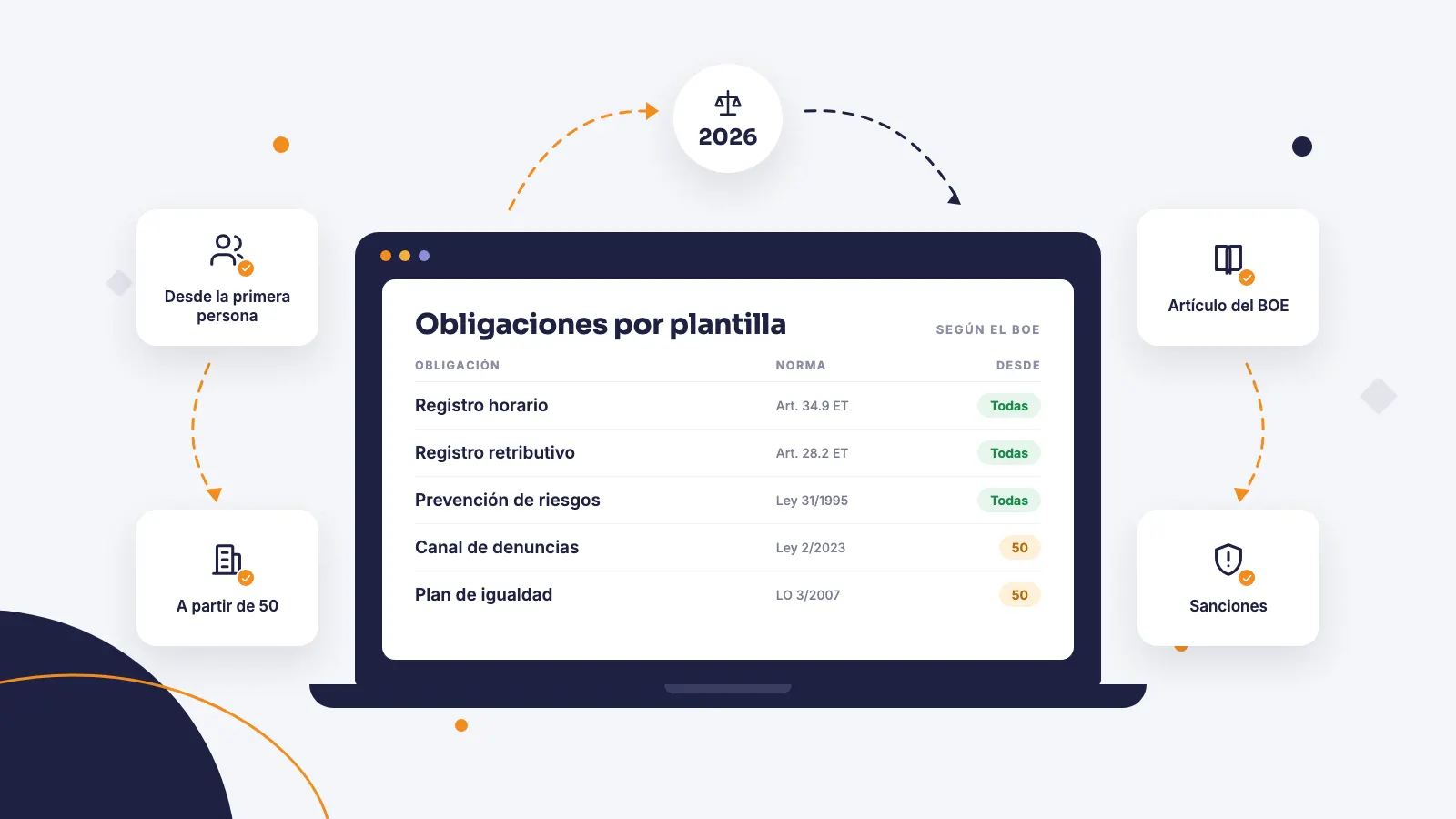
Almost every employment obligation of a company in Spain starts with the first hire. Headcount decides the rest: at 50 employees come the whistleblowing channel, the equality plan and the disability quota, and above 50, LGTBI measures. Workers’ representatives and remote work, where they exist, add obligations of their own.
This guide sorts them by size, with the BOE article behind each one. It starts with how headcount is counted, because each law counts in its own way and a company of 47 people may already be above 50. At the end there is a summary table and what Quantummycos does in each case. If you would rather go law by law, they are on the HR compliance in Spain page, with a headcount selector.
In short. From the first hire: Social Security registration before the start date, written information on the contract, a daily working-time record, annual leave, time off and the work calendar, payslips, a pay register, a sexual harassment protocol, risk prevention and data protection. If there are workers’ representatives, inform and consult them. If anyone works remotely for at least 30% of their hours, a written agreement. With 50 or more employees: whistleblowing channel, equality plan, the 2% quota and justifying a 25% gap in the pay register. With more than 50: LGTBI measures and protocol. And not yet binding: EU pay transparency and digital time recording.
How headcount is counted for each threshold
There is no single rule: each law sets its own threshold and sometimes its own way of counting. What recurs is that people are counted, not full-time equivalents, so someone working half-time counts as a whole person.
| Threshold | For | How it is counted | Law |
|---|---|---|---|
| 50 or more | Equality plan | The company’s whole workforce, across all its workplaces and on any contract, including permanent seasonal staff (fijos discontinuos), fixed-term staff and temporary agency workers. Each part-time employee counts as one. Fixed-term contracts that ended in the previous six months are added, one person for every hundred days worked or part thereof. The count is made at least on the last day of June and of December. | Art. 3 RD 901/2020 |
| More than 50 | LGTBI measures and protocol | The same rule as the equality plan, on the last day of June and of December. | Art. 3 RD 1026/2024 |
| 50 or more | Whistleblowing channel | The law refers to fifty or more employees and does not say how to count them. The Independent Whistleblower Protection Authority suggests the equality plan rule as a guideline. | Art. 10.1.a Law 2/2023 |
| 50 or more | 2% disability quota | The company’s total workforce, across all its workplaces and on any form of contract. | Art. 42.1 General Disability Law |
| 6 to 10, 11 to 49 and 50 or more per workplace | Staff delegates and works council | Per company or per workplace. Permanent seasonal staff and fixed-term contracts of more than a year count as permanent; contracts of up to a year count as one person for every two hundred days worked, or part thereof, in the year before the election is called. | Arts. 62, 63 and 72.2 ET |
| 50 or more per company or workplace | Health and safety committee | The people in the company or workplace. To work out how many prevention delegates apply, contracts of up to a year count as one for every two hundred days worked, or part thereof, in the previous year. | Arts. 35 and 38 LPRL |
Two details change the result. First, fixed-term staff who have already left still count. A company with 47 people on the payroll, eight of them part-time (who count as eight), that in the previous six months ended three fixed-term contracts of 120, 90 and 40 days worked, adds up to 47 + 2 + 1 + 1 = 51. It must have an equality plan and, being above 50, LGTBI measures.
Second, dropping below 50 does not release you. Once the threshold is reached and the negotiating committee is set up, the equality plan obligation stays until the plan expires or, where applicable, for four years (art. 3.3 RD 901/2020). For LGTBI measures, the count on the day the committee is set up stays fixed until the measures expire (art. 3.3 RD 1026/2024).
Employer obligations from the first hire
This applies to every company with employees, whether it has one or a thousand and whatever its sector. It is the longest part and the one SMEs neglect most.
When hiring and when someone leaves
- Social Security registration before the person starts work, and never more than sixty days ahead (art. 32 RD 84/1996). Not applying for it is a serious infringement for each person affected: €3,750 to €12,000.
- Report the contract and any extensions to the public employment service within ten days (art. 8.3 ET).
- Give written information on the terms of the contract before any employment relationship of more than four weeks begins: base salary and each complement separately, working hours and how they are distributed, annual leave, the probation period and the collective agreement, among others. Royal Decree 723/2026 requires it and has been in force since 5 October 2026; if everything is already in the written contract, the duty is met.
- Report the departure to Social Security within six calendar days of the person leaving, not three as before (Royal Decree 643/2026, since 1 August 2026), and send a proposed final settlement (finiquito) with the notice that the contract is ending (art. 49.2 ET).
Each step is in starters, leavers and final settlement and written contract terms, and step by step in the guides to onboarding and offboarding and how to calculate the final settlement.
Working-time record
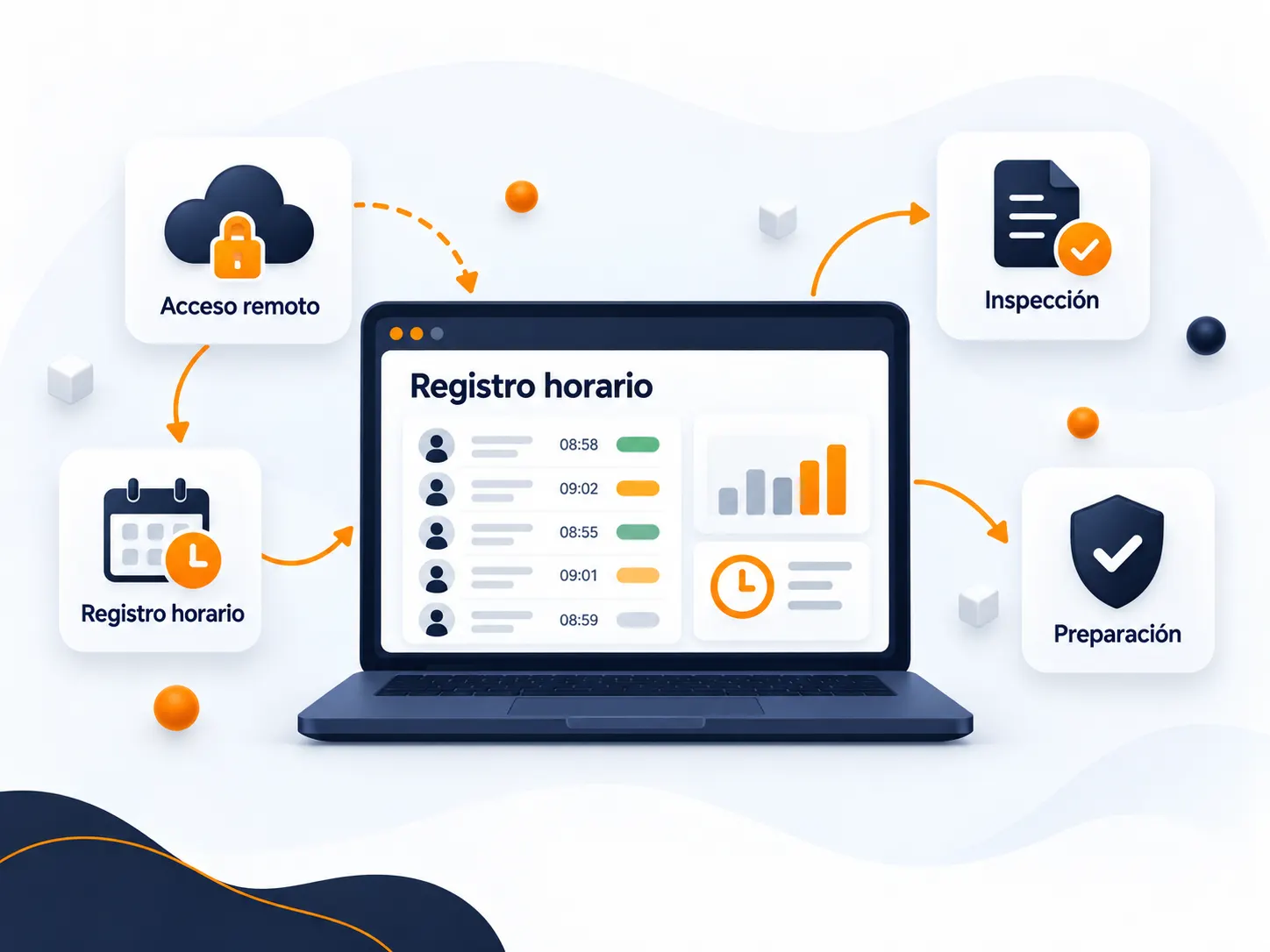
Every company records each day the exact start and end time of each person’s working day, keeps the record for four years and makes it available to staff, their legal representatives and the Labour Inspectorate (art. 34.9 ET). For part-time contracts, hours are totalled each month and the summary is handed over with the payslip (art. 12.4.c ET), and the same applies to counting overtime (art. 35.5 ET). Failing to do so is a serious infringement: €751 to €7,500. It is explained in the time recording section, the guide to fines for not keeping a working-time record and the one on whether paper or spreadsheet records are legal.
Hours, rest, annual leave and calendar
- A maximum of 40 hours a week averaged over the year and, unless another distribution is agreed, nine ordinary hours a day (art. 34 ET).
- Twelve hours’ rest between working days, a break of at least 15 minutes on continuous working days of more than six hours and a weekly rest of a day and a half in a row (arts. 34 and 37 ET).
- At least thirty calendar days of paid annual leave, which cannot be swapped for money and whose dates are known two months in advance (art. 38 ET), plus the paid time off in article 37.
- A work calendar each year, displayed somewhere visible in every workplace, with no more than fourteen public holidays, two of them local (arts. 34.6 and 37.2 ET).
New in 2026: since 23 October, reduced hours for a child with cancer or another serious illness are also available during continuous treatment without hospital admission, and both parents can take them at the same time (art. 37.6 ET, as worded by Law 4/2026 and Royal Decree-Law 31/2026, the latter still awaiting parliamentary validation). The detail is in hours and rest, leave and time off and work calendar, and in the guides to holiday entitlement and paid leave.
Pay, payslips and the pay register
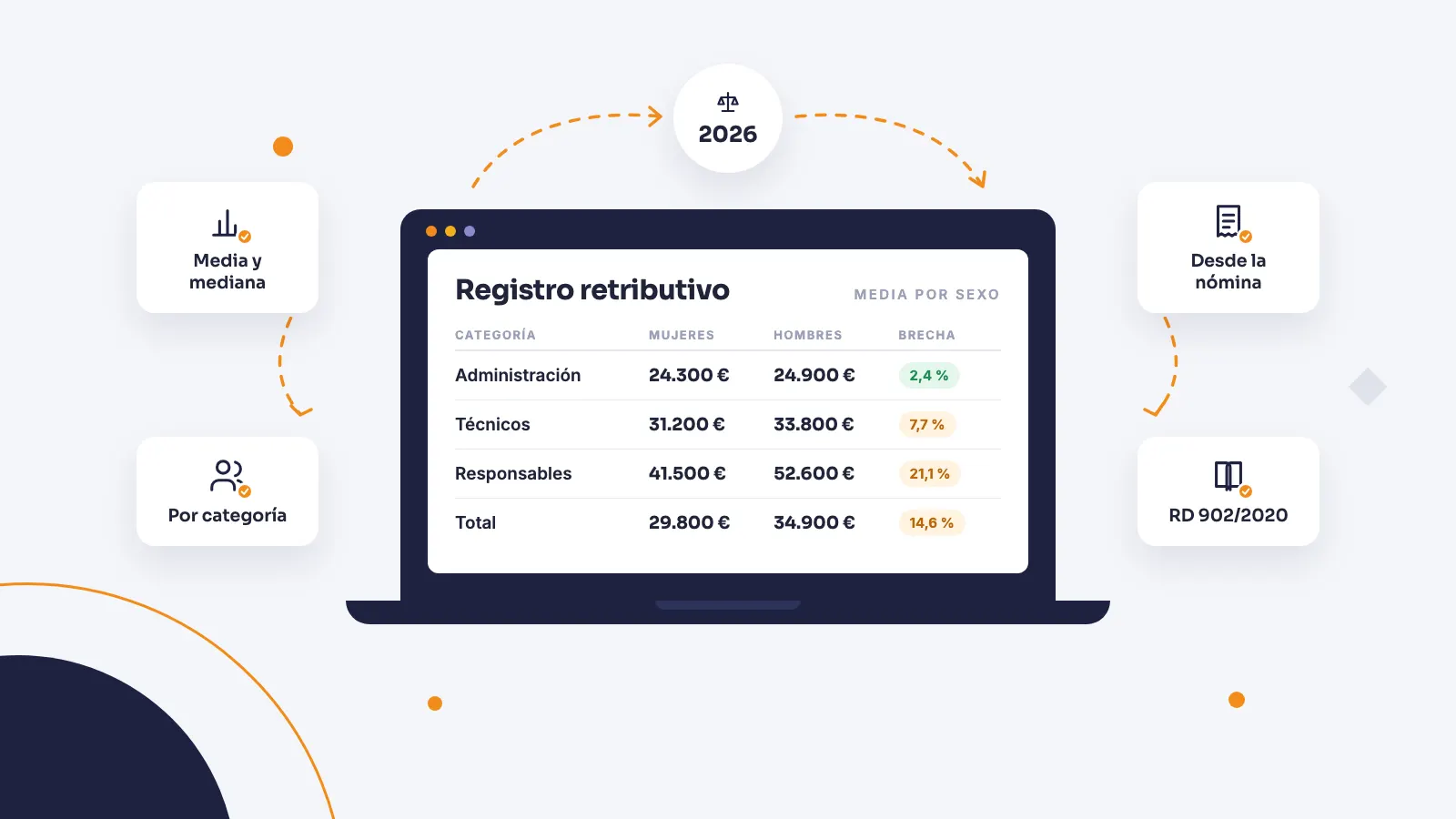
Salary is paid on time, for periods of no more than a month, and documented with an individual payslip that follows the official model or the one set in the collective agreement (art. 29 ET and the Order of 27 December 1994). From the first hire, the company must also keep a pay register (registro retributivo): the mean and the median of what women and men are paid in each group, category or job, with base salary, each complement and each non-salary payment kept apart, covering the whole workforce, managers included (art. 28.2 ET and Royal Decree 902/2020). The pay register guide explains it step by step, and the payslips and pay register sections summarise each article.
Equality, harassment and non-discrimination
- A protocol against sexual and gender-based harassment, online harassment included, with a procedure to prevent it and a channel for complaints, plus awareness and training for all staff (art. 12 Organic Law 10/2022). Size makes no difference.
- No discrimination in recruitment, training, promotion, pay, working hours or dismissal, and no questions about a candidate’s health (art. 9 Law 15/2022).
- Adapting the job for people with disabilities, unless it would be an excessive burden. Since 23 October 2026 this also covers their spouse or registered partner and relatives up to the second degree by blood who care for them (art. 40.2 of the General Disability Law).
All three are summarised in sexual harassment protocol, equal treatment and disability.
Occupational risk prevention
Every company organises prevention, assesses the risks of each job, has a prevention plan, informs and trains each person, ensures health surveillance and coordinates with the rest of the companies working at its premises (Law 31/1995). Size only changes how it is organised: with up to ten people, or up to twenty-five with a single workplace, the employer may take on prevention personally if they work at the premises regularly, have the required training and the activity is not one of the hazardous ones in annex I, but health surveillance must always be covered another way (art. 11 RD 39/1997). The health and safety section summarises it.
Staff data and digital rights
The company is the controller of its staff’s data: it tells each person how their data is processed, applies security measures, keeps a record of processing activities, which also applies below 250 people because this data is processed continuously, and has a processing agreement with every provider that handles the data on its behalf (GDPR). Spain’s Organic Law 3/2018 adds a right-to-disconnect policy, drawn up after hearing the workers’ representatives where there are any (art. 88), rules on using company devices (art. 87) and informing staff before using cameras or geolocation (arts. 89 and 90). More in data protection and digital rights.
If there are workers’ representatives
Whether there are representatives is not the company’s decision: elections are called by the unions or by a majority of the staff (art. 67.1 ET). Staff delegates can be elected from 11 people, or from 6 if the staff so decide by majority (one up to 30 people and three from 31 to 49), and a works council in each workplace of 50 or more (arts. 62 and 63 ET). Delegates have the same powers as a works council. Where they exist, the company must:
- Consult them on how the working-time record is organised, if neither the collective agreement nor a company agreement sets it (art. 34.9 ET), and ask for their report before introducing or changing a system to monitor work, such as clocking in or location at clock-in: they have fifteen days to issue it (art. 64.5.f and 64.6 ET).
- Consult them at least ten days before preparing the pay register and give them access to all of it (art. 28.2 ET and arts. 5.3 and 5.6 RD 902/2020). Without representatives, whoever asks only receives the percentage differences.
- Inform them every quarter about absenteeism and workplace accidents, at least once a year about equality between women and men, including the pay register, and about the rules of the algorithms that affect working conditions or access to and retention of employment (art. 64 ET).
- Give them within ten days the basic copy of every contract that must be in writing and of every remote work agreement, which is then sent to the public employment office (art. 8.4 ET and art. 6.2 Law 10/2021).
- Hear them before approving the right-to-disconnect policy and inform them before using cameras or geolocation (arts. 88 to 90 LOPDGDD).
On health and safety, up to 30 people the prevention delegate is the staff delegate, and from 31 to 49 one is chosen from among the delegates (art. 35.2 LPRL). The full list is in informing and consulting workers’ representatives.
If anyone works remotely
Law 10/2021 applies to regular remote work: at least 30% of working time over a three-month period, or the equivalent percentage depending on the length of the contract (art. 1). The company then needs:
- A written agreement, signed before remote work starts (art. 6.1), with the minimum content the law sets: equipment and expenses, hours, the share of remote work, place of work, reversibility, monitoring and duration, among others (art. 7).
- A copy for the workers’ representatives within ten days, which is then sent to the public employment office; without representatives, the basic copy is sent all the same (art. 6.2).
- To provide the equipment and pay or compensate expenses (arts. 11 and 12), assess the risks of the remote workstation (art. 16) and guarantee the right to disconnect (art. 18).
- A time record that faithfully reflects remote working time, with the start and end of each working day (art. 14).
Not putting the agreement in writing is a serious infringement: €751 to €7,500. It is all in remote work.
Obligations with 50 or more employees
Whistleblowing channel
Every private company with 50 or more employees must have an internal reporting system (art. 10.1.a Law 2/2023); those with 50 to 249 had to have one from 1 December 2023. Companies in financial services, anti-money laundering, transport safety or the environment need one whatever their size. The channel must accept anonymous reports, receipt must be acknowledged within seven calendar days and an answer given within three months (six in especially complex cases), and the company appoints a System Manager and notifies the Independent Whistleblower Protection Authority, or the competent regional authority, of the appointment within ten working days. Not having one, when intentional, is a very serious infringement: €600,001 to €1,000,000 for a company. The whistleblowing channel guide explains it in full, and the law is summarised in whistleblowing channel.
Equality plan and pay audit
With 50 or more employees, equality measures become an equality plan negotiated with the workers’ representatives (art. 45.2 Organic Law 3/2007). The negotiating committee is set up within three months of reaching 50, and the plan must be negotiated, approved and submitted for registration no later than a year after those three months end (art. 4 RD 901/2020). It starts from a diagnosis covering nine areas, from recruitment and promotion to pay and harassment, is entered in a public register and lasts four years at most, with a monitoring committee and at least an interim and a final evaluation (art. 9). Without workers’ representatives, the staff side is made up of the most representative unions and those of the sector. The plan includes a pay audit, with a job evaluation and an action plan (arts. 7 and 8 RD 902/2020). Breaching these obligations is a serious infringement: €751 to €7,500. Summary in equality plan.
The 25% gap and the 2% quota
- If the average pay of one sex exceeds that of the other by 25% or more, over the total payroll or the average of what was paid, the company justifies in the pay register itself that the difference has nothing to do with sex (art. 28.3 ET).
- At least 2% of the workforce must be people with disabilities, or alternative measures are applied if the company is exempted by its sectoral agreement or by a decision notified to the labour authority (art. 42.1 of the General Disability Law). Failing to meet the quota or its alternative measures is a serious infringement: €751 to €7,500.
Works council and health and safety committee
In each workplace with 50 or more people, representation becomes a works council (art. 63.1 ET). On health and safety, 50 to 100 people have two prevention delegates, and every company or workplace with 50 or more sets up a health and safety committee, made up of those delegates and the same number of employer representatives, which meets every quarter (arts. 35 and 38 LPRL).
With more than 50: LGTBI measures and protocol
From 51 employees, counted as for the equality plan, the company negotiates a planned set of measures for the equality of LGTBI people, with a protocol against harassment and violence towards them (art. 15.1 Law 4/2023). As a general rule, the negotiating committee is set up within three months of going above 50; if there is no agreement three months after negotiations start, or the collective agreement does not include them, the measures in Royal Decree 1026/2024 apply until others are agreed (art. 5). The protocol also protects job applicants, temporary agency workers, suppliers, customers and visitors (art. 2.4). If the company knows of harassment on these grounds and takes no steps to stop it, the infringement is very serious: €7,501 to €225,018. With 50 employees or fewer, it is voluntary. More in LGTBI measures.
What is coming and not yet binding
Pay transparency
Directive (EU) 2023/970 strengthens equal pay through transparency. The deadline to transpose it passed on 7 June 2026 and Spain has not done so: there is only a draft royal decree that partly transposes it, not yet approved, so today the pay register of Royal Decree 902/2020 applies. Once transposed, each person will be able to ask in writing for their pay and the average, by sex, of those doing the same work or work of equal value, and the company will have two months to answer. There will also be a gender pay gap report depending on size: the Directive requires it from 100 employees, with the first in 2027 from 150 and in 2031 for 100 to 149, and the Spanish draft requires it from 50, for companies with a pay audit. If a category shows a difference of 5% or more that is neither justified nor corrected within six months, the Directive requires a joint pay assessment with the workers’ representatives. The pay transparency section tracks it.
Digital time recording
The Ministry of Labour is processing a royal decree that would make the working-time record digital. As of 27 October 2026 it has not been approved or published in the BOE, so it is not binding: what applies is the record in article 34.9 of the Workers’ Statute. Under the October 2025 public consultation text, which may change, each person would make their own entries at the time, no change would be made without the authorisation of both the company and the person, and the workers’ representatives and the Labour Inspectorate would have immediate access, including remotely. It would come into force twenty days after publication. It is explained in the digital time recording section and the guide to digital time recording.
Summary table by headcount
| Obligation | From | Law | What Quantummycos does |
|---|---|---|---|
| Social Security registration before the start date and deregistration within six days | All | Art. 32 RD 84/1996 | The registration and deregistration tasks, on the checklist for every starter and leaver (Enterprise). The filing itself goes through the RED system or your accountant. |
| Written information on the contract | All | RD 723/2026 | Stores the document in the person’s folder, which they open on the web and in the app (Professional). |
| Daily working-time record | All | Art. 34.9 ET | It is the record: clock-ins timed by the server, never deleted, with the history of every correction (all plans). |
| Maximum hours and rest | All | Arts. 34 and 37 ET | Flags rest of less than twelve hours and days of more than six hours without a 15-minute break (all plans). |
| Annual leave and time off | All | Arts. 37 and 38 ET | Requests and approvals on the web or in the app, recording who decided and when (all plans). |
| Work calendar | All | Art. 34.6 ET | Fills itself in with the national holidays (Enterprise). Displaying it in each workplace is up to the company. |
| Payslips | All | Art. 29 ET | A “Payslips” folder for each person (Professional). It does not calculate payroll. |
| Pay register | All | Art. 28.2 ET and RD 902/2020 | Produces it from the pay on each employee profile, as a PDF and in Excel (Professional). |
| Sexual and gender-based harassment protocol | All | Art. 12 Organic Law 10/2022 | Its own category in the Whistleblowing channel and confirmed reading of the protocol (Enterprise). Writing it is up to the company. |
| Occupational risk prevention | All | Law 31/1995 | Records who read the plan, the induction training of each starter and when each medical check-up expires (Enterprise). Assessing the risks is up to the company. |
| Staff data protection | All | GDPR | Acts as data processor, under contract, with encrypted connections and roles that limit who sees what (all plans). |
| Informing and consulting representatives | If there are delegates or a works council | Art. 64 ET | Absences and the pay register as a PDF or in Excel to hand over (Professional). |
| Remote work agreement and a faithful record | If anyone works remotely 30% of their hours | Law 10/2021 | Clocking in from home just as at the office (all plans) and the signed agreement on file (Enterprise). |
| Whistleblowing channel | 50 or more | Law 2/2023 | It is the internal channel (Enterprise). |
| Equality plan and pay audit | 50 or more | Organic Law 3/2007 and RD 901/2020 | Provides the gap by sex and job for the diagnosis (Professional). Negotiating it is up to the company. |
| Justifying a 25% gap | 50 or more | Art. 28.3 ET | Flags it and points out the jobs that need justifying (Professional). |
| 2% disability quota | 50 or more | Art. 42 General Disability Law | Nothing: it stores no disability data. |
| LGTBI measures and protocol | More than 50 | Law 4/2023 and RD 1026/2024 | A route for complaints in the Whistleblowing channel and confirmed reading of the measures (Enterprise). |
| Gender pay gap report | Once transposed | Directive (EU) 2023/970 | Already calculates its indicators (Professional). |
| Digital time recording | If approved | Draft royal decree | Clocking in is already digital and personal (all plans). |
What Quantummycos does in each case
For three of these obligations, Quantummycos is the system the law requires. For many others it provides the tool or keeps the evidence. What the law asks the company to do itself (negotiate, appoint, assess risks, register and deregister staff, pay) is still up to the company.
- It is the working-time record, on every plan. Each person clocks in, logs breaks and clocks out on the web or in the app, from home too; the time is set by the server, no clock-in is ever deleted and every correction keeps what was there before, what is there after, who made it, when and why. With Analytics and reporting (Professional), the record comes out as a PDF per person and month or in Excel.
- It is the whistleblowing channel that Law 2/2023 requires, on the Enterprise plan: anonymous by default, also open to people outside the workforce, with follow-up by code, the legal deadlines in view and a register of reports that only those who manage the channel can see.
- It produces the pay register (Professional) from the pay on each employee profile, which AI fills in by reading the payslip: mean and median pay for women and men, the gap by job, and base salary and complements shown separately, as a PDF and in Excel. With 50 or more employees, it flags when the average hourly gap reaches 25%. It has to be completed with what it does not break down, such as the median of each pay component or non-salary payments.
- It helps with the rest. The clock-in timeline flags rest of less than twelve hours and days of more than six hours without a 15-minute break. Annual leave and time off are requested and approved on the web or in the app, recording who decided and when. Payslips and the contract information document go into each person’s folder (Professional). On Enterprise, Document compliance asks all staff to read and confirm the harassment protocol or the prevention plan, and Onboarding and offboarding puts the Social Security and final settlement tasks on the checklist for every starter and leaver.
What it does not do matters too: it does not calculate payroll, does not connect to Social Security, sends nothing to any authority, does not assess risks or negotiate plans, and stores no disability data. The workers’ representatives and the Labour Inspectorate have no access of their own, so the record is handed to them as a download. Every obligation, with what Quantummycos does and what is still yours, is on the HR compliance in Spain page, and each module has its own page: Time tracking and clock-ins, Pay transparency and Whistleblowing channel.
Keep reading
- Whistleblowing channel in Spain: what Law 2/2023 requires and how to comply in 2026, for when headcount reaches 50.
- Spain’s pay register 2026: what it is, who needs one and how to build it, mandatory from the first hire.
- How to spot HR bottlenecks in a growing company, because obligations arrive together as a company grows.
- Equality plan, harassment protocol and prevention delegate, in the HR dictionary.
Sources
- Workers’ Statute, consolidated text (BOE), articles 8, 12, 28, 29, 34, 35, 37, 38 and 49.
- Workers’ Statute, workforce representation (BOE), articles 62, 63, 64, 67 and 72.
- Royal Decree 901/2020 on equality plans and their registration (BOE), articles 3, 4 and 9.
- Organic Law 3/2007 on effective equality between women and men (BOE), article 45.
- Royal Decree 902/2020 on equal pay between women and men (BOE), articles 5, 7 and 8.
- Law 2/2023 on the protection of people who report regulatory breaches and on the fight against corruption (BOE), article 10.
- Law 4/2023 on real and effective equality for trans people and the rights of LGTBI people (BOE), article 15.
- Royal Decree 1026/2024 on the planned set of measures for the equality and non-discrimination of LGTBI people in companies (BOE), articles 2, 3 and 5.
- General Law on the rights of persons with disabilities and their social inclusion, consolidated text (BOE), articles 40 and 42.
- Law 31/1995 on Occupational Risk Prevention (BOE), articles 35 and 38.
- Royal Decree 39/1997, Prevention Services Regulation (BOE), article 11.
- Law 10/2021 on remote work (BOE), articles 1, 6, 7, 11, 12, 14, 16 and 18.
- Organic Law 10/2022 on the comprehensive guarantee of sexual freedom (BOE), article 12.
- Law 15/2022 on equal treatment and non-discrimination (BOE), article 9.
- Organic Law 3/2018 on Personal Data Protection and the guarantee of digital rights (BOE), articles 87 to 90.
- Royal Decree 723/2026 on transparent and predictable working conditions (BOE), article 3.
- Royal Decree 84/1996, General Regulation on company registration and on the registration, deregistration and data changes of workers with Social Security (BOE), article 32.
- Law on Infringements and Sanctions in the Social Order (LISOS), consolidated text (BOE), articles 7, 8, 15, 22 and 40.
- General Data Protection Regulation (BOE).
- Directive (EU) 2023/970 on pay transparency (BOE).
- Draft Royal Decree amending Royal Decree 902/2020 (Ministry of Labour, 3 August 2026).
- Draft Royal Decree on working-time recording (Ministry of Labour, October 2025 public consultation text).
- Recommendation 1/2026 of the Independent Whistleblower Protection Authority, on the internal reporting system.
This article is for information only and is not legal advice. Collective agreements can extend or specify these obligations: always check the text in force in the BOE and consult your employment adviser. Last reviewed: 27 October 2026.
- Employment law
- Compliance
- SMEs
- HR
Frequently asked questions
Almost all of them. From the first hire, the company must register the person with Social Security before they start, notify the contract to the public employment service and give them written information on its terms, record their working hours every day, respect maximum hours, rest, annual leave and time off, display the work calendar, give them a payslip, keep a pay register, have a protocol against sexual and gender-based harassment, organise risk prevention and comply with data protection. The obligations that depend on size start at 50 employees.
It depends on the law. For the equality plan, the company’s whole workforce is counted, across all its workplaces and on any contract; each part-time employee counts as one, and fixed-term contracts that ended in the previous six months are added, one person for every hundred days worked or part thereof (art. 3 of Royal Decree 901/2020). The count is made at least on the last day of June and of December. LGTBI measures use the same rule, and for the whistleblowing channel the Independent Whistleblower Protection Authority suggests it as a guideline.
Yes. For the equality plan and LGTBI measures, Royal Decree 901/2020 and Royal Decree 1026/2024 say so expressly: each person on a part-time contract counts as one, whatever their hours. Ten people working half-time are ten, not five. The guideline the Independent Whistleblower Protection Authority suggests for the whistleblowing channel counts them the same way.
With 50 or more employees come the whistleblowing channel (Law 2/2023), the equality plan with its pay audit (Organic Law 3/2007 and Royal Decree 901/2020), the 2% disability quota or its alternative measures, and the duty to justify in the pay register a gap of 25% or more between the sexes. In each workplace with 50 or more, representation becomes a works council and a health and safety committee is set up. Above 50, from 51, LGTBI measures and a protocol follow (Law 4/2023).
The obligations do not always end. For the equality plan, once the negotiating committee has been set up, the obligation continues even if headcount drops below 50, until the plan expires or, if no term was set, for four years (art. 3.3 of Royal Decree 901/2020). For LGTBI measures, the headcount on the day the negotiating committee is set up is the one that counts, and it holds until the measures expire even if headcount drops below 51 (art. 3.3 of Royal Decree 1026/2024).
It is not the company’s decision. Elections are called by the unions or by a majority of the staff at the workplace (art. 67.1 of the Workers’ Statute). Staff delegates can be elected from 11 people, or from 6 if the staff so decide, and a works council in each workplace of 50 or more. Where there are representatives, the company must inform and consult them on, among other things, the working-time record, the pay register, monitoring systems such as clocking in, absenteeism every quarter and equality every year.
No. As of 27 October 2026, Spain has not transposed Directive (EU) 2023/970 on pay transparency, even though the deadline passed on 7 June 2026, and the royal decree on digital time recording has not been approved or published in the BOE. What applies today is the pay register of Royal Decree 902/2020 and the daily working-time record in article 34.9 of the Workers’ Statute.