People management
Sick leave in Spain: who pays each day and what changes from 1 December 2026
The company pays days 4 to 15 of sick leave for common illness and Social Security pays from day 16. With worked examples in euros and the changes made by Royal Decree-law 31/2026 from 1 December 2026.
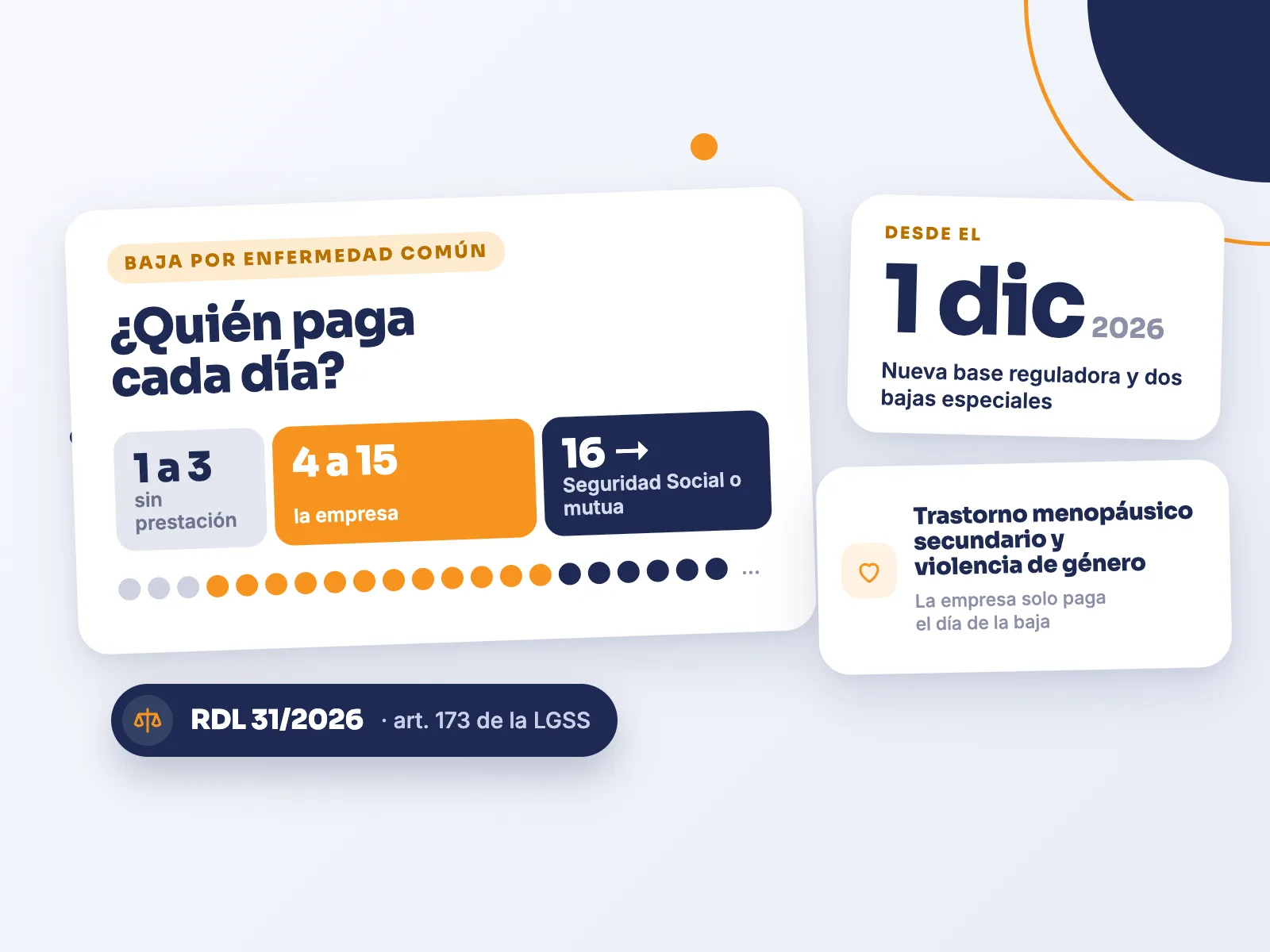
In sick leave for common illness, the company pays the benefit from day 4 to day 15 and Social Security, through the National Social Security Institute (INSS) or the company’s mutual insurer (mutua), pays from day 16; on days 1 to 3 nobody pays, unless the collective agreement, the contract or a company agreement improves on it (arts. 173.1, 43 and 239 of the General Social Security Act, LGSS). After a work accident or an occupational illness, the company pays only the salary for the day the leave starts and the INSS or the mutual insurer pays the rest (art. 173.1 LGSS).
In short. From 1 December 2026, Royal Decree-law 31/2026 changes three things in temporary incapacity: the regulatory base (base reguladora, the daily amount the benefit percentage is applied to) of full-time contracts uses the contribution base of two months earlier (art. 171.2 LGSS); two new special sick leaves are added (special situations of temporary incapacity), for secondary menopausal disorder and for injuries from gender-based violence (art. 169.1.a LGSS); and in all special sick leaves, new and old, the company pays only the salary for the day the leave starts (art. 173.1 LGSS). The days 4 to 15 that the company pays in sick leave for common illness and the 60 % and 75 % rates do not change.
Who pays sick leave for common illness, the company or Social Security?
In sick leave for common illness or a non-work accident, the company pays the benefit from day 4 to day 15 and Social Security or the mutual insurer pays from day 16. On days 1 to 3 there is no benefit (art. 173.1 LGSS) and no legal duty to pay salary either, because the leave suspends the contract (arts. 45.1.c and 45.2 of the Workers’ Statute). Work accidents, occupational illness and special sick leaves split the payments differently, further down.
| Day of the leave | Who pays | Benefit, as a % of the regulatory base |
|---|---|---|
| 1 to 3 | Nobody, unless a collective or company agreement says otherwise | No benefit |
| 4 to 15 (12 days) | The company | 60 % |
| 16 to 20 | Social Security or mutual insurer | 60 % |
| From 21 | Social Security or mutual insurer | 75 % |
The 60 % and 75 % apply to the regulatory base (Royal Decree 53/1980 and art. 2 of Decree 3158/1966). The regulatory base is not the salary: in the general case it is the contribution base for common contingencies of one month divided by 30 (art. 13 of Decree 1646/1972 and, from 1 December 2026, art. 171.2 LGSS). The mutual insurer pays if the company has assigned it that cover (art. 83.1 LGSS) and, if not, the INSS.
Who pays sick leave for a work accident or occupational illness?
In a work accident or an occupational illness, the company pays the full salary for the day the leave starts and the mutual insurer or the INSS pays 75 % of the regulatory base from the following day (art. 173.1 LGSS and art. 2 of Decree 3158/1966). The company does not pay days 4 to 15, and no previous contribution period is required (art. 172.b LGSS).
How much do you receive on sick leave and how much does it cost the company?
With a contribution base of €2,000 a month, the regulatory base is €66.67 a day (2,000 ÷ 30): 60 % is €40 and 75 % is €50. A 25-day sick leave for common illness breaks down like this:
| Days | Who pays | Amount |
|---|---|---|
| 1 to 3 | Nobody | €0 |
| 4 to 15 (12 × €40) | The company | €480 |
| 16 to 20 (5 × €40) | Social Security or mutual insurer | €200 |
| 21 to 25 (5 × €50) | Social Security or mutual insurer | €250 |
| Total benefit | Company €480 and Social Security €450 | €930 |
These are gross amounts and assume that the monthly salary equals the contribution base (extra payments pro-rated), with no overtime or supplements, counted in calendar days. On top come the contributions (art. 144.4 LGSS) and the cost of covering the post. For a work accident of 25 days, on the same assumptions, the company pays €66.67 and the mutual insurer €1,200 (24 × €50).
What changes in sick leave from 1 December 2026 with RDL 31/2026?
Royal Decree-law 31/2026 (RDL 31/2026) came into force on 21 October, the Standing Committee (Diputación Permanente) of the Congress of Deputies validated it on 18 November (published in the BOE, Spain’s official gazette, on the 20th) and its changes to sick leave under the General Social Security Scheme (Régimen General) take effect on 1 December 2026 (fourth final provision):
| What changes | Until 30 November | From 1 December 2026 |
|---|---|---|
| Regulatory base (full-time) | Contribution base of the month before the leave (Decree 1646/1972, art. 13) | Contribution base of two months before the month of the leave (October for a leave starting in December), now in the law (art. 171.2 LGSS) |
| Special sick leaves | Incapacitating secondary menstruation, termination of pregnancy, week 39 of pregnancy and organ donation | The same, plus secondary menopausal disorder and injuries from gender-based violence (art. 169.1.a LGSS) |
| Day the leave starts, in the special ones | Menstruation and donation: the INSS or the mutual insurer from the same day; in the others, the company on the first day | In all of them: the company pays the full salary for the day the leave starts and the INSS or the mutual insurer pays the benefit from the following day (art. 173.1 LGSS) |
| What does not change | The days 4 to 15 that the company pays in sick leave for common illness, the 60 % and 75 % rates and the 75 % reduction in the employer contribution for common contingencies while a person aged 62 or over is on leave (in place since 2022, art. 144.4 LGSS) | |
Do the 1 December changes apply to sick leave that is already under way?
For the regulatory base, no: the INSS calculation module (version 6.1, November 2026) applies the new rule to sick leave dated from 1 December 2026, and earlier sick leave continues under the previous rule.
For special sick leaves there is real uncertainty. The first transitional provision applies them to sick leave started from the decree-law’s entry into force (21 October), but the fourth final provision delays the effects to 1 December. As of 26 November we have not found any official criterion (neither in the BOE nor in the INSS manual) for those started between 21 October and 30 November: confirm with your payroll adviser (gestoría) or your mutual insurer how they are treated.
How is the regulatory base for sick leave calculated from 1 December 2026?
From 1 December 2026, the regulatory base for sick leave for common illness is the contribution base for common contingencies of the month immediately before the month preceding the leave, divided by 30 if the person is paid monthly and was registered with Social Security for the whole month (art. 171.2 LGSS). In other words, two months back: a pay rise in November does not count for sick leave starting in December. In a work accident or occupational illness, the occupational-contingency base of that same month is used, without overtime, plus the overtime of the year before the month preceding the leave, divided by 365 (art. 171.2, third paragraph).
Example: with a contribution base of €1,800 in October and €2,200 in November, a 25-day sick leave starting on 10 December would previously have used November and now uses October.
| Rule | Daily regulatory base | Benefit for the 25 days | Of which, the company (days 4 to 15) |
|---|---|---|---|
| Previous (November, €2,200) | €73.33 | €1,023 | €528 |
| New (October, €1,800) | €60.00 | €837 | €432 |
If the salary rose just before the leave, the person receives less; in sick leave for common illness the company also pays less, and in the others it does not, because it pays the salary for the day the leave starts (art. 173.1 LGSS). Someone who joined the company in the month before the leave or in the same month has a different base (art. 171.3 LGSS). For part-time and permanent seasonal (fijo discontinuo) contracts nothing changes: art. 248.1.c LGSS has used, since 1 April 2025, the bases of up to three months immediately before the month preceding the leave. For the self-employed, the same rule is in art. 318.h LGSS, in force since 21 October.
Who pays sick leave for menopause or gender-based violence?
In the special sick leave for secondary menopausal disorder and in the one for injuries from gender-based violence, the company pays the full salary for the day the leave starts and Social Security or the mutual insurer pays the benefit from the following day, with no prior contribution required (arts. 172 and 173.1 LGSS). Going through the menopause is not enough: the leave requires a limiting condition caused by a secondary menopausal disorder, specifically coded, that prevents the person from working (art. 169.1.a, 4th LGSS). Both apply to women workers.
| Special sick leave (art. 169.1.a LGSS) | What must be shown | Benefit |
|---|---|---|
| 1st Incapacitating secondary menstruation; termination of pregnancy | Medical care and inability to work | 60 % and 75 % |
| 2nd Pregnancy from week 39 | The contribution periods of art. 178.1 | 60 % and 75 % |
| 3rd Organ or tissue donation | Medical care and inability to work | 100 % |
| 4th Secondary menopausal disorder (new) | That it is coded for that purpose (as of 26 November we have not found an official code) | 60 % and 75 % |
| 5th Injuries from gender-based violence (new) | Medical care and inability to work because of the injuries and, before discharge, an official medical document notifying the Public Prosecutor or the court, a protection order, a precautionary measure or a Public Prosecutor’s report with evidence, or a conviction, stating the causal link between the injury and the act of violence | 60 % and 75 % |
The Ministry of Inclusion states that the amount will be that of sick leave for common illness (60 % up to day 20 and 75 % from day 21); the decree-law says only “equivalent amount” to that of common-contingency benefit (art. 171.1) and does not settle days 2 and 3, which carry no benefit in sick leave for common illness. In the example of €2,000 and 25 days of leave for menopausal disorder, the company pays €66.67 instead of €480 and the person receives about €1,077 gross (€66.67 of salary and €1,010 of benefit: 19 days at €40 and 5 at €50) instead of €930, about €147 more. About €80 of those €147, from days 2 and 3 at 60 %, depends on that percentage applying: the Ministry says so, the decree-law does not settle it.
What if the collective agreement improves the sick leave benefit?
The law sets the minimum and allows it to be improved by collective agreement, contract or company agreement, at the company’s expense (voluntary improvements, arts. 43 and 239 LGSS). In the agreement, look at two things:
- From which day, up to what percentage and for which leaves it tops up: “up to 100 % from the first day” is not the same as “from day 4”, and “common illness or non-work accident” does not clearly cover special sick leaves, which the law calls “due to common contingencies”.
- Which base it refers to: “regulatory base” follows the new rule (two months back); “common-contingency base of the month before the triggering event” (the start of the leave), as in art. 52 of the III State Collective Agreement for Social Action and Intervention, will no longer match the legal one from 1 December.
The risk to the saving: in the menopause example, the company stops paying €480 of benefit, but the collective agreement can wipe out that saving. A supplement up to 100 % of salary from the first day does not: the company bears the €1,667 of salary for the 25 days minus what Social Security pays, about €1,217 in sick leave for common illness (minus €450) and about €657 in the special one (minus €1,010), that is, €560 less. Only a clause that fixes an amount payable by the company whatever Social Security pays wipes it out. Read it before taking the saving for granted.
What should the company check for sick leave that starts from 1 December 2026?
- Tell your payroll adviser (gestoría) that the regulatory base changes for sick leave from 1 December (art. 171.2 LGSS). Compare it with the one the INSS sends you (Fichero INSS Empresas, FIE); according to its manual, the INSS cannot always calculate it when the medical note is issued.
- Review the collective agreement (supplements, the base it refers to, the leaves it covers) and record each leave with its exact start date, which decides the applicable rule.
- Do not ask for the diagnosis, which is health data (art. 9 of the General Data Protection Regulation): the company receives only administrative data on the leave and transmits its own to the INSS through the RED system (Social Security’s electronic data-exchange system) within three working days (art. 7.2 of Royal Decree 625/2014). Check that your payroll adviser does so: failing that, it can be a minor infringement (art. 21.4 of the Law on Infringements and Penalties in the Social Order).
How Quantummycos handles it
Quantummycos records each sick leave as an absence, with its start and end dates. Your payroll adviser still calculates the benefit and the payroll and communicates with Social Security through the RED system.
It is recorded as “Sick leave” or “Work accident” (“Work accident or occupational illness” in the app) and whoever has that permission approves it (approving it only confirms the record: it is the doctor who signs the person off). It does not use holiday days and it appears in the absence calendar and in the clock-in timeline, where it warns when someone clocks in, without blocking it. The Leave and absence report (Professional and Enterprise plans) gives your payroll adviser the approved sick leave by month, with its indicative effect on payroll.
Leave management is included in the free plan (up to 2 people, no card): start free or compare the plans on the pricing page.
Keep reading
- The hidden cost of absenteeism in Spain.
- Holiday entitlement in Spain 2026.
- Paid leave in Spain 2026: the full table of days by situation.
Sources (official texts, in Spanish)
- Royal Decree-law 31/2026 of 20 October (BOE), article one, first transitional provision and fourth final provision; and its validation, Resolution of 18 November 2026 (BOE).
- General Social Security Act, consolidated text (BOE), articles 43, 83, 102, 144, 165, 169, 171 to 174, 178, 239, 248 and 318.
- Royal Decree 53/1980 (BOE); Decree 3158/1966 (BOE), article 2; Decree 1646/1972 (BOE), article 13.
- Law 21/2021 of 28 December (BOE), article 1.
- Royal Decree 625/2014 (BOE), article 7, as amended by Royal Decree 1060/2022 (BOE).
- Workers’ Statute (BOE), articles 45.1.c and 45.2; Law on Infringements and Penalties in the Social Order (BOE), article 21.4; General Data Protection Regulation (BOE), article 9.
- III State Collective Agreement for Social Action and Intervention 2026-2029 (BOE), article 52.
- INSS, calculation module for the regulatory base of temporary incapacity, version 6.1 (November 2026).
- Press release of the Ministry of Inclusion, Social Security and Migration, 20 October 2026.
This article is for information only and is not legal advice. The collective agreement and the criteria published by Social Security can change what is explained here: always check the current text in the BOE and consult your labour adviser. Last reviewed: 26 November 2026.
- Absences
- Employment law
- Social security contributions
- SMEs
Frequently asked questions
In sick leave for common illness, the company pays from day 4 to 15 and Social Security, through the National Social Security Institute (INSS) or the mutual insurer, pays from day 16; on days 1 to 3 nobody pays by law, unless the collective agreement, the contract or a company agreement improves on it (articles 173.1, 43 and 239 of the General Social Security Act). After a work accident or an occupational illness, the company pays only the salary for the day the leave starts and the mutual insurer or the INSS pays the rest.
Twelve: from day 4 to day 15 of the leave, both included (article 173.1 of the General Social Security Act). These are the only benefit days at the company’s expense: the first three generate no benefit and, from day 16, Social Security or the mutual insurer pays.
In sick leave for common illness or a non-work accident, by law no: the benefit starts on the fourth day (article 173.1 of the General Social Security Act, LGSS) and the leave suspends the contract (articles 45.1.c and 45.2 of the Workers’ Statute). The company pays those days only if the collective agreement, the contract or a company agreement provides for it (articles 43 and 239 LGSS). In a work accident, an occupational illness and special sick leaves payment starts earlier: the company pays the salary for the day the leave starts and the benefit follows from the next day.
Not by law. In common illness the benefit is 60 % of the regulatory base (base reguladora) from day 4 to 20 and 75 % from day 21 (Royal Decree 53/1980 and article 2 of Decree 3158/1966); in a work accident or occupational illness, 75 % from the day after the leave starts. It has to be topped up to 100 % only if the collective agreement, the contract or a company agreement says so (voluntary improvements, articles 43 and 239 of the General Social Security Act), which set from which day, up to what percentage and for how long.
In common illness, yes: 180 days of contributions in the previous five years (article 172 of the General Social Security Act). In an accident, work-related or not, and in occupational illness no prior contribution period is required, although the person must be registered with Social Security or in an equivalent situation (articles 165.1 and 172.b). Nor is it required in special sick leaves, except pregnancy from week 39, which keeps the minimum periods of article 178.1; from 1 December 2026 the exemption also covers the two new ones, secondary menopausal disorder and injuries from gender-based violence.
No. Since 1 April 2023, Royal Decree 1060/2022 removed that obligation: the person gets a copy of the doctor’s note but does not hand it in. The National Social Security Institute (INSS) notifies the company of the leave with administrative data, without the diagnosis, and the company transmits its own data through the RED system (Social Security’s electronic data-exchange system) within three working days (article 7.2 of Royal Decree 625/2014; it does not apply to those not required to use RED). The company has no reason to ask for the diagnosis: it is health data (article 9 of the General Data Protection Regulation).
It is the system by which the company advances the benefit in the payroll, on behalf of Social Security or the mutual insurer, and deducts it from the contributions it pays in (article 102.2 of the General Social Security Act). In sick leave for common illness the person does not notice the change of payer on day 16 and the company does not recover days 4 to 15; in a work accident, an occupational illness or a special sick leave it does not recover the salary for the day the leave starts.
For the regulatory base (base reguladora), no: according to the calculation module of the National Social Security Institute (INSS, version 6.1), the new rule applies to sick leave dated from 1 December 2026 and earlier sick leave continues under the previous rule. For special sick leaves started between 21 October and 30 November 2026 we have found no official criterion as of 26 November: the first transitional provision of Royal Decree-law 31/2026 speaks of processes started from its entry into force and the fourth final provision delays the effects to 1 December.
No. The 75 % reduction in the employer contribution for common contingencies during the sick leave of people aged 62 or over has been in article 144.4 of the General Social Security Act since 1 January 2022 (Law 21/2021). Royal Decree-law 31/2026 of 20 October rewrites section 4 of the article and repeats that paragraph unchanged.
There is no approved change in who pays sick leave for common illness. As of 26 November 2026, article 173.1 of the General Social Security Act still sets that from day 4 to 15 the benefit is at the company’s expense and Royal Decree-law 31/2026 does not touch that rule. In special sick leaves, as in work accidents and occupational illness, the company pays only the salary for the day the leave starts (article 173.1).
At most 365 days, extendable by another 180 if the person is expected to be discharged through recovery: 545 in total (article 169.1.a of the General Social Security Act). The benefit ends at 545 days or earlier, through medical discharge, retirement or death, among other causes (article 174.1). If the leave ends with a medical discharge and a proposal for permanent incapacity, or when the 545 days run out, the person keeps being paid (the “extension of economic effects”, prolongación de efectos económicos) until the decision on permanent incapacity is notified (article 174.5).